*** This version of Confluence is for testing only and contains a copy of content from June 29th 2026. No changes will be preserved. ***

 Vandana Suresh Shah, last updated on Nov 17, 2025
8 minute read
Vandana Suresh Shah, last updated on Nov 17, 2025
8 minute read
The Library of Congress MARC data represent bibliographic and related information in machine-readable form. Extracting data from Marc records helps to identify and categorize materials, and create groups such as books, videos, serials, physical vs. electronic, etc. MARC records are detailed and contain all possible information about the material such as author, title, language, date of publication, etc.
Information is stored as ‘fields’. Each field contains a particular type of information. Many fields contain subfields, and each subfield is identified by an 'indicator' or an alphanumeric code to specify what type of information is contained in the subfield.
For general queries, we usually need to extract data from only a few fields and sub-fields. only. These fields are described below. The rest of the fields include record length, coding scheme, etc., which are usually not of interest in materials-related queries.
The myriad levels of confusion for a programmer who is not trained as a cataloguer are not to be understimated in terms of time required to understand the MARC data and to write code to extract the correct data elements. Those who plan to use MARC data in their queries should work closely with colleagues who have extensive experience with MARC.
This documentation briefly describes a few of the main fields that query writers will need to use in order to count materials by format. Queries that need to include details of materials, it is necessary to consult with an experienced cataloger or query writer who has in-depth knowledge of the MARC system.
These fields have no subfields, and therefore no indicators which are associated with subfields. All information is indicated according to fixed character designations (example with code below),
The 000 field can contain upto eight data elements, where each is defined by its position in the data field. The two main elements of interest are 06 (type of record), and 07 (bibliographic level). Each is only one character.
06 - Type of record
a - Language material
c - Notated music
d - Manuscript notated music
e - Cartographic material
f - Manuscript cartographic material
g - Projected medium
i - Nonmusical sound recording
j - Musical sound recording
k - Two-dimensional nonprojectable graphic
m - Computer file
o - Kit
p - Mixed materials
r - Three-dimensional artifact or naturally occurring object
t - Manuscript language material
07 - Bibliographic level
a - Monographic component part
b - Serial component part
c - Collection
d – Subunit
i - Integrating resource
m - Monograph/Item
s – Serial
NOTE: We need to select the correct value in the column labeled 'field', because the 'content' column contains values for all the data elements of the selected field. Each field contains its own row of data in the marc table, where all the field rows for the same record can be identified by the same instance_id.
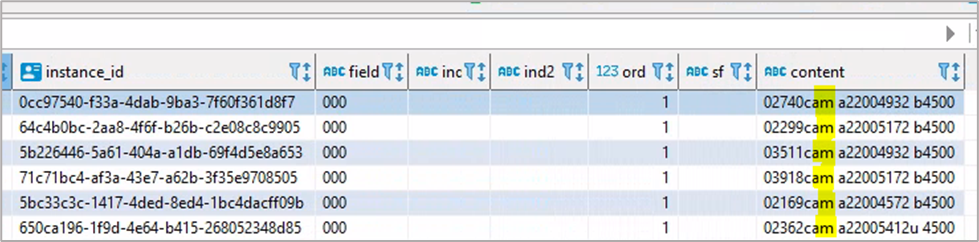
It is important to note that the ‘content’ field in the table begins with a 0, which is not included in the character count. So the 7th space indicates the 06 character, and the 8th space is for the 07 character.
In the screenshot of the marc table below, the 7th and 8th characters are highlighted in the ‘content’ field. The ‘a’ in the 7th space shows that the resource is language material (from the 06 character) and the ‘m’ in the 8th space shows that the resource is a monograph/item (from the 07 character).
Table 1.
Example code to extract information from the 06 and 07 data from the marc table in Metadb:
SELECT instance_id, field, substring(sm."content", 7, 2) AS "format_code"
FROM folio_source_record.marc__t AS sm
WHERE field ='000';
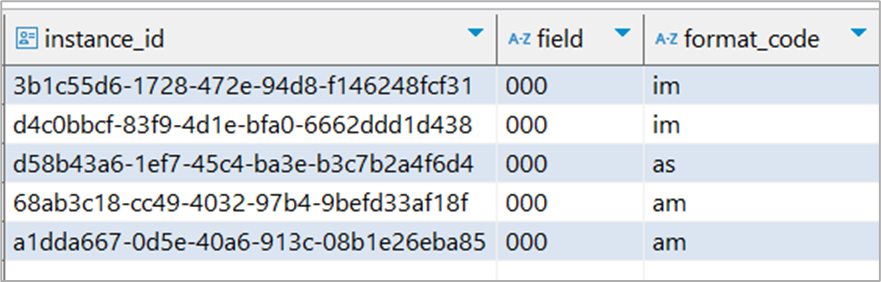
The results table below (Table 2) show that rows 1 and 2 are monographs (07=m) which are non-musical sound recordings (06=i). (In library terms, a monograph refers to any non-serial publication including but not limited to books, reports, and audio-visual materials.) The remaining rows can be classified in a smilar manner using the 06 and 07 charcters of the 000 leader field.
Table 2.
Other Control Fields - 00X (001, 003, 005, 006, 007, 008)
These fields also have no indicators or subfield codes. The first three are not often relevant for query writers.
NOTE: Information is somewhat randomly contained in the numeric order of the fields. For example, field 006 contains information that cannot fit into 008.
Fixed Field 008 - Bibliographic Details
The 008 field contains information about the physical form of the resource, such as form of material, language, etc. Some characters are common for all materials, and others differ based on material. For example, characters 7-10 and 11-14 indicate date1 and date2 respectively, for all materials. However, characters 8-21 indicate type of illustration for books, and characters 18-19 indicate form of composition for music.
There are seven possible material configurations: Books (BK), Computer Files (CF), Maps (MP), Music (MU), Continuing Resources (CR), Visual Materials (VM), and Mixed Materials (MX). Once the material type has been determined by the system from the leader field, we can obtain information relevant to that specific material type from the 008 field.
It is important to know that material configurations in the 008 field are determined by the system and not by the cataloger, depending on cataloger entries for the 000 leader field.
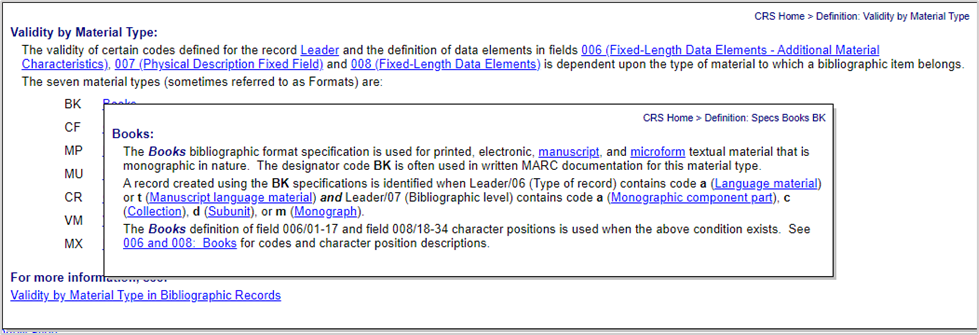
A record is determined to be a book if it meets the following criteria in the 000 leader field: (character 6 = a or t) AND (char 7 = a, c, d, or m). If this takes place, then in the 008 field, a record is created using the BK definition. In no place does it say ‘BK’. That’s not a possible code. See this documentation for details. Once the cataloger enters the requisite configuration in the leader 000 field, when they go to the 008 field, they will receive options only for possible book details (see screen shot below from the Cataloger's Reference Shelf documentation).
Example code:
SELECT instance_id, field, substring(sm."content", 36, 2) AS "language"
FROM folio_source_record.marc__t AS sm
WHERE field = '008' AND instance_id = 'a1dda667-0d5e-40a6-913c-08b1e26eba85'
;
The results screenshot below (Table 3) contains a row of data from the marc table where the 000 leader field shows that the material is a book (see Table 2, row 5) . In the 008 field, if the material is a book, the characters 35 and 36 describe the language of the book (spaces 36 and 37). Looking at the this row which contains data for the 008 field in spaces 36 and 37, we see that the book is in 'EN' (English).
Table 3.

Fixed field 006 – Additional Material Characteristics
This field is used for information about special aspects of the item being cataloged that cannot be coded in field 008.
Unlike the previously defined fields, the first character in the 006 field is contained in the first space, and NOT in the second space. To add to the illogic, the documentation refers to this as character position 00.
There is a one-to-one correspondence between the 006 and the 008 fields, because the 006 field is a sort of ‘appendix’ field for 008 information. Note that everything in 006 appears in the same order as 008 but NOT in the same charcter spaces. From the marc 006 documentation: "In all cases, field 006 positions 01-17 relate to positions 18-34 in one of the field 008 configurations." (See the section 'Guidelines for Applying Content Designators.)
the 1st space (character 00) in the 'content' column of the 006 field identifies 'form of material'. As seen in the screen shot below (Table 4), the 1st space (character 00) is the character 'm'. Referring to the documentation for the 006 field (under 'Field Definition and Scope'), ‘m’ indicates Computer file/Electronic resource. (Recall that this material type has been determined by the values present in the leader 000 field).
After that, the remaining characters are material-specific. Looking under 'Computer files/Electronic Resources' in the 006 documentation, we see that the 6th character describes the 'Form of item' and the 9th character describes 'Type of computer file'. However, values for the material-specific characters are found in the documentation for the 008 field. As the example below refers to a computer file, the ‘o’ in the 6th space indicates ‘online’, and the ‘d’ in the 9th space indicates that the computer file type is a document.
Table 4.

Fixed Field 007 – Physical Description
This field is relatively sane. As in the case of the 006 field, the first character in the 007 field is contained in the first space, and NOT in the second space, and is referred to as the 00 character. The first character indicates category of material, and based on that, possible characteristics for each type of material. All this information is contained in the main documentation page for the 007 field, with clear links to details. For example, if the first character is ‘a’, that indicates the material is a map.
Character spaces that follow indicate map characteristics. The 01 character (the second space) indicates material designation (Atlas, or Diagram, or Map, and so on). Clicking on ‘Maps’ on the main 007 documentation, we get all possible values of all characters for maps.
In the screenshot below (table 5), the first character in the 00 position is ‘c’, indicating it is an electronic resource. Clicking on details for 'electronic resource', we see that the second character (in the 01 position) is ‘r’, which indicates it is a remote resource. The fourth charater (in the 03 position) refers to 'color', and the value 'n' indicates 'non-applicable'.
Table 5.
