Date Created:   April 19, 2024    Last Updated:   June 17, 2026

Overview

Cornell Health provides a wide range of healthcare services to registered students. Charges for student copays may be billed through the University Bursar system. Bursar billing information is transmitted from Point and Click (PnC) to the Bursar. Alternatively, students may pay copays directly by check or credit card. In addition to service-related charges, Cornell Health assesses a health fee each semester through Bursar as part of tuition billing. The health fee is charged to students located in either the Ithaca, Geneva, or New York City areas. Cornell Health’s pharmacy sells over-the-counter medications, prescription medications, and other medical supplies. Purchases may be paid for by bursar, check, or credit card. Cornell Health bills insurance carriers on behalf of students for covered healthcare services. In some cases, reimbursement rates are based on pre-negotiated agreements with insurance providers. To ensure the accuracy of financial reporting, Cornell Health reconciles accounts receivable and revenue recorded in its operational systems to the University’s general ledger. These reconciliations help ensure that revenue is recognized accurately in the appropriate accounting period, whether monthly or semester based. 

CriticalityHigh

FrequencyDaily

TurnaroundOther

Student: Students receive healthcare services through Cornell Health and may be required to pay a copay for certain services. In addition, all registered students on the Ithaca, Geneva, or New York City campuses are charged a health fee as part of their enrollment with the University.

Billing Staff: Responsible for processing healthcare service transactions in the Point and Click (PNC). Their responsibilities include applying the appropriate billing codes, submitting charges to insurance, applying payments to patient accounts and ensuring that transactions are accurately transmitted to the Bursar.

Pharmacy Staff: responsible for processing pharmacy transactions in the QS1 system. They ensure that insurance is billed appropriately and copays are collected at time of pick up via credit card or bursar.

Unit Finance Staff: Reconcile accounts receivable for QS1 and for Point N Click systems.  Responsible for the reconciliation of the student revenue from billing system all the way through to the general ledger.

Shared Services Center (SSC): Responsible for processing pharmacy transactions in the QS1 system. They ensure that insurance is billed appropriately and copays are collected at time of pick up via credit card or bursar.

  • Point n Click (PnC) transactions for billing and payments 
  • Reports on accounts receivable balances 
  • QS1 transactions for billing and payments 
  • Kuali Financial System GL transactions
  • Bursar System
  • PNC
  • QS1 
  • Bursar 
  • Peoplesoft 
  • Kuali Financial System (KFS) 
  • OAS Reporting Dashboard (KDW) 
  • Cardpointe 
  • Waystar 
  • EnlivenHealth 
  • Nelnet
  • Seed
  1. Student status, if student becomes unregistered or goes on leave, bursar may reject the transaction. 
  2. Transactions failing to feed to the Bursar
  3. Delayed notification of student registration status

QS1 and Point n Click

  1. CH Billing procedure 5.14.24.docx | Powered by Box 
  1. 6 - PnC Bursar Procedure.docx | Powered by Box 
  1. Pharmacy Bursar Procedure.docx | Powered by Box 
  1. 5 - Applying Insurance Payments In PNC.docx | Powered by Box 
  1. Collections Procedure 4.23.docx | Powered by Box 

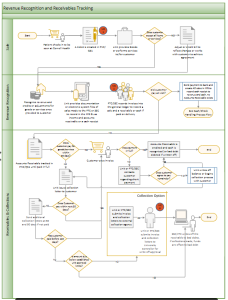
QS1 

Patient picks up Rx/OTC 

Is patient bursar billable? 

Yes – charges sent to bursar 

No – payment collected at time of pick up 


PNC Continued 

All the stops should then go to payment/collection process 

  • Is student bursar billable – charges sent to bursar – stop 
  • Did patient pay at visit 
    • Yes – daily deposit process 
    • No – invoice process 
      • was invoice paid – yes – daily deposit process 
      • was charge outstanding after 90 days? 
        • Collection process – 3 invoices, 3 phone calls 
          • Paid – daily deposit process 
          • No – submit for bad debt approval and write of in PNC 


Revenue Recognition 

CH runs end of month reports from PNC/QS1 – files sent to SSC to upload or record in the KFS GL as income as transactions flow through a clearing account  


Reconciliation 

A/R Reconciliation  

  •  A/R account Reconciliation reports run from KFS, PNC and QS1.   
  • Any variances to ending balances between the GL and the PNC or QS1 systems are identified and documented, and the report is sent to the SSC 

Payment reports are created in PNC/QS1           

  • Reports are pulled from Bursar 
    • Do totals match – yes – stop 
      • No – what tickets are identified as not matching             
        • Correct in PNC/QS1  -stop 
  • Reports are pulled from CC vendor 
    • Do totals match – yes – stop 
      • No – what tickets are identified as not matching             
        • Correct in PNC/QS1  -stop 
  • Reports are pulled from KFS income clrg account, QS1, Cardpoint, PNC and EnlivenHealth
    • Do cash/checks/insurance/credit card payment totals match – yes – stop 
      • No – what tickets are identified as not matching             
        • Correct in PNC/QS1  -stop 
  • Variances and/or timing issues are identified and documented and reconciliation is sent to SSC 

Key Risks 

Key Controls 

Transactions not fed to Bursar from originating system. 

  1. Reconciliations are done monthly to verify all billed transactions in PNC and QS1 reconcile to the bursar transactions and the KFS GL total for the month. 
  2. Variances are researched and credits or corrections made as needed. 

Billing Errors: Mistakes in invoicing, such as incorrect pricing, wrong billing codes, etc. can lead to disputes with insurance providers and delays in insurance payments. Billing errors may result from manual data entry or inadequate review processes.  

  1. PNC has a built-in claim scrubbing tool to detect any possible billing issues before a claim is submitted to insurance.  Cornell Health uses an insurance clearinghouse to submit claims, which has an additional scrubbing tool. 

Regulatory Compliance: Health Information Privacy Act (HIPAA) compliance is critical.

  1. Staff must complete HIPAA training at hire and annually. 
  2. Cornell Health has a HIPAA Compliance Officer. 

Data Security and Privacy: Handling sensitive customer information, such as payment details and personal data, exposes the university to risks of data breaches, identity theft, and PCI regulatory non-compliance.    

  1. Employee access is limited to the part of the system needed for their specific job duties. 
  2. Access audits are conducted by IT.

Non-payment or discounted payment by Insurance Providers: Can result in higher insurance allowances and write-offs. 

  1. Cornell Health has contractual agreements with 2 payers and is working to include additional insurers to minimize exposure.
  • Student enrollment 
  • Insurance provider contract rates 
  • Insurance revenue allowance trends 
  • AR write offs
  • Budget vs actual results
  • KFS – Kuali Financial System
  • OAS – Oracle Analytics Server, financial reporting tool (formerly known as OBIEE)
  • GL – General Ledger
  • PnC – Point and Click System
  • QS1 – Pharmacy System
  • SSC – Shared Services Center that processes financial transactions for Cornell Health

Revenue Recognition and Receivables Tracking Process Flow Chart

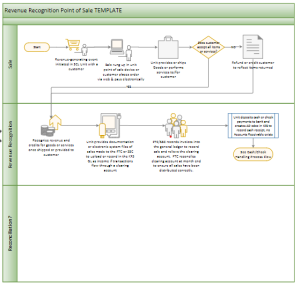
Revenue Recognition Point of Sale Template
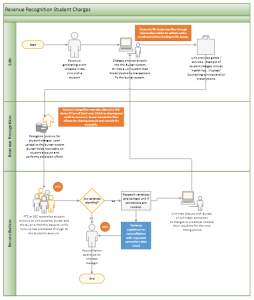
Revenue Recognition Student Charges
  • No labels