PLEASE NOTE THAT THIS PROCEDURE IS STILL UNDERGOING REVISION AS OF FEBRUARY 2026.
Scope: This procedure provides the context and the steps for LTS staff to transfer items from central-campus collections to the corresponding Rare collections at the Annex. Often called "medium rare" or "R2" transfers, these are low-use, but historically significant resources that are sent to be housed at the Annex, but retain the stricter non-circulating policy (i.e. reading room access only).
Contact: Pedro Arroyo
Unit: Database Quality
Date last updated: February 18, 2026
Date of next review: February 2027
Overview
Material Eligible for Rare Annex
Processing Locations
Procedure
Physical Examination of the Book
Editing the Voyager Record
Special Cases
Mulitivolumes
Charged or Missing Volumes
Bound With
Sending A Book To Conservation
Book Returned from Conservation
Slavery or Nathan Location
Provenances (Former Owners)
OVERVIEW
Research universities carry significant responsibilities for preserving the printed heritage under their care. Cornell University Library takes this responsibility seriously, and is committed to providing adequate protection and security for all its historic materials. As appropriate, library units should inventory their general collections to identify materials appropriate for transfer to a special collections facility. Cornell Library's Annex facility also provides units with a secure housing option for low-use items of long-term historical value, or for items that are at risk of theft or damage on the open shelves. Such items may be assigned to the Rare Annex location (rmc,anx), from which they will circulate only to a secure, observed reading room on the central Cornell campus.
A. Material Eligible for Rare Annex
At Cornell, all items printed before 1865 must be provided with secure, climate-controlled storage and monitored reading room access. In addition, materials printed after 1850 and before 1930 should be evaluated for significant artifactual, historical, or market characteristics and assigned to a location best suited to ensure long term preservation and use. All items 1864 and earlier are processed automatically for Rare Annex. Items from 1865-1869 are reviewed by RMC staff for Rare Annex; any items not selected for Rare Annex will be processed for the Circulating Annex. Items from 1870-1930 are reviewed by RMC staff for Rare Annex; it not selected for Rare Annex, then the appropriate Olin/Uris selector reviews for central campus or circulating Annex. Full criteria for Cornell University Library's transfer guidelines are available on the staff web at Policy on Transfer of General Collection Material to Special Collections. (<--This link is not working/old Collection Dev. staffweb)
B. Processing Locations
Currently, transfer of material identified as rare from central campus to the Library Annex has been approved for the following libraries:
Olin
Kroch Asia
Kroch, Rare & Manuscript Collections (RMC)
Uris
Requests from other unit libraries to send rare material to the Library Annex should be submitted to the appropriate contact in Library Technical Services. DBQ staff will, in turn, contact representatives from RMC, the Library Annex, the LTS Automation Team, Digitization and Conservation Services, and, if necessary, the FOLIO Upgrade Team to set up circulation, programmatic and workflow aspects of executing the transfers.
PROCEDURE
A. Physical Examination of the Book
- Determine the binding type from among the following materials:
- Full, 3/4, or 1/2 leather over marbled boards
- Library buckram
- Publisher's cloth
- Pictorial publisher's cloth
- Library pamphlet
- Spine and/or upper cover gilt
- Determine the provenance by looking at the front and back pages and inside covers of the book for these indicators:
- Bookplate(s)
- Stamp(s)
- Signature(s)
- Inscription(s)
- Determine whether the book was donated to CUL by a specific person or group (as distinguished from provenance, which focuses on previous ownership/custody)
- If the book lacks a barcode, refer to the instructions on barcoding for Rare Annex transfers below.
- If the book is part of a multivolume set, refer to the "Multivolume" instructions in the Special Cases section below
- Check the book for continuous pagination. If it is not continuous, and the book is a bound-with, refer to the "Bound-with" instructions in the Special Cases section below
- If the book requires repair, refer to the instructions for "Sending a book to Conservation" in the Special Cases section below
B. Editing the FOLIO Records
1. Display the Instance record by scanning or entering the barcode of the book from the Item search (this ensures matching item records in the case of multiple copies).
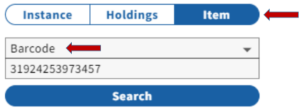
Note: If the barcode yields no result, search the catalog by keyword, title, or other search term to find the record.
- If there is a record in FOLIO, and the book in-hand is a duplicate copy, follow the guidelines for added copies/locations.
- If there is a record, but this book had been withdrawn or declared missing, follow the instructions for reinstatements and add a new Item record if necessary.
- If there is a record with a Holdings that clearly matches the copy in-hand, but the book lacks a barcode, refer to the instructions on barcoding for Rare Annex transfers below.
- If there is no Instance record, or if the information is confusing or conflicting, give the book to the DBQ supervisor for cataloging and barcoding.
2. Update the MARC record:
- To record provenance:
- Add a 700 1_ (or 710 2_) field with the Name heading copied from 100/110 field of authority record, (if there is no authority record, follow the instructions for a gift below).
- Add a subfield "e" at the end of the 7XX, with a note on their relationship with the book:
- $e former owner as indicated by a bookplate or stamp
- $e signer to indicate that the person signed the book.
- $e inscriber to indicate that the person inscribed the book to someone (and if recipient's name is provided, they may also get a 700 field as former owner.
- Add a subfield "5" to the end of the field, followed by "NIC" (the specific code for CUL), to show
Examples: 700 1__$a White, Andrew Dickson,$d1832-1918,$e former owner $5 NIC
710 2__$a American Textile History Museum, $e former owner. $5 NIC
- If provenance includes the phrase "From the Income of a bequest made by__", no provenance note is added to the bib record.
- Add $dNIC at end of the 040 field if you have added any new 700 or 710 fields to the record.
- Add an Administrative Note to the Instance record, showing a post-cataloging maintenance transaction. (The LTS macro for this is ,,mc. Consult with the DBQ supervisor if you do not have this macro).
3. Update the Holdings record:
- Add a Holdings Administrative note with the transaction code for transfers, including piece-count and the original location code (e.g. date:20250225 ttype:t userid:pca1 ploc:lts pcs:1 orig:olin) (The LTS keyboard macro for this transaction code is ,,t. If this macro is not on your computer, consult with the DBQ supervisor).
- Update the Permanent Location field as follows:
- Change olin, uris,or rmc,ice to rmc,anx
- Change ech, sasa, or was to ech,ranx, sasa,ranx or was,ranx
- Add a public Holdings Note (note type: note) with description of binding type.
- Add a NON-public Holdings note (note type: note) with the appropriate transfer note (e.g. "transferred to Annex from Olin 2/25/26 pca1", or simply "transfer from olin 2/25/26 pca1")
Examples:
- If you have recorded provenance, add it to the public Holdings note with the binding information. Evidence of ownership (e.g. bookplate, signature, inscription) should appear in parentheses after the owner's name (e.g. Provenance: Andrew Dickson White (bookplate). Multiple former owners can also be reflected, depending on what evidence has been left on the book (see examples below).
- If the work was inscribed by the author, note this specifically by including "inscribed by the author" within the parentheses.
- If the work has a gift letter, postcard, or other item tipped in, include this information with its location after the binding type (e.g. Gift letter tipped in front).
Examples:
4. Recording Gifts:
- Donors of the material to the library collection are distinguished from provenance by having a separate Holdings Note with Note Type: Source of Acquisition. If the donor prefers to remain anonymous, make sure to click the staff only box at the end of the note field.
- Note: Past workflows involved tracing donors with 541 fields in the MARC record, and provenance notes are often combined with donor notes. Because of confusion caused by patrons searching the donors as authors, however, and to accommodate the donors who wish to remain anonymous, LTS staff no longer add a 541 field, and should create the separate "Source of Acquisition" note in the Holdings record, separately from the provenance note(s).
Example:

5. Update the Item record
- Change these fields to the following, as applicable:
- Perm Loc.: RMC Annex, Echols Rare Annex, South Asia Rare Annex or Wason Rare Annex.
- Item Type: Non-circulating
- If the item is in a preservation box or has loose items such as newspaper clippings inside the cover, count the pieces (INCLUDING the box) and enter the number in the Number of Pieces field.
- If no item record has yet been created, create one and affix the barcode to the first leaf of the book
- Place the item on the Annex book truck in the Physical Processing area.
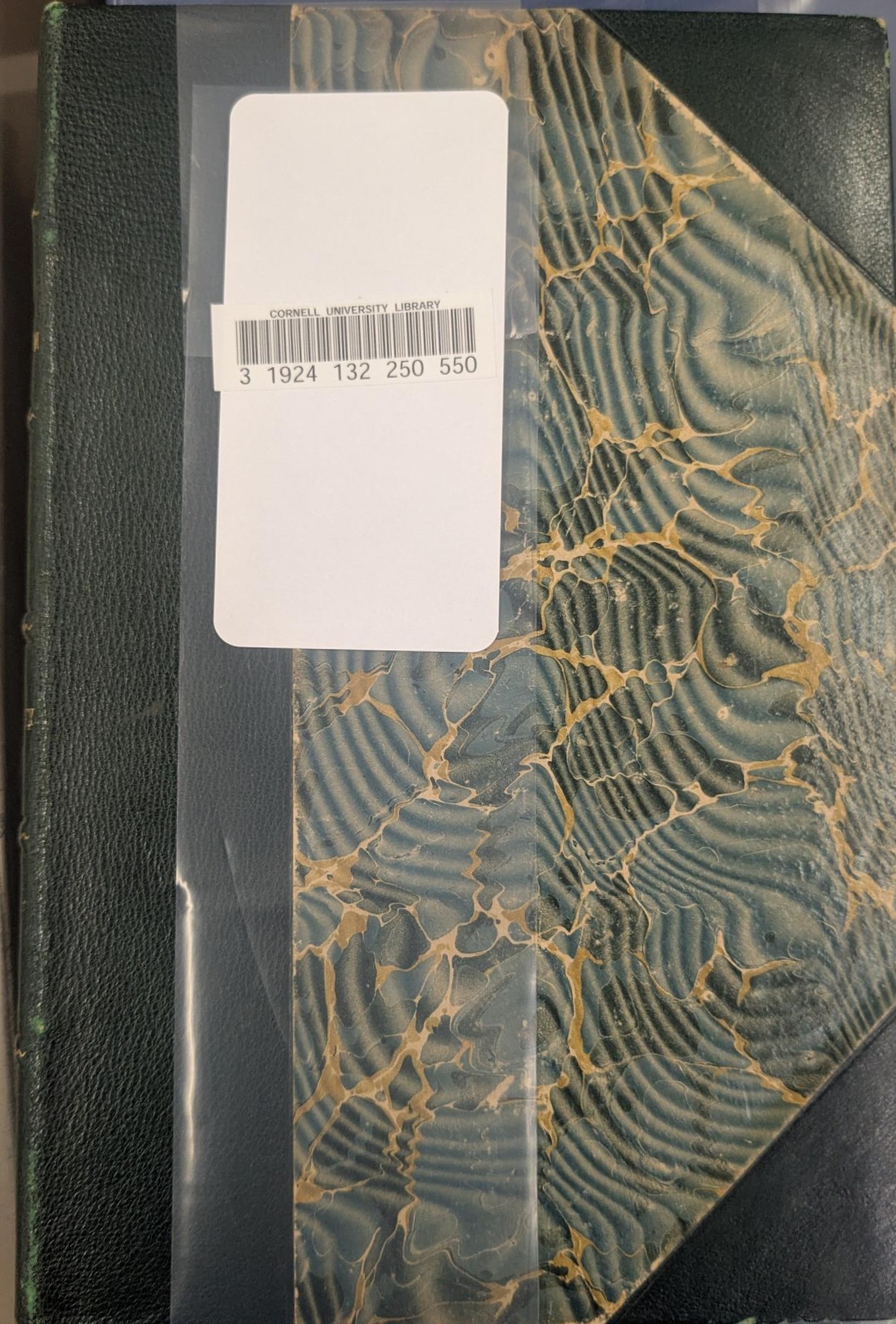
6. Adding a Barcode to a transfer book: if a book that is being transferred to a Rare Annex collection lacks a barcode, wrap a mylar strip vertically around the cover with the spine on the LEFT (usually the front cover). Let the ends of the mylar overlap slightly, without any tension on the cover, but flush enough so that it will stay in place, without sliding off easily. Attach the 2 ends of the strip with an AVERY 5963 label, which is 2"x 4", and will cover a generous area over the plastic strip. Attach the barcode to the label.
Example:
SPECIAL CASES
A. Mulitivolumes
1. Follow the instructions for the Instance and MARC modifications as shown above for provenance
- If the different volumes in the set show different owners, inscribers, etc., the 7XX fields in the MARC record do not have to show which volumes they owned. The 700 fields can simply be added as described above.
- Add an Administrative note in the Instance record with a post-cataloging maintenance code (,,mc).
2. In the Holdings record, check the Holdings Statement to make sure you have all available volumes of the work:
- If volumes are charged, follow the instructions for charged volumes below
- If you do not have all available items, check the stacks for missing volumes
- If you cannot locate items in the stacks (and they are NOT charged), follow the procedures for missing volumes below.
3. Holdings Notes: follow the instructions for noting provenance, binding, and/or donor information as described above, but provide volume-specific information as available, and combine the respective Holdings notes as necessary, for example:
- If the different volumes in the set show different donor information, then the corresponding Holdings note (type: Source of acquisition) can say something like: "v.1-2: Gift of Andrew Dickson White, v.3-5:Gift of Henry Sage."
Similarly, if the volumes are bound in different materials, note this by listing the materials separately in the corresponding Holdings Note (type: note).
Example: v.1-2,4 bound in library buckram; v.3,5-6 bound in 1/2 leather over marbled boards, spine gilt.
- The provenance can also be combined with the binding note in the same Holdings note (but NOT with the Gift note, which has a different note type!):

4. Open and update the Item records for each individual volume as described above, changing the Permanent location and Loan Type fields for each volume as appropriate.
B. Charged or Missing Volumes
Holdings Records:
1. If the number of charged or missing volumes is very few compared to the number of volumes being transferred (if not, see step 2 below):
- Update the Holdings for the volumes in hand, as described above
- In the (staff-only) Holdings note that cites the transfer, note which volumes are charged or missing: (e.g. v.1-2, 4 transferred to Annex, v.3 charged [date])
Example:

2. If the number of charged or missing exceeds a reasonable ratio for a simple transfer, it MAY be necessary to do one or more of the following, but consult with the DBQ, RMC, and/or Cataloging supervisor beforehand:
- Recall the charged material, as it should now be non-circulating, with reading-room-access only.
- Withdraw the missing volumes, and transfer the remaining ones, if appropriate.
- Create a separate Holdings for the Rare/Annex material that is being transferred, while waiting to deal with the charged/missing items in the original Holdings. This would necessitate additional changes in the Holdings statements of both of the affected Holdings,
- The best of the above options depends on the specific circumstances of each set being transferred.
Item Records:
1. For volumes which are missing or charged, do NOT change the Permanent location or Loan type fields, as you would for the volumes in-hand. Instead:
- Add a Staff-only Check-in Note stating the following:
- "Cataloging Review [Date]-
- At the end of the above note, specify the volumes status, where to send it, and why:
- NOTE: The "Cataloging Review" designation refers to a shelf where circulation staff are instructed to put books that come up for maintenance by LTS. The Check-In Note brings up an alert when the barcode is read, so the note is less likely to be missed than if it were put in the regular Item Notes.
Examples: 

- When the book is returned or found, remove the check-in notes in the item record.
C. Bound-With
- Open the records for all included titles by performing a call # search, or by searching the Item barcode in a "Holdings Notes" search.
- Follow the instructions for FOLIO updates for each Instance and Holdings record.
- Follow the Bound with Procedure (#132) for FOLIO updates for the holdings records
- Update the Permanent Location and Loan Type fields in the single item record that represents all of the bound parts.
D. Sending A Book To Conservation
- Follow the instructions for FOLIO updates for the Instance record
- In the holdings record. Add a Holdings Note (note type:note), saying sent to Conservation [date] as part of the transfer note, noting the volume number if necessary
- In the Item record add an Item Note saying "Return to DBQ staff for R2 - [date] [ initials]"
E. Book Returned from Conservation
- Remove the Holdings and Item notes referring to sending/returning the book from Conservation.
- If an mm case is present
- Add this to the pieces count in the item record
- Write the barcode number on the spine of the box (no call # is necessary)
F. Slavery or Nathan Location
If "Slavery" or "Nathan" appears as part of the call number written inside the book, the location should be changed to Rare (in pencil) in the book.
- Anthon, Charles, 1797-1867.
- Berkowitz, H. Chonon, (Hyman Chonon), 1895-1945.
- Bird, Samuel B.
- Bopp, Franz, 1791-1867.
- Faust, Albert Bernhardt, 1870-1951.
- Fiske, Willard, 1831-1904.
- Hart, J. M. (James Morgan), 1839-1916.
- Loewy, Benno, 1854-1919.
- Scaife, James Verner.
- Perry, William Stevens, 1832-1898.
- Smith, Goldwin, 1823-1910.
- Smith, Herbert H. (Herbert Huntington), 1851-1919.
- Smith, Preserved, 1880-1941.
- Sparks, Jared, 1789-1866.
- Stanton, Theodore, 1851-1925.
- Straight, Willard Dickerman, 1880-1918.
- White, Andrew Dickson, 1832-1918.
- Wynne, Lewis Bingley.
- Zarncke, Friedrich, 1825-1891.

 Pamela Parish, last updated by Pedro Arroyo on Mar 02, 2026
11 minute read
Pamela Parish, last updated by Pedro Arroyo on Mar 02, 2026
11 minute read





