THIS PROCEDURE IS UNDERGOING REVISIONS AS OF 9/21/25, AND IS NOT YET FULLY UP TO DATE.
Scope: This procedure covers the creation or revision of records for "Bound-With" materials, where two or more works, issued independently, were later bound, filmed, or housed together in a single unit. The titles inside a bound-with can be related by elements like publisher, author, year, or subject, but sometimes the relationship isn't clear. The physical piece will have just 1 barcode, so it is critical that the Bound-With notations be entered accurately in the Holdings and Item records of each title/instance associated with it, to link them all correctly to that single barcode. Otherwise, staff and patrons may have trouble locating the resource. Processing Bound-With resources can be challenging and time-consuming, so it is recommended that staff have thorough training, experience, and/or guidance and collaboration when working with them.
The "Bound-With" instructions for print titles assume that "with" notes will be specific to the copy in hand. "Filmed-With" situations are more nebulous, and depend on whether the filming (or re-filming) is universal or copy-specific, or on whether the microfilm copy has been added to a print record. Catalogers should use judgment in determining how and when to record "filmed-with" information, based on the situation.
Contact: Pedro Arroyo
Unit: Database Quality
Date last reviewed: 9/2/2025
Date of next review: October 2025
Basic Bound-With Resources (Print)
Filmed With (Microfilm Titles)
Important Notes
Serial Title-Changes within Bound Volumes
Partially Analyzed Serials
I. Basic Bound-With Resources (Print):
The instructions in parts 1-4 of this section primarily cover the creation or maintenance of records for the most basic type of Bound-with resource, where each internal title is a single-part, printed monograph. Parts 5 and 6 cover cases where one or more titles in a Bound-with is either an issue of a serial, or a volume in a multi-part monograph. CUL may have previously cataloged these resources with either the standard title citation in the Holdings notes (as shown in sections 1.A.1-2d.) or the ordinal citation (section 1.A.3 below).
There are separate, "non-basic" categories of Bound-with resources, however, such as Partially analyzed serials or Serial title-changes in bound volumes, which routinely come up for maintenance. These types of bound-with resources have their own specific instructions, and staff should take care to refer to the most appropriate guidelines for the resource in hand. (bolded text can be links, either further down, or in a separate document).
1. Instance and Holdings records of first title ("parent" records):
A. Identify which title is FIRST in the physical volume. For that title:
- Locate or create a matching Instance record, adding any statistical codes or administrative notes as appropriate. Save the Instance.
- Locate or create a Holdings record for the Instance, adding the Holdings Type, location, and call number information for the first title. This will be the same call number used for all records associated with the Bound-With.
- If the first title is part of a multi-volume or serial, make sure it is represented in the Holdings Statement (see also items 5 and 6 below for titles needing Holdings Statements, Enumerations, etc.)
- Add Oversize designation according to the dimensions of the overall volume, even if the first part is smaller than the outer cover, and would not itself be oversize. (See also Oversize section below)
- Add a Holdings Note, with Note type: Note, identifying the NEXT (second) part/title in the resource. If the title is excessively long, enter enough of it to allow for a reasonable search (see examples).
- Use the following format: Bound with: author name (last,first). Title of second part. (Example: "Bound with: Arroyo, Pedro. The Joy of Hoarding").
- NOTE: this Holdings note should be PUBLIC. Do NOT check the "staff only" box at the end of the field.
- Save and close the Holdings record.
- Ordinal Citations in Holdings Notes: If the Bound-with resource has an added spine title or cover title, the CUL catalog may also show a public Holdings note indicating that the title is the "first in a volume with spine title: [XYZ]", or "First in a volume lettered [XYZ]", or occasionally, simply "no. 1 of 5 in a volume" (for resources that lack any added title). Many CUL Bound-With and Filmed-With resources reflect this approach instead of the more standard title citations shown above, and the call numbers of each title often end with numbers denoting their position in the Bound-With resource, similar to a series-class call number. Staff should perform maintenance consistent with the original method used for cataloging, but should process any NEW sets of Bound-With records using the title citation approach, and the call numbers should NOT receive sequential numbering. If the Bound-With has a spine title, it can be entered in an additional Holdings Note along with the position of the appropriate title, as an added option.
EXAMPLES:




2. Item Record for the first/parent title
A. Create an item record, attached to the Holdings for the first title in the resource, as outlined above:
- Enter the barcode number in the Barcode field.
- This single item record will represent the entire physical piece, so be sure to record the proper enumeration and/or chronology for the bound volume in the item record ONLY if it appears on the spine, or on a title page referring to the ENTIRE bound-with resource. If the first part/title IS ITSELF an individual volume or issue of a serial or multi-volume (but the overall resource lacks spine or t.p. enumeration), the parent enumeration field will be left BLANK (see also sections 5 and 6 below). <Discussed w. Pam, confirm w. CWM
3. Instance and Holdings Records for second (and subsequent) titles in a Bound-with resource ("child records")
A. After creating or correcting the "parent" records in the resource as outlined above, identify the subsequent titles or works in the physical volume. For each one:
- Locate, import, or create a matching Instance record, adding administrative notes or statistical codes as applicable, and Save.
- For Single-part monographs, locate or create the corresponding Holdings record:
- Make sure the call number is the same as that of the first title, or "parent" record. (if the part is a serial issue or part of a multi-volume, see also steps 5 and 6 below).
- Copy numbers: if the second (or subsequent) title in a bound-with is an additional copy of a book we already hold, do NOT apply a copy number. It will adopt only the copy number of the FIRST title, if applicable.
- As with the first title, assign an Oversize designation based on the overall physical resource, not on any of the parts. (see below for additional Oversize rules for serial issues and volumes).
- Add a Holdings Note, with Note type: Note, saying "Bound with: [Author/title of the FIRST resource in the volume]". This note should be public/not staff-only.
- Add another Holdings Note, with Note Type: Bound with item data, and enter the barcode number from the bound-with resource (or copied from the Item record of the first title in the resource). This note should also be public/not staff-only. This is the ONLY place the barcode will be recorded for second and subsequent titles/parts in a bound-with resource. It will NOT be recorded in their Item records (see below).
- All of the titles/parts AFTER the first (parent) title should have some variation of the 2 Holdings notes in steps d. and e. above: one citing the FIRST author & title in the resource, and one showing the barcode on the resource as "Bound with item data". There may also be other Holdings notes present (e.g. provenance or collection info), but the above 2 Holdings notes are essential to the accessibility of the resource.
- For bound-with items that were processed with the ordinal citations described above, second or subsequent titles in the resource will simply follow the sequence in which the title appears (e.g. "no. 3 in a volume lettered...", or "no. 4 in a volume with spine title:", etc.) The call numbers common to the individual parts will likely have numbers denoting their position in the resource, similar to series-class call numbers.
Examples:



4. Item Records for second (or subsequent) titles in a Bound-with (aka "empty" item records)
A. Single-part Monographs:
- Create a new item record
- Leave the barcode field BLANK.
- The Material Type field should be set to the same type as the first title in the item (e.g. Book, Map, Microform, etc.)
- Type "Bound with" in the Enumeration field of the record.
- If the item is part of a microfilm, microfiche, microcard, microprint or other film type, type "Filmed with" in the Enumeration field of the item record (see Filmed-With section below).
- Save and Close the Item record.
5. Holdings records of Second (and Subsequent) parts of Bound-with materials, when those parts are volumes/issues of multi-part monographs or Serials:
A. Call Numbers: All parts in the bound-with share the same call number, so if any of the second/subsequent titles belongs to a serial, AND we hold other issues of that serial (NOT in bound-with formats), then those issues in the bound-with need a separate Holdings on the serial record, as they will have a different call number than issues we might hold.
B. Holdings Notes:
If the second or subsequent part of a bound-with resource is part of a serial or multi-volume set, add that part's volume/issue number (or other identifying information) with the barcode in the Holdings Note (with note type "Bound With Item Data", as outlined in Section 3.A.2.d above). This is to show which part or parts of the title represented by that holdings record are included in the Bound-with resource.
Examples:
In the following example, the second (or subsequent) part in a bound-with resource is v. 4 of a monographic or serial title. The Holdings for that monograph or serial has this "Bound with Item Data" Holdings note:
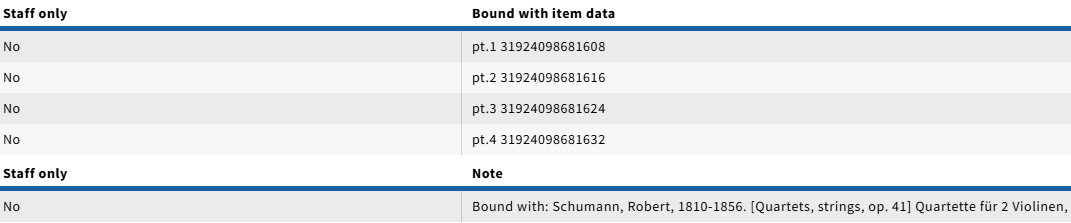
In this next example, the individual parts for the instruments of a work of classical music by Mendelssohn are bound separately in different bound-with resources, with the first part in each bound-with resource being by Schumann. Accordingly, the

In general, use the same captioning used in the holdings for the serial or multi-part holdings string ("vol.", "pt.", "no."). If necessary, a note pertaining to the physical arrangement can also be added, as in the above example.
B. Special OVERSIZE section here, for complicated cases? e,g, What if it starts with a v.1 that is not oversize by itself, but is inside Oversize covers, AND we also have v. 2-4, which are not oversize? Would they all be shelved in Oversize? Or would there be a Holdings note for v.1 saying it's shelved in Oversize? Would there be a separate Holdings for v.1 (Oversize), and for v. 2-4 (non Oversize)?
6. Item Records for second or subsequent titles with Holdings Statements/Enumeration/Chronology:
A. After entering the volume information with the "parent" barcode in the Holdings note, we similarly add the enumeration/chronology information in the corresponding "empty" Item record:
- Create the Item record following steps 4.A.1.a-e above, leaving the Barcode field BLANK.
- For Volume or Part statements, add the appropriate volume/part information to the Enumeration field, AFTER the "Bound With:" note.
Examples: If the Holdings Note says "v.1 31924XXXXXX...", we would enter it as "Bound with: v.1"in the Enumeration field of the corresponding "empty" Item record. Other captions can be entered as appropriate to match, so if part of a bound-with is a "pt.4" of a given serial or multi-vol, the Item Enumeration field in its "empty" item record would say "Bound with: pt.4".- NOTE: The phrasing can look confusing here, but in these examples, the Enumeration field note is showing that the title is inside a Bound-With resource, and that it is v.1 (or pt.2, etc.) of its title. It is NOT meant to show that the part is bound with v.1 (or bound with pt.2, etc.) as a verb phrase, because this part is v.1, or pt. 2.
- If there are only dates in the Holdings Statement (e.g. 1999 or 1829), the date corresponding to the part in the bound-with should be entered in the Chronology field of the empty Item record. The "Bound with:" note, including the colon, should still be in the Enumeration field, of empty item record, without anything after it.
- If the Holdings Statement has BOTH both volume and date information (e.g. "Bd.6 (1946)"), then the volume information should go after the "Bound with:" note in the Enumeration field (e.g. "Bound with:Bd.6"), and the date would go in the Chronology field, without the parentheses.
- If the Holdings Statement has Supplement or Index data, these would also transfer to the Enumeration and Chronology fields of the Item record. For example: If there is Holdings statement with "no.1-2", and a Statement for the supplement "1929", the volume caption data would be entered as "Bound with:no.1-2" in the Enumeration field, and the supplement data would appear as, "includes supplement 1929" in the Chronology field.
- If the Holding Statement shows dates ONLY, e.g. "1986", and the Statement for Supplements shows "1986:Dec.", the "Bound with:" note still goes in the Enumeration field of the Item record, by itself, and the Chronology field will show as "1986 (includes supplement 1986:Dec.)"
6. If there are multiple Holdings Statements for volumes, supplements and/or indexes, check whether the data appears correctly in the public catalog, and consult with appropriate staff as applicable.
II. Filmed-With (Microfilm and Microfiche Titles):
Filmed-With resources share many of the same characteristics and instructions as printed Bound-withs, but for microfilm and microfiche materials. As with printed Bound-Withs, any new Filmed-With records should be cataloged using the title citation method described above , but there are many CUL films cataloged with the ordinal citation method (e.g. "No.5 of 7 titles on Microfilm 4665, Reel 3."), or as partially analyzed serials.
One major difference is that staff may need to use a film or fiche reader to examine the content, though in many cases, we can perform the appropriate record maintenance without having to view all of the material on a reel. Another major difference is that, because of their large capacity, it is possible for some Filmed-with parent records (or partially analyzed serial records) to have hundreds or even thousands of child records (or analyzed monographs) associated with them.
A. Single-Part Monographs - Parent records
- As with printed bound-withs, identify which title is first on the film, either with a viewer, or by searching the appropriate Instance Notes, Holdings Notes, or call number (for record maintenance).
- If it is not clear which title is first (e.g from damage, lack of a title page, unknown language, etc.), choose one of the titles as the "primary" title.
- Follow the instructions in section I.1.A.1-2d. above, to create "parent" Instance and Holdings records for the microfilm, based on the primary title.
- Make sure to use the term "Filmed with" instead of "Bound with" in the Holdings notes.
- Create an item record, if one is not already attached to the parent Holdings. Since this single item record will represent the entire physical reel, be sure to record the proper enumeration and chronology for the whole reel (if applicable) in the item record, NOT for the first title itself (see also section I.2.A.b above.)
B. Single-Part Monographs - Child Records
- Identify the second and subsequent titles on the film. For each title:
- Follow the above instructions for creating or locating Instance, Holdings, and Item records for the second and subsequent titles.
- Like printed bound-with resources, the public Holdings notes should contain the barcode on the main film in one note (with type Bound with item data), and a reference to the first title on the film in the second note, unless it was cataloged using the ordinal method (see examples below).
- The Item records of the child should have empty barcode fields, and the Enumeration field should show "Filmed With:".
- The call numbers should be the same for all titles, with the possible exception of position numbers at the end.
Examples:
Basic Filmed-with: The first illustration shows the Holdings notes of a second-or-subsequent thesis title, that is filmed with other theses on the reel. The Holdings Note cites the first title on the film, with the Bound with item data note containing the barcode on the film box. The second illustration shows the common call number for all titles on the reel, as well as the empty barcode field and the Filmed with: note in the Enumeration field:
Ordinal citations: Many microfilms are cataloged and maintained using this method, or in combination with the title citation method, for a more complete description;
- BASIC:

- COMBINATION:

C. Multi-part Monograph volumes and Serial Issues in Filmed-With Resources:
As with printed Bound-with materials, Filmed-with resources may be comprised (partially or entirely) of monographic volumes or issues of serials, and the records should reflect this accordingly:
- Parent records:
- If the Holdings statement of the parent Instance shows volume information, then there should be a Holdings note showing which volumes of the first title are on the reel, and citing the next title/part on the reel, OR a note saying that it's the first on a reel with other titles.
- The parent Item record should have the barcode number on the film box in the Barcode field.
- The Enumeration field of the parent Item record should have ONLY the main reel number on the box (if present), and NOT the individual enumeration/vol. numbers of the first title.
- Child Records:
Should contain Holdings Note (note type: Bound with item data) with the barcode from the Item record of the first title (or directly from the film box).
- A Holdings Note (note type: Note) designating which specific volumes are filmed with others. Older cataloged material may have the ordinal citation, but new Filmed-with records should use title citation notes.
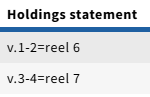
- NOTE: Sometimes it's necessary to create a separate Holdings for issues or volumes which are second or subsequent parts in a Filmed-With, as with printed Bound-with, because of the call number difference between the volume(s) in the Filmed-with, vs. those in the NON-Filmed-with. In the case of Filmed-with, it's also possible that the issue(s) on the microfilm will have a Holdings on the print record, and the print record holdings statement should note that certain issues are on a microfilm. (See Instance 318711 or 1894447 or 1901969).
- The Item record should follow the same guidelines as for Bound-With (see section 6A above), with "Filmed with:" in the Enumeration field, followed by the volume information of the specific issue.
EXAMPLES: (add explanatory text)

III. IMPORTANT NOTES
- Processing or Transferring Bound-With material for the ANNEX: ADD ITEM RECORD/LOCATION CLAUSE FOR ANNEX ITEMS HERE.
- Abbreviated or Incomplete Bound-with and Filmed-with Records: Some CUL records for Bound-with material are abbreviated or incomplete in some ways. This may be from evolving procedures, differing practices between campus libraries, or from Retrospective Conversion projects, These projects prioritized the transition of records from the card catalogue to a computerized system, and not every Bound-with or Filmed-with resource was fully cataloged at the time. Consequently, many of these bound or filmed items treated the first cataloged title as the parent record, which may not be the first title in the resource. There also would be a staff-only Holdings Note saying that some of the titles in the volume or reel were not cataloged, or even that ONLY the first title was cataloged, and the other titles were not.
Examples:


Other Categories of Bound-with and Filmed-with material: Serial Title Changes and Partially Analyzed Serials.
I. Serial Title-Changes within bound volumes:
Many CUL serials are bound together in large collected volumes. When a serial changes its title, a new bibliographic record is made/imported for the new (succeeding) title (see also 780/785 fields MARC), and all issues published under that title are assigned to the Holdings record of the new (succeeding) title. Frequently, however, the final issue published under the previous title has been bound together with the first issues of the new title. The same serial may change its title several times, and each title's Holdings may have a parent and/or a child Item record attached to it, indicating that issues of the previous titles were bound with issues of the succeeding titles.
For example: the serial "VISTA Volunteer" (Instance 1334440) changed its name to "VISTA" (Instance 1334441) for a year, and then back to "Vista Volunteer" (Instance 1334443). The later issues of the first title were bound with a volume of the middle title, which in turn had its later issues bound with the third title:
1. Vista Volunteer (Instance 133440):

Holdings:
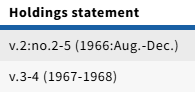 Holdings Notes: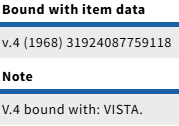
2. Vista (Instance 1334441, "middle title"):

Holdings:
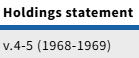 Holdings Notes: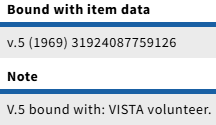
3. Vista Volunteer (Instance 1334443):

II. Partially Analyzed Serials:
Some serials have individual issues (or sets of issues) published with their own distinct title. CUL has cataloged many of these issues on both the serial record and on a separate monographic record, which uses the serial's title as the series statement, and the distinct title of the issue(s) as the main title of the monograph. Adding these parallel monographic records, or 'analytics', means that those issues were 'analyzed', making the overall serial 'partially analyzed'. There are even fully analyzed serials, where every issue is cataloged on a parallel monographic record. The purpose of analyzing is to widen the field of searchable terms for content which would not be adequately described by the serial record alone. This greatly increases accessibility to patrons, who may be searching by a specific title, author, or subject, and would otherwise not discover the content if it were "hidden" in the serial record exclusively.
While LTS no longer analyzes serials at selector request, staff should be familiar with the processing methods, as they still come up for maintenance . Partially analyzed serials are not always bound with other material physically (although they can be), but the records share many properties with "true" bound-with material, as we're similarly cataloging one title on two different sets of records, which need to be linked together by single barcode.
A. Basic properties (analyzed issues are single-part monographs):
This section covers cases where each serial with a distinct title gets a parallel single-part monographic record:
- The piece in-hand should be cataloged on the main serial record, with appropriate inclusion in the Holdings Statements, and corresponding Item Record as applicable, including Barcode, enumeration, and chronology information.
- The Holdings of the serial record should have a staff-only Holdings Note that says "Partially Analyzed Serial"
- The piece in-hand should ALSO have a matching monographic Instance record, with the serial title as the series, and the distinct title as the main title, along with other available elements we'd expect for a cataloged monograph (contributors, publisher, date, subjects, etc.).
- In the Holdings of the monographic record:
- The Call Number should match the serial's call number AND copy number (if applicable), with the issue number at the end, similar to a series-class call number.
- There should be a public Holdings Note, with note type: note, saying "Also cataloged as part of serial [Title of serial]" (see examples)
- There should be an additional public Holdings note, with note type: Bound with Item Data, and the barcode number used in the item record for the piece on the serial record.
- There may be other Holdings notes present, including "Analytic" (sometimes abbreviated "anal."), or unrelated information, such as provenance or collection information.
Basic Example (single-part monograph analytics):
- The serial "History and archaeology. =Histoire et archéologie", on Instance 351561, has a staff-only Holdings note showing that it's a partially analyzed serial, indicating that some issues of this serial have also been cataloged as monographs. It also has a complete Holdings Statement showing nos. 1-69, and a list of Item records with barcodes and appropriate enumeration for those issues
- One of those issues, (no. 47) was analyzed, and has a parallel monographic record with the title "We have held our own" : the western interior of Nova Scotia, 1800-1940"
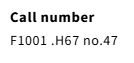
- Accordingly, the Holdings record of the monographic has the same call number as the serial, with the issue number at the end, AND has 2 public Holdings notes – one showing that it's also cataloged on the serial record, and one showing the barcode that it is associated with:

B. Analyzed multi-volumes spanning 2 or more serial issues:
When the analyzed monographic title in a serial has multiple volumes and spans multiple issues, the Monographic Holdings and Item records should reflect the details as follows:
Holdings Records:
- The Call number will be the same as the Serial call number, with the serial issue numbers corresponding to each volume at the end, similar to a series-class call number.
- In the Holdings Statement, the top line should show which volumes of the monograph are held overall, as would be typical for a multi-volume resource.
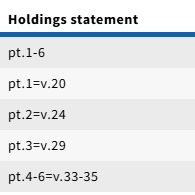
- In the next lines of the Holdings Statement, each monographic volume or part is listed with its corresponding serial issue number, with an Equals sign (=) between them (e.g. pt.1=v.20). If sequential volumes correspond to sequential issues, they can be grouped on one line (e.g. pt.4-6=v.33-35 ).
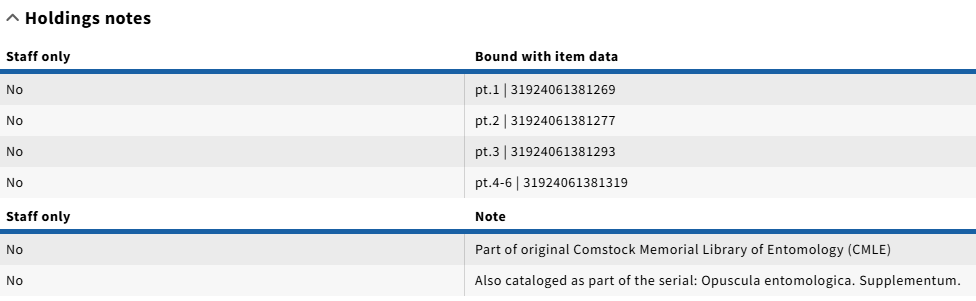
- Separate public Holdings Notes, with Note type: Bound with item data, will show the individual volume caption with the barcode number used for the corresponding item record on the serial record, separated by a PIPE. For example: pt.1 | 31924061381269 in one note (by itself), and pt.2 | 31924061381277 in the next note, etc.
- As with other Bound-with materials, use the same captioning used for the respective serial and monograph parts when making entries in Holdings and Item records.
Item Records:
- In the monographic Item records for the multi-volume, the barcode field should be BLANK. (The Item records of the Serial will have the actual barcodes).
- The Enumeration field should contain the term “Boundwith:”. followed by the Holdings statement entry for that particular volume (e.g. Boundwith: pt.1=v.20)
- {{There should be an Item note, with Note Type: Bound with, showing the same caption and number association as in the Holdings Statement and Enumeration fields as stated above (i.e. pt.1=v.20, or . pt.4-6=v.33-35).}}
Example 1:
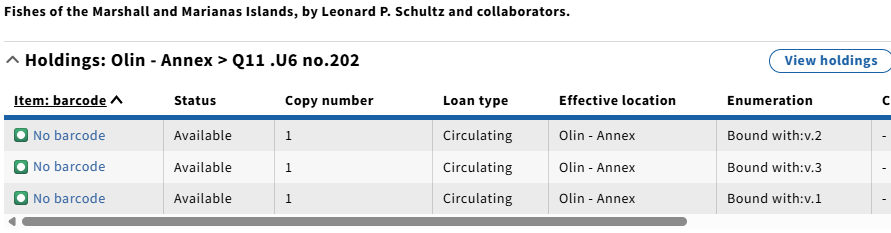
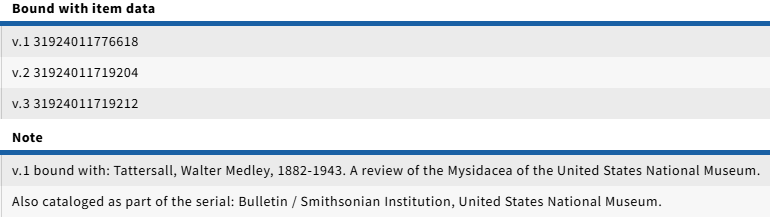
The serial "Bulletin /Smithsonian Institution (Instance 2013888) is a partially analyzed serial, and no. 202 of the serial is a 3-volume analyzed set with the title "Fishes of the Marshall and Marianas Islands" (Instance 1117089). v.1 is physically bound with the previous issue (201), which is also an analyzed serial, while vols. 2 and 3 have their own "solo" item records and barcodes in the Serial record. In
- The Holdings record of the 3-volume set shows the same call number as the serial record, with the issue number at the end (the same for all 3 volumes).
- It also shows the "Also cataloged as part of..." note, and the Bound with item data notes, showing the corresponding barcodes for the monographic volume records, as found in the item records for the Serial.
- Because v.1 of this 3-volume set is physically bound with another analyzed serial, the Holdings has an extra note referring to the first title in the piece, just like a standard Bound-with resource.
- The Item Record also shows the "Bound-With" information corresponding to the monographic volumes in the Enumeration field.
- NOTE: In this example, it was NOT necessary to set up a Holdings statement with the "volume=issue number" sequences, because all 3 volumes comprise the same issue (no. 202) of the serial.
Example 2:
The monographic multi-volume title “The ground-beetles (Carabidae, excl. Cicindelinae) of Canada and Alaska” (instance 1114770) is a 6-part monograph analyzed from the serial “Opuscula entomologica. Supplementum.” , volumes 20, 24, 29, 33-35 (Instance 1948271). The monographic Holdings of the multi-vol. within the serial has the following properties:
- The call number (same as serial record), with issue numbers at the end:

- The Holdings Statement, with the overall held volumes at the top, followed by the individual volumes and their corresponding issue number:
- The Holdings Notes:
- Public notes (type: "Bound with item data"), showing individual parts and corresponding barcode numbers, separated by a pipe.
- A public note stating that it is also cataloged as part of the matching serial, along with any other notes that may be unrelated to its bound-with cataloging.
- The Item Records for the monographic parts:
- Blank barcode fields
- Enumeration fields showing "Boundwith", along with the parts-to-issues equation as listed in the Holdings Statement:

END OF CURRENT PROCEDURE DRAFT. THE FOLLOWING MATERIAL IS YET TO BE DELETED OR REVISED AND ADDED ABOVE, OR REPRESENT ODD/EXCEPTIONAL CASES/QUESTIONS THAT DON'T ALIGN WITH THE ABOVE
Exceptional Examples:
Filmed-With where Instance records do NOT share the same call no.:

4. For retrospective conversion only: If Cornell has cataloged one or more titles (but has also not cataloged one or more titles) that have been filmed together in a single physical reel, select the first cataloged title as your primary title (Note: it may not be the first volume on the reel), add a MFHD to this, and to all the other cataloged titles in the volume, with appropriate ‘bound with’ notes and 876s. Ignore all the uncataloged titles on the reel. In addition, add the following staff note in the MFHD for the primary title:
Ex.: 852 ... $x Some titles on physical reel will not be cataloged.
However, if Cornell has not cataloged any titles that have been filmed together on a single physical reel, create a bib record and MFHD for the first title in the volume. Add the following staff note in the MFHD:
Ex.: 852 ... $x Other titles on physical reel will not be cataloged.
Item Records Without Barcodes for Bound With and Filmed With at the Annex
- After the Holdings notes with the fields are created for the bound with holdings and the “parent” record with the item that contains the barcode is accessioned at the Annex, Batch Processing staff will receive an email of a report generated by a weekday- scheduled cron job detailing the mismatch of locations between the “parent” and the other holdings with the 876 barcode.
- Batch Processing staff will use this report to execute a script to flip the holdings with the 876 field to the “parent” MFHD’s location and create item without barcodes (“empty”) with an enumeration of “Bound with" or “Filmed with.” If the 876 field has a subfield 3 with the enumeration of the volume or reel in which that title is contained, then that is appended to the enumeration of the “empty” item record.
Ex. Boundwith:v.4-8
Note: “Empty” items should only be created after the parent holding has been accessioned. Otherwise this causes problems for staff at the Annex. - NO LONGER TRUE. Empty Item records are fine to create before sending to Annex, as long as Holdings notes / bound-with data is accurate. (May have been true under Barb? but now, Cammie says it's much better to have them for patron requests, as it won't direct them to "Ask a Librarian". It will go directly to a staff member who can track the item down and figure out if something is incorrect in the records.
---------------------------
b. In the case of a partially analyzed serial, use the enumeration from the piece itself, when appropriate (Is this reflected in one of the original examples below? Numbering gets very confusing very quickly (see also bib 444353).
(7/22) Different "types" of bound-with: (should we add sections for these in detail, and then further sub-divide the procedure accordingly?)
- Series analytics? (see bib 2216393 for example: is)? I

 Pamela Parish, last updated by Pedro Arroyo on Oct 10, 2025
23 minute read
Pamela Parish, last updated by Pedro Arroyo on Oct 10, 2025
23 minute read