*** This version of Confluence is for testing only and contains a copy of content from June 29th 2026. No changes will be preserved. ***

 Dee Zajac, last updated on Jan 24, 2025
7 minute read
Dee Zajac, last updated on Jan 24, 2025
7 minute read
Date Created: February 2, 2024 Last Updated: November, 2024
Overview:
Athletics provides hazing prevention education and holds 1100 Varsity student athletes on Cornell’s 37 varsity team’s accountable for their hazing related behaviors. Athletes active on a varsity team roster are required to view an educational video, familiarize themselves with the student-athlete handbook, which includes information specific to hazing and athletic disciplinary action, and attest to having received and understood the information as part of the eligibility process. In addition, at the start of the academic year, athletes are required to attend team meetings where expectations for behavior, and educational resources, including those specific to hazing, are shared. Student athletes are also required to attend an all-department orientation, kick-off celebration and resource fair typically held the first night of classes during the fall semester where campus partners are invited to share relevant information. Given their leadership roles, in-person hazing education is required by all team captains and provided regularly to coaches. Throughout the academic year, athletics works closely with campus partners (Skorton Center for Health Initiative, Equity, Empowerment, and Belonging, CUPD, etc) to provide required team training of their coach’s choosing, any and all of which are geared towards safety and community standards expected of all campus individuals and groups, one of which includes education specific to hazing Intermittent communications to the full student-athlete population, including education on how to report hazing, the investigation and disciplinary process, and possible consequences are provided at times throughout the year and remain accessible as part of the Student-Athlete Support Services Canvas course. Athletics, in consultation with the Office of Student Conduct and Community Standards (OSCCS) is responsible for investigating Varsity athletic team hazing reports, determining sanctions, and managing appropriate follow-up for team-based allegations. The Office of Student Conduct and Community Standards manages individual cases and collaborates with Athletics as needed on follow up for non-compliance related to individuals.
Criticality: High | Frequency: Other | Turnaround: Other |
Key Documents / Sources of Information:
System Access Needed:
Common Problems or Issues Encountered:
Step by Step Procedures:
Education/Prevention:
Adjudication:
Accountability:
Key Risks | Key Controls |
Some hazing education is provided at points in time (i.e., beginning of year team meetings, department-wide kick-off resource fair, team trainings, etc.) that may ultimately miss staff and student-athletes depending on when they join a team or the department. . | 1. The Skorton Center for Health Initiatives offers in-person and online trainings options for student athletes and coaching staff. 2. Intermittent communications/reminders are provided to the student-athlete population at agreed upon points throughout the academic year. 3. Upon being activated to a roster, all athletes are required to attest to having received baseline education on hazing as part of the eligibility process upon being activated to a roster. 4. All athletes are required to participate in one training per semester, which may include hazing prevention. 5. Athletes living in on campus housing have access to educational opportunities in their residence halls. These hazing prevention educational opportunities may include poster campaigns and/or bulletin boards that the Skorton Center provides. |
Coaches may use discretion of when and where to address team and individual behaviors. | 1. Reported allegations are handled centrally by the Office of Student Conduct and Community Standards, separately from Team expectations and enforcement. 2. Student-athletes are educated on process for reporting concerns of hazing whether through the University online reporting mechanism, phone or other recommendations as made available via Hazing at Cornell website, or via Real Response, an anonymous reporting mechanism available to student-athletes specifically. |
1. | |
Collusion during an investigation | 1. Confidential and anonymous reporting is available through Campus Kaizen Guardian or the Cornell Ethics and Compliance Hotline. |
Loss of reputation to Athletic Team and/or loss of reputation to Cornell University | 1. Violations are posted on Cornell University’s hazing.cornell.edu website. 2. Cornell’s Hazing Prevention Model is a visible commitment to addressing hazing and serves as a guiding framework for universities across the United States. |
Glossary of Key Terms/Acronyms:
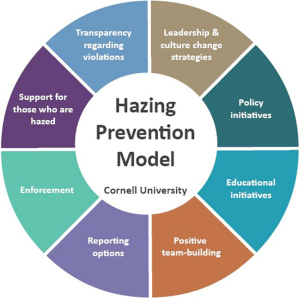
Between 2001 and 2015, Cornell University developed a comprehensive (i.e. multi-component) public health hazing prevention model that addresses individuals, organizations, and the broader environment. This model includes eight elements: leadership and culture change strategies; policy initiatives; educational initiatives; positive team building; reporting options; enforcement; support for victims; and transparency regarding violations. For more information visit www.hazing.cornell.edu
