*** This version of Confluence is for testing only and contains a copy of content from June 29th 2026. No changes will be preserved. ***

 user-5be22, last updated on Dec 06, 2012
3 minute read
user-5be22, last updated on Dec 06, 2012
3 minute read
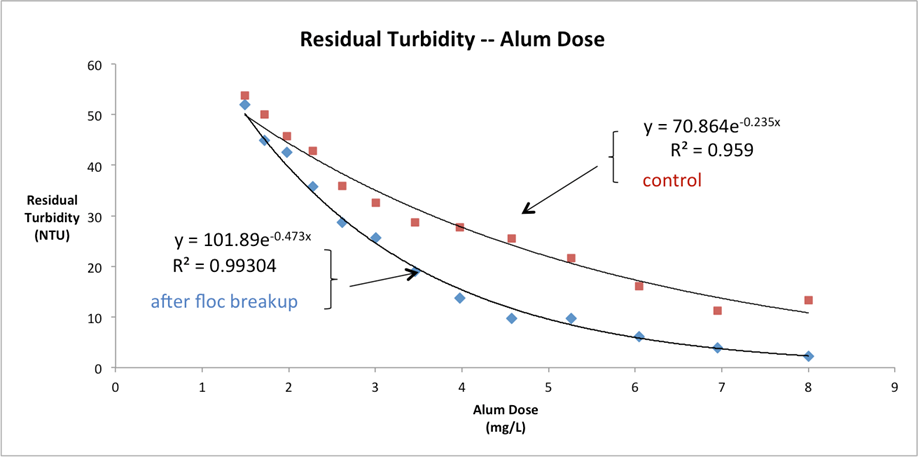
According to the predictive flocculation model proposed by Swetland et. al., 2012, large flocs do not significantly contribute to turbidity removal -- only small colloids can collide effectively and aggregate to a size that will be removed by sedimentation. Based on the hypothesis that "large flocs are useless", a floc breakup procedure was devised. Results obtained using a coiled tube flocculator and flocculation residual turbidity analyzer (FReTA) shows that higher turbidity removal was achieved after breaking the flocs, comparing to results using the same method but without floc breakup. Therefore breaking flocs at regular intervals to maintain continuous growth will promote better performance of flocculation. This research finding provided a good reference for future hydraulic flocculator design.
1. Only laminar flow occurs in tube flocculators.
2. Colloids cannot attach to large flocs at maximum size thus we need to break those flocs to maintain continuous growth.
3. At low coagulant doses, the residual turbidity is relatively high because the attachment efficiency is not big enough to allow flocs to form. With the increase of coagulant dose, attachment efficiency rises so the residual turbidity is lowered.
4. Discrete settling is assumed in analysis of data since the distance Z is much less than the 0.5m interval between sampling ports used in conventional flocculant settling tests. [citation-5]
5. Flocs will collide and grow when they travel from one breakup position to another.
1. Only laminar flow occurs in tube flocculators.
2. Colloids cannot attach to large flocs at maximum size thus we need to break those flocs to maintain continuous growth.
3. At low coagulant doses, the residual turbidity is relatively high because the attachment efficiency is not big enough to allow flocs to form. With the increase of coagulant dose, attachment efficiency rises so the residual turbidity is lowered.
4. Discrete settling is assumed in analysis of data since the distance Z is much less than the 0.5m interval between sampling ports used in conventional flocculant settling tests.
5. Flocs will collide and grow when they travel from one breakup position to another.
All experiments conducted are using the same method recorded in AguaClara's archive with the following directory: N://files.cornell.edu/EN/aguaclara/RESEARCH/Tube Floc/Spring 2012/Experiments/6-29-2012.
The specific description of this method is provided below.
Table 1 Experimental Method Fall 2012
Set Point |
Value |
|---|---|
Target influent turbidity max |
100 NTU |
Target influent turbdity min |
97.3 NTU |
Raw water flow rate |
5.5 mL/s |
Length of tube flocculator |
83.88 m |
Alum base |
1.3 |
Alum coefficient |
1.15 |
Max reps |
15 |
Alum stock concentration |
700 mg/L |
Note: A power law relationship is used to set a range of alum dose to spread out the residual turbidity vs. dose curve. This equation shows how we set the dose of alum: !Picture4.png|width=300!Where max reps means the number of experimental cycles, which is set by operators.
A floc breakup procedure was devised according to the calculations of energy dissipation rate, capture velocity, collision time. Six hose clamps were evenly placed onto tube flocculator (2 on each unit, see figure 1). The inner diameter of clamps are calculated based on the maximum energy dissipation rate. After the floc breakup device were set up, the flocculator were cleaned using a tiny sponge to remove the clay that sticked to the walls of flocculator. Then a complete experiment with the same method as the control experiment was conducted. 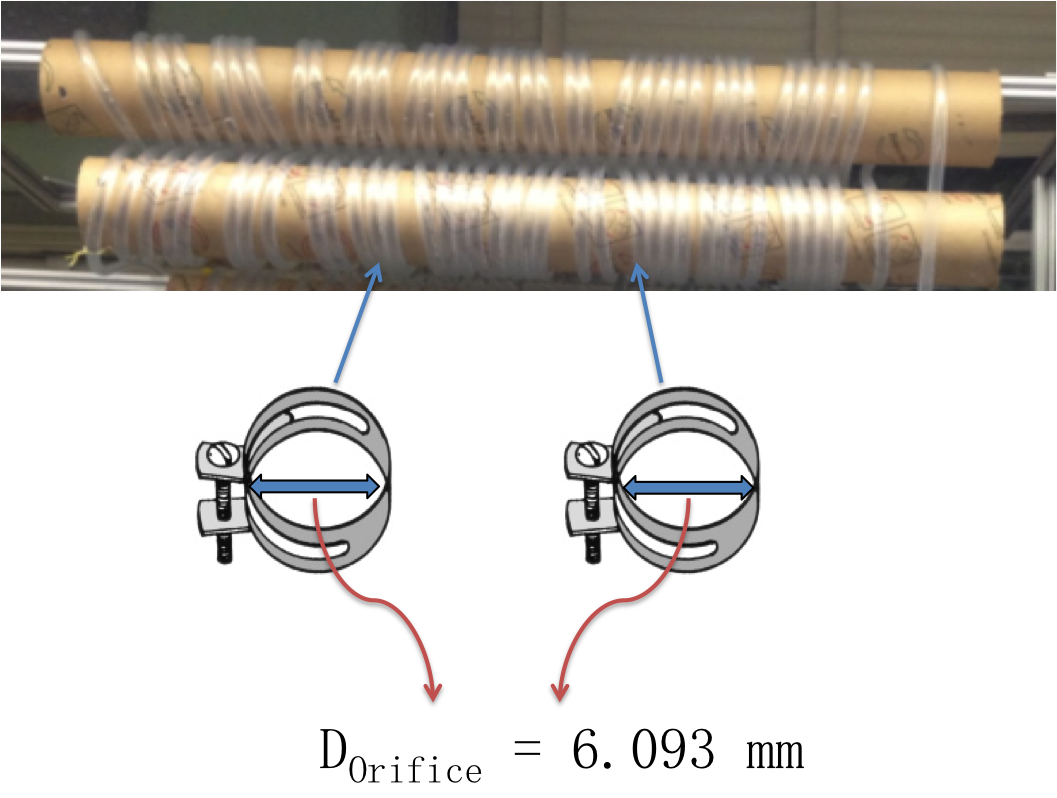
Figure 2 demonstrates the compared results of residual turbidity with floc breakup and without floc breakup. Obviously, the residual turbidity are lower when breaking the flocs using clamps. At the alum dose 4, 4.6 and 5.2 mg/L, the difference of residual turbidity curve reaches 10 NTU. Both curve seems to fit into the logarithmic trend line -- the one with floc breakup matches the trend line even with a correlation coefficient of 0.9934. The results not only proves that our hypothesis "large flocs are useless" is right but also offers us insight into improving AguaClara's current flocculator design.