*** This version of Confluence is for testing only and contains a copy of content from June 29th 2026. No changes will be preserved. ***

 user-bfae5, last updated on Aug 05, 2009
2 minute read
user-bfae5, last updated on Aug 05, 2009
2 minute read
For this experiment, dial soap mixed in water, pump, flow accumulator, water tank and water container were used in order to create water jets.
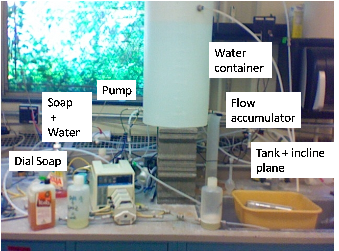
Figure: Setup testing parameters for foam formation
Three parameters were investigated to study foam formation:
1) Average velocity of jets
2) Type of surface
3) Length the water travels down the incline plane
The velocity of the jets in our experiment was increased by increasing the flow coming from the pump, which substituted for increasing the head in the actual plants. In the first run, the jets fall onto the accumulated water on the tank, then a plane was used to catch the water jets before falling into the tank. The plane was placed at different distances and angles to observe the change in bubble formation.
The experiment affirmed that the velocity of the jet, its length, and the type of surface it impacts are all limiting parameters. By observing the water jet at different flow rates it was determined that the length of the jet is dependent on the velocity of the jet. At low flow rates the length of the jet is shorter than at higher flow rates. As seen in Figure 1, the length of the jet refers to the part of the jet where the water surface is turbulence-free and thus appears smooth and transparent. It is when the surface of the jet becomes sufficiently turbulent that air is entrained as the symmetry of the jet breaks during free fall. When a jet hits the water surface a void forms in the water and from the tip of this void an air bubble is pinched off as demonstrated in the attached scientific paper: The entrainment of air by water jet impinging on a free surface. Therefore, when the water jet hit a solid smooth surface there was no foam formation.