*** This version of Confluence is for testing only and contains a copy of content from June 29th 2026. No changes will be preserved. ***

...
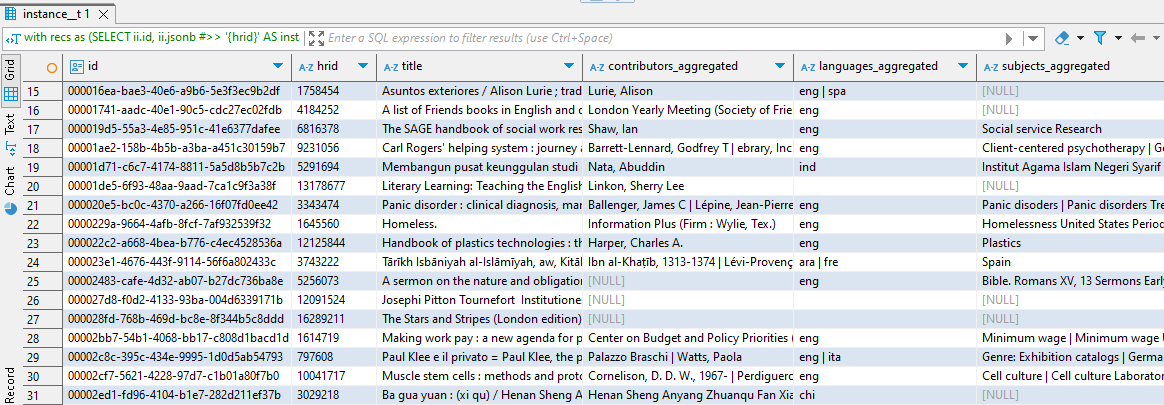
In this example, we're finding three array elements from the folio_inventory.instance table: contributors, languages, and subjects, then joining the result to a complete set of instance records.
...
WITH recs
...
AS ----- Get the array elements for contributors, languages and subject using nested jsonb extract statements in the Select clause
(SELECT
ii.id,
ii.jsonb #>> '{hrid}'
...
AS instance_hrid, ---- first level text extract
ii.jsonb #>> '{title}'
...
AS title, ---- first level text extract
jsonb_extract_path_text (jsonb_array_elements (jsonb_extract_path (ii.jsonb, 'contributors')),'name')
...
AS contributors, -- contributors array extract (second-level extract)
(jsonb_array_elements (jsonb_extract_path (ii.jsonb,'languages'))) #>>'{}' as languages, ----- languages array extract (top-level extract) – note the empty curly brackets
jsonb_extract_path_text (jsonb_array_elements (jsonb_extract_path (ii.jsonb, 'subjects')),'value') as subjects ----- subject array extract (second-level extract)
FROM FROM folio_inventory.instance AS AS ii
),
...
SELECT ------- Get all the
...
records from the
...
instance__t table;
...
left join
...
the results of the first query
...
recsthat got the array elements
instance__t.id,
recs. instance__t.hrid,
recs instance__t.title,
string_agg (distinct recs.contributors,' | ') as contributors_aggregated,
string_agg (distinct recs.lanuageslanguages,' | ') as languages_aggregated,
string_agg (distinct recs.subjects,' | ') as subjects_aggregated
FROM recs
GROUP BY recs.id, recs.instance_hrid, recs.title
...
aggregated
from folio_inventory.instance__t
left join recs
on instance__t.id = recs.id
group by
instance__t.id,
instance__t.hrid,
instance__t.title
;
;
RESULT: