 Sign-up for free online course on ANSYS simulations!
| Include Page | ||||
|---|---|---|---|---|
|
| Include Page | ||||
|---|---|---|---|---|
|
Turbulent Pipe Flow
Created using ANSYS 13.0
Problem Specification
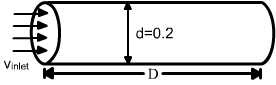
Let's revisit the pipe flow example considered in the previous exercise. As before, the inlet velocity is 1 m/s, the fluid exhausts into the ambient atmosphere and density is 1 kg/m3. For µ = 2 x 10 -5 kg/(ms), the Reynolds no. based on the pipe diameter and average velocity at the inlet is
| Wiki Markup |
|---|
| Wiki Markup |
{include: FLUENT Google Analytics} {include: Turbulent Pipe Flow - Panel} h1. Turbulent Pipe Flow Created using ANSYS 13.0 h2. Problem Specification !Fluent_pipeflow.jpg! Let's revisit the pipe flow example considered in the previous exercise. As before, the inlet velocity is 1 m/s, the fluid exhausts into the ambient atmosphere and density is 1 _kg/m{_}{_}{^}3{^}_. For µ = 2 x 10 ^\-5^ _kg/(ms_), the Reynolds no. based on the pipe diameter and average velocity at the inlet is {latex} \large $$ {Re} = {\rho VD \over \mu} = 10,000 $$ {latex} |
This
...
change
...
of
...
viscosity
...
has
...
taken
...
us
...
from
...
a
...
Reynolds
...
number
...
of
...
100
...
to
...
10,000.
...
At
...
this
...
Reynolds
...
number,
...
the
...
flow
...
is
...
usually
...
completely
...
turbulent.
...
We'll
...
solve
...
this
...
problem
...
numerically
...
using
...
ANSYS
...
FLUENT.
...
Among
...
the
...
results
...
we'll
...
look
...
at
...
are
...
centerline
...
velocity,
...
skin
...
friction
...
coefficient
...
and
...
the
...
axial
...
velocity
...
profile
...
at
...
the
...
outlet.
...
...
...
...
...
...
...
...
...
...