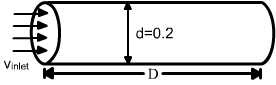
Created using ANSYS 13.0
Let's revisit the pipe flow example considered in the previous exercise. As before, the inlet velocity is 1 m/s, the fluid exhausts into the ambient atmosphere and density is 1 kg/m3. For µ = 2 x 10 -5 kg/(ms), the Reynolds no. based on the pipe diameter and average velocity at the inlet is
{latex}
\large
$$
{Re} = {\rho VD \over \mu} = 10,000
$$
{latex} |
This change of viscosity has taken us from a Reynolds number of 100 to 10,000. At this Reynolds number, the flow is usually completely turbulent.
We'll solve this problem numerically using ANSYS FLUENT. Among the results we'll look at are centerline velocity, skin friction coefficient and the axial velocity profile at the outlet.
Go to Step 1: Pre-Analysis & Start-Up
Go to all FLUENT Learning Modules