*** This version of Confluence is for testing only and contains a copy of content from June 29th 2026. No changes will be preserved. ***

 Sharon Helen Markus, last updated on Mar 23, 2026
3 minute read
Sharon Helen Markus, last updated on Mar 23, 2026
3 minute read

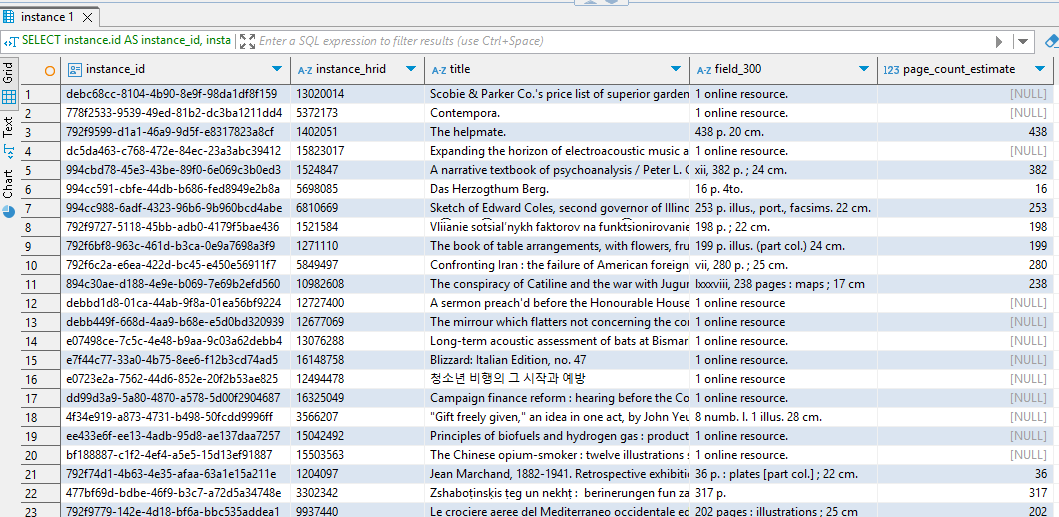
This example below shows 236 pages in the item, which is an electronic resources. If your query is only pulling items from a physical location, you should not get any electronic resources. However, it is good to be aware that the physical description may include
It is impossible to account for every variation of page number entry in your query


Basic code to extract physical description from the instance table
This method does not use the problematic marc__t table. This code extracts the "physical descriptions" array from the instance record; records that do not have a physical descriptions array will not drop out, because a left join lateral function is used. Note that when you choose a specific physical location, the electronic resources will not be included.
WITH parameters as (

SELECT

/*Enter the location code for the library between the apostrophes, e.g. 'olin' , 'law,res' /*

(SELECT
'olin'::VARCHAR as location_code_filter
),

 instance.id AS instance_id,
    instance.jsonb#>>'{hrid}' AS instance_hrid,
    instance.jsonb#>>'{title}' as title,
    location__t.code,
    phys.jsonb#>>'{}' AS field_300,
    CASE
        WHEN substring (phys.jsonb#>>'{}','\d{1,4}') IS NOT NULL
        AND (phys.jsonb#>>'{}' like '%page%' or phys.jsonb#>>'{}' LIKE '%p.%' or phys.jsonb#>>'{}' LIKE '%leaves%' or phys.jsonb#>>'{}' LIKE '% l.%' )

       THEN substring (phys.jsonb#>>'{}','\d{1,4}')::INT
        ELSE NULL
    END AS page_count_estimate,

phys.ordinality

FROM folio_inventory.instance


LEFT JOIN LATERAL jsonb_array_elements (jsonb_extract_path (instance.jsonb,'physicalDescriptions')) WITH ordinality AS phys (jsonb)
ON TRUE

LEFT JOIN folio_inventory.holdings_record__t  on instance.id = holdings_record__t.instance_id

LEFT JOIN folio_inventory.location__t  on holdings_record__t.permanent_location_id = location__t.id

WHERE
CASE WHEN

   (SELECT location_code_filter FROM parameters IS NULL)
THEN location__t.code !=‘serv,remo’
ELSE location__t.code = (SELECT location_code_filter from parameters)
END

;
Result: