*** This version of Confluence is for testing only and contains a copy of content from June 29th 2026. No changes will be preserved. ***

 user-47b50, last updated on Mar 18, 2010
2 minute read
user-47b50, last updated on Mar 18, 2010
2 minute read
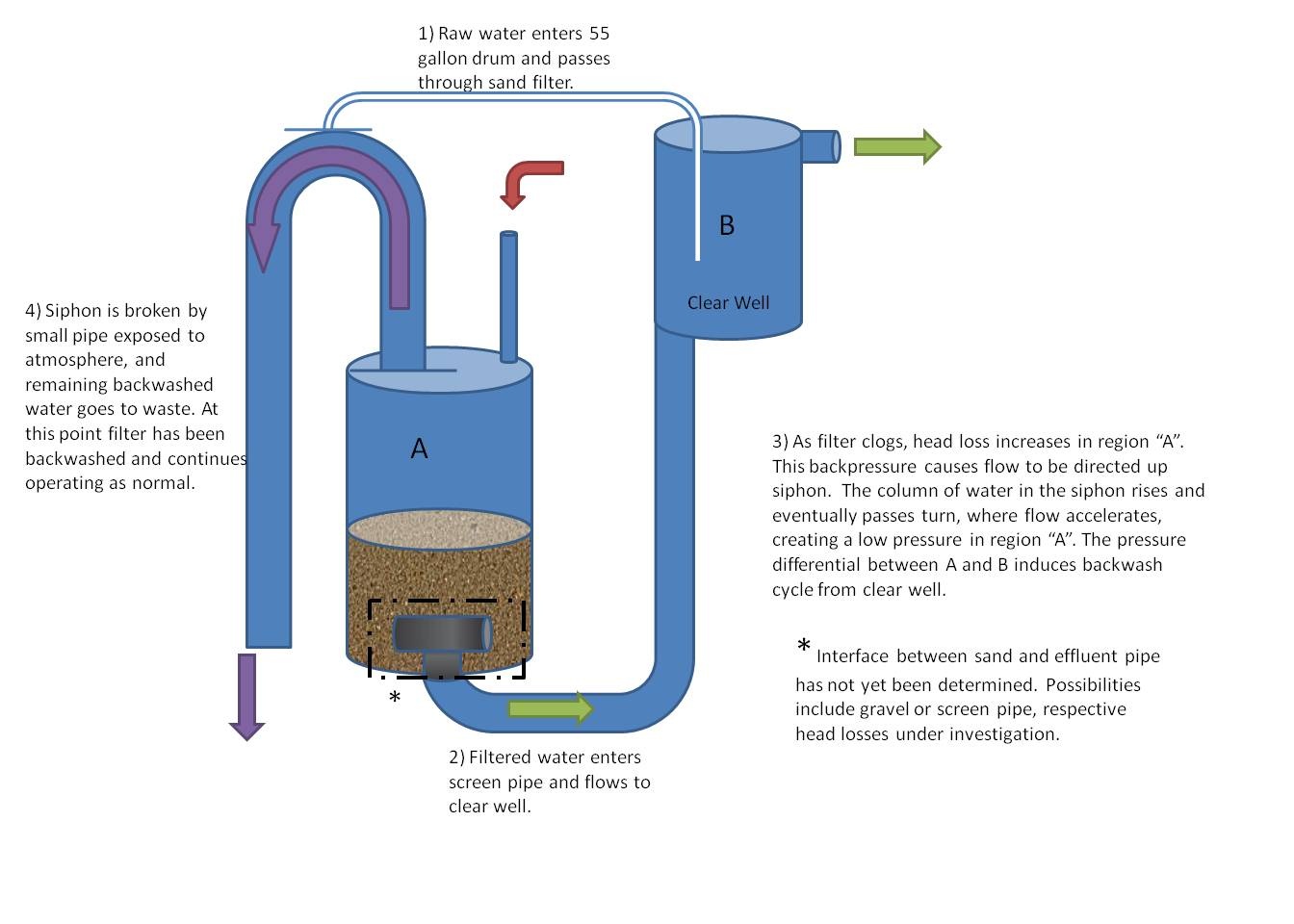
The goal of our research is to evaluate the feasibility of a siphon-aided backwash design to be used for a sand or mixed-media down-flow filter. The benefits of siphon-aided backwash is:
1) The height of the clear-well does not need to be equal to the the head pressure required to attain 30%-50% expansion.
2) The siphon tube is designed to fill up when the filters have reached a terminal headloss (a set point we determine). Thus, they only backwash when they are dirty.
3) Since the headloss energy is used to prime the siphon, and eventually trigger backwash, fewer valves are required which reduces cost and labor.
The filter bed rests inside an air-tight container. The influent enters through a port above the sand bed. The siphon is also connected through a separate port, connected to the container, above the sand bed. The clean water exits the container below the sand bed, which leads to clear-well storage.
Flow scheme in regular down-flow mode:
Raw water enters from the top>sand bed>out to clear-well
In backwash mode: The siphon is "primed" by the headloss generated in the clogging filter, which causes the raw water to flow up the siphon tube. Eventually the water begins to flow over the bend of the siphon and as it fills the tube, a negative pressure gradient is established, diverting all flow out the siphon.
Water from clear-well flows in reverse>sand bed (from bottom)>siphon>waste
A)
B)
C)