*** This version of Confluence is for testing only and contains a copy of content from June 29th 2026. No changes will be preserved. ***

 user-aad2f, last updated on May 21, 2010
4 minute read
user-aad2f, last updated on May 21, 2010
4 minute read
Filtration is a part of the water treatment process in which colloidal and suspended material are removed from water by passing through layers of porous media like sand, foam, or fabric. After a while, these dirt materials build up in or on the surface of the media, so the filter needs to be cleaned. This is usually done through backwashing, sending clean water backwards through the filter medium to dislodge particles. Here are two examples of filtration plants in Honduras, one conventional and one multistage filtration:
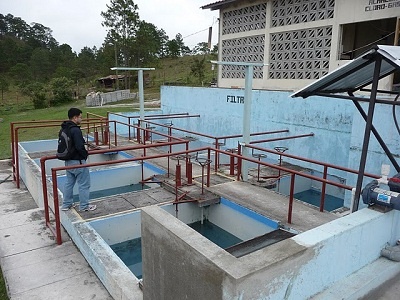
Santa Rosa Water Filtration Plant
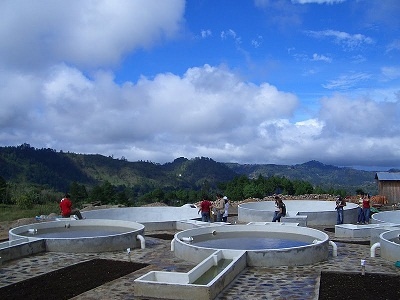
San Pedro de Tutule <Unable to render embedded object: File (-- --><) not found.-- function msoCommentShow(anchor_id, com_id) { if(msoBrowserCheck()) { c = document.all(com_id); a = document.all(anchor_id); if (null != c && null == c.length && null != a && null == a.length) { var cw = c.offsetWidth; var ch = c.offsetHeight; var aw = a.offsetWidth; var ah = a.offsetHeight; var x = a.offsetLeft; var y = a.offsetTop; var el = a; while (el.tagName != "BODY")
var bw = document.body.clientWidth; var bh = document.body.clientHeight; var bsl = document.body.scrollLeft; var bst = document.body.scrollTop; if (x + cw + ah / 2> bw + bsl && x + aw - ah / 2 - cw>= bsl )
else
if (y + ch + ah / 2> bh + bst && y + ah / 2 - ch>= bst )
else
c.style.visibility = "visible"; } } } function msoCommentHide(com_id) { if(msoBrowserCheck()) { c = document.all(com_id); if (null != c && null == c.length)
} } function msoBrowserCheck()
if (msoBrowserCheck())
// -><!- /* Font Definitions */ @font-face
@font-face
@font-face
@font-face
/* Style Definitions */ p.MsoNormal, li.MsoNormal, div.MsoNormal
p.MsoCommentText, li.MsoCommentText, div.MsoCommentText
span.MsoCommentReference
span.CommentTextChar
.MsoChpDefault
.MsoPapDefault
@page Section1
div.Section1
-->FiME (Multiple Stage Filtration) Plant
Multistage filtration is the "other" low-tech option for communities using surface waters. Some features of multistage filtration are:
One disadvantage of the Tutule FIME plant is that it takes up a lot of space. Multi-filtration plants are generally 7-25 times bigger than the AguaClara sedimentation tank. We are designing our whole filtration system to be about the same size as the AguaClara sedimentation tank. We want to keep our system small so that a minimal amount of materials are required, keeping the price down.
AguaClara also strives to make the treatment plant as simple as possible to operate, so multistage filtration is not an option since it is so labor intensive.
Both of these filtration systems are powered by gravity, which is something AguaClara strives for as well.
One problem we observed with the Santa Rosa system is that it has eight filters, and to backwash one filter, it uses all the other seven. That means that during backwashing, all of the water that gets filtered goes towards backwashing, so production of clean water is stopped. Backwashing only takes about ten minutes per filter, but with eight filters, it adds up to a lot of time and water spent backwashing.
Many filtration systems have features that AguaClara cannot copy, such as the use of electricity, having parts invisible to the operator, and parts that are expensive or difficult to obtain in Honduras. These two sites have found solutions to many of the problems, but the AguaClara filtration aims to achieve even more. We are looking at foam and stacked filtration, trying to filter and backwash completely by gravity with minimal loss of water to backwashing. We will have our filtration system covered so that no debris can land in it, but the system will also be open to the operator so he or she can easily observe the filters, especially during backwash. Lastly, we are keeping the size minimal to ensure that the system is affordable.