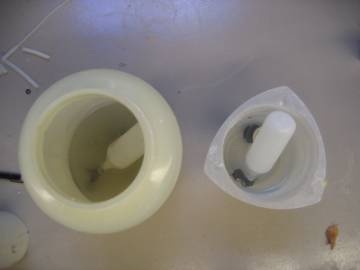
The first experiment conducted was a simple corrosion test for the manufactured float valves. The float valves are mostly plastic, with a stainless steel screw and pivot pin and a rubber pad that shuts off the inflow when the float rises. The pivot pin creates the joint that the float valve rises around, and if that fails then the entire float valve fails. The rubber pad is of similar importance in that if it fails then the inflow cannot be plugged and regulated. An entire float valve was placed into 120 g/L alum solution and a second entire float valve was placed in 13 g/L hypochlorite solution. These are the concentrations used in the AguaClara plant in Ojojona. The float valves were checked every week and observations were made regarding apparent wear and corrosion on the various exposed parts. The alum and chlorine solutions were replaced every week to ensure that the chemicals did not lose their reactivity. While the continuous chemical submersion is more extreme than normal operating conditions, it showed which parts of the float valves tend to fail first under exposure. Those parts can then be replaced with more corrosion-resistant counterparts to improve the life span of the float valves.