Date Created: April 12, 2024 Last Updated: May 14, 2024
Overview:
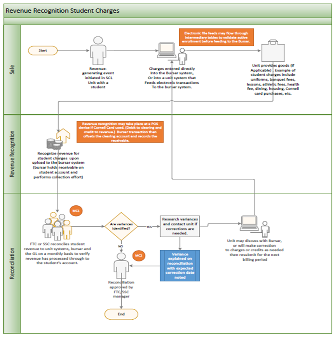
Campus Life generates revenue with students for housing, meal plans, Cornell academic materials program (CAMP) and Cornell Retail store purchases. All student billing is processed through local systems and fed to the Bursar System. FTC reconciles StarRez, CS Gold, NetSuite and the Bill table to the Bursar and the general ledger to ensure revenue is recorded accurately in the financial statements for the month/semester that the income is earned.
Criticality: High | Frequency: Other | Turnaround: Other |
Key Parties / Contacts: Student: The student electronically signs licenses for Housing and Dining once they accept enrollment to Cornell University. These initiate billing transactions fed to the bursar that the student is responsible for paying. Meal plan contracts are also fed to the CS Gold system to create a meal plan for the student based on the contract selected. The student uses their Cornell ID Card at a POS device to make purchases at Cornell Retail (store) or Cornell Dining which are fed to the bursar system daily and added to the student’s bursar bill. UG students are also automatically enrolled in the CAMP program and charged a fixed amount on the regular tuition bill. Students have the option to opt out of the CAMP program. Unit Staff: The unit staff are responsible for processing transactions in their local systems and ensuring transactions feed over to the bursar system without error/failure. SSIT Staff: Manage the file extract process from StarRez and NetSuite and submit to the bursar system for processing. Follow up on billing issues due to file errors as needed. Financial Transaction Center (FTC): Responsible for the reconciliation of the student revenue from billing system all the way through to the general ledger. Issues identified must be brought to the attention of the unit so they can be addressed appropriately and corrected. |
Key Documents / Sources of Information:
- StarRez license and billing for housing
- CS Gold meal plan data
- NetSuite student purchases
- Kuali Financial System GL transactions
- Bill Table activity
System Access Needed:
- StarRez
- CS Gold
- NetSuite
- Bill Table
- Kuali Financial System (KFS)
- OAS Reporting Dashboard (KDW)
Common Problems or Issues Encountered:
- Student status, if student becomes unregistered or goes on leave, bursar may reject the transaction.
- Transactions failing to feed to the Bursar
- Delayed notification of student status
- Proration tool charge accuracy
Step by Step Procedures:
Student Housing
- Students sign up for housing online once they accept enrollment to Cornell University
- License is submitted using an electronic signature: once the electronic signature is submitted, the student is billed once a semester through StarRez and charges are fed to the Bursar system weekly to bill the student accounts.
- Once fed to the Student accounts, a receivable is created in the GL, along with the Housing revenue. (See Billing Process below for fees charged to Housing by Bursar)
- Housing revenue is recognized once transactions are posted to the Bursar through a file feed.
- No refunds are made unless the student does not attend the University
- Exceptions: Medical reason, never checked in, required academic leave, University emergency, pandemic (or similar disaster)
- All billing is initiated through the StarRez system and fed to the bursar via unique codes; undergrad and graduate housing charges are coded separately.
- Undergrad: Billing done in July for first semester and January for the second semester Graduate: Students are billed monthly (12 bills and payments per contract term).
- Billing issues can occur if the student enrolls without being registered or becomes unregistered during the semesters.
- This occurs if there is a delay in an accepted student's financial aid payment, if a student takes a leave of absence or withdraws.
- Report of suspended transactions comes from Bursar to Housing Office
- Housing office monitor's suspense accounts to ensure that transaction clears or makes the proper adjustments needed.
Student Dining Meal Plans
- Meal Plans are available in unlimited, and 14 meals per week plans and a 10 meals per semester plan. First year students are required to be on the unlimited plan.
- Students sign up for meal plans online once they accept enrollment to Cornell University in the StarRez system.
- Contract is submitted using an electronic signature: once the electronic signature is submitted, the student’s meal plan account is added to the CS Gold system and their Cornell ID card is loaded with the meals/rules associated with the meal plan purchased.
- The BRB component of the meal plan (for retail dining unit purchases) is also added to the CS Gold system and loaded onto the student’s Cornell ID card.
- In addition, Dining charges for the purchased plan are fed to the Bursar system to bill the student bursar accounts.
- Once fed to the student account, a receivable (Debit) is created in the GL on the bursar account, along with the Meal Plan Deferred Revenue (Credit) on the CL account. This revenue is not recognized until the period in which the student has access to use the meals.
- BRB can also be purchased separately during the semester. The purchased Bucks will be added to the CS Gold system under the student’s ID.
- Any remaining BRBs at the end of the academic year are non-refundable and non-transferable.
- Cornell has 10 All You Care to Eat Dining units across the campus at which students can “spend” the meals attached to their meal plans.
- As students visit one of these units, their ID is swiped at a Micros terminal, prior to being admitted to eatery. Micros “calls” the CS Gold system to verify that the student has a meal available for this day and this meal period and deducts the meal from the student’s available meal balance.
- At the end of each week, all these meal swipes are summarized by Dining Unit and the Meal Plan Deferred Revenue is relieved (Debit) and the Dining Units receive revenue for each meal served (credit). Meals that are available to a student but not used in a week (Missed Meals) are non-refundable and not transferable to the next week. Therefore, the value of the Missed Meals is recorded as dining revenue and relieves the Meal Plan Deferred Revenue.
- Big Red Bucks can be used as tender for food items at any of the Dining Units (not just All You Care to Eat units), as well as vending machines around campus and at the Statler Hotel eateries.
- As students visit one of these units and make a purchase, their ID is swiped at checkout. The register system “calls” the CS Gold system to verify that the student has available BRB and deducts the dollar value of the purchase from the student’s available balance.
- At the end of each week, all the BRB used are summarized by Dining Unit and the Student Big Red Bucks Deferred Revenue is relieved (Debit) and the Dining Units receive revenue for BRB dollars used (credit).
- Any remaining BRBs at the end of the academic year are non-refundable and the Student Big Red Bucks Deferred Revenue is reduced to zero. Revenue is recorded to the Dining Administration account.
Cornell Retail Services Student Purchases
- Students make purchases using Cornell Card at the POS device in the store or online via the website.
- NetSuite validates the student is registered at the POS device.
- Transactions are fed to the Bursar system daily, revenue is recognized, and AR is billed to the student’s account at the bursar’s office. Bursar office will transfer to the store via a clearing account.
- CAMP - Digital first subscription-based program for academic materials. One program fee will be charged to cover required textbooks, per semester. Undergraduate students are automatically enrolled and charged a fixed amount as part of the regular tuition bill through the Bursar. This process will take place in July (fall semester) & January (spring semester). Students do have the option to opt out of the program.
- Bursar office will transfer to the store via a deferred revenue account.
- Billing audit tool will provide report allowing BSC to compare the balance activity in deferred account to student bursar transactions.
- Store will recognize revenue as earned once students receive access to academic materials.
Key Risks | Key Controls |
Revenue not recorded through to the GL for Housing | 1. Reconciliations are done monthly to verify all billed transactions in StarRez, reconcile to the bursar transactions and the KFS GL total for the month. 2. Variances are researched and credits or corrections made as needed. |
Revenue is not distributed to the appropriate units in Dining for meal plan revenue, BRB’s and Cornell Card | 1. Income distribution worksheet, for both meal plans and BRB, is prepared weekly using data from CS Gold to support the journal to distribute (recognize) meal plan/BRB income and relieve the deferred revenue accounts. 2. Reconciliation of meal plan deferred revenue account is prepared on a quarterly basis. 3. All other dining deferred revenue accounts reconciliations, including Student Big Red Bucks, are prepared each month. All reconciliations are completed by an FTC team member and reviewed and approved by the FTC Assoc Director. |
Revenue is not distributed to Cornell Retail Services for Cornell Card transactions or CAMP billing | 1. Monthly reconciliation is done by the FTC to verify that all NetSuite transactions tendered with the Cornell Card have been paid by the Bursar. 2. Variances are investigated and resolved. 3. CAMP - Monthly reconciliation of the clearing account via student bursar billed data and cash sales that booked to deferred revenue. Entry to clear deferred revenue and clearing account completed at this time. 4. It is verified/documented at the end of each month that each account in NetSuite agrees with the summarized object/sub-object codes in KFS at the Org Level. |
Supply chain disruptions | 1. Dining has substitutes for their top 100 items and has a secondary supplier in case the primary fails. 2. The Dining wellness team can change recipes on the fly or create new recipes if product sourcing issues arise. |
Regulatory Compliance: Failure to comply with regulatory requirements related to taxation, licensing, food safety, and health regulations can result in fines, penalties, or legal liabilities. | 1. Dining has regular training programs on food safety and handling. 2. Tompkins County BOH does regular inspections. |
Data Security and Privacy: Handling sensitive student information, such as payment details and personal data, exposes the university to risks of data breaches, and potential FERPA violations. | 1. Access to protected data is limited to only information needed by individual position. 2. Staff complete |
Revenue is not able to be collected due to withdrawal/unregistered timelines |
Metrics:
- Budget vs Actual
- Occupancy Rates
- Average Room Rate
- Meal Plan Utilization rate
- Dining unit traffic patterns
- Revenue per meal
- Gross Margin ratios
- Average transaction value
Glossary of Key Terms/Acronyms:
- KFS – Kuali Financial System
- OAS – Oracle Analytics Server, financial reporting tool (formerly known as OBIEE)
- GL – General Ledger
- FTC – Student and Campus Life Financial Transaction Center that processes financial transactions for Cornell Catering.
Campus Life Student Revenue Process Flow Chart