Date Created: January 16, 2024 Last Updated: July 2, 2024
Overview:
Cornell Retail Services maintains a significant inventory in their warehouse and in each store location. Inventory is tracked in NetSuite and updated as items are sold. Cycle counts are performed regularly, and an annual inventory count is completed each fiscal year. Additional processes and controls for ordering, storage, and access are in place to protect inventory and to prevent opportunities for fraud or theft.
Criticality: High | Frequency: Other | Turnaround: Other |
Key Parties / Contacts:
Buying Team: Responsible for placing orders, monitoring inventory levels and reviewing any pricing or delivery discrepancies. Buying team also updates SharePoint documents to identify inventory items for cycle counts and validates the final physical inventory counts.
Warehouse Team: Receives product at the warehouse, verifies item counts and pricing on orders. Identifies items for return to vendors (damaged, wrong item, etc.) and manages the return process. Assigns inventory to specific bins and manages transfer of inventory to store locations. Ensures inventory security at the warehouse and conducts assigned cycle counts in the warehouse regularly.
Store Location Staff: Assist in completing inventory cycle counts and annual physical inventory. Monitors inventory on the sales floor.
Inventory Associate: Responsible for processing inventory adjustments for the store locations.
NetSuite System Analyst: Responsible for reviewing and exporting file to provide to the inventory service provider and importing inventory results for inventory service provider into NetSuite.
Security Coordinator: Reviews security protocols and monitors inventory in the main store and the Commons’ locations through surveillance camera footage.
Inventory Service Provider: Complete annual physical inventory and provides reporting to store management to review and adjust inventory balances if needed.
Financial Transaction Center (FTC): Responsible for processing vendor invoices and credits timely and recording inventory adjustment entries.
Key Documents / Sources of Information:
- NetSuite
- SharePoint Excel files
- Kuali Financial System
- Invoices, credits, returns and packing slips from vendors
System Access Needed:
- NetSuite
- Kuali Financial System (KFS)
- OAS Reporting Dashboard (KDW)
Common Problems or Issues Encountered:
- Credits and returns can make tracking and reconciliation challenging.
- Physical inventory counts could contain errors.
- Pricing issues may exist in item records in NetSuite.
Step by Step Procedures:
Ordering Product:
- The Buying Team places an order(s) with a vendor for inventory items to replenish what is sold based on inventory records in NetSuite, or orders special items.
- Buying team may need to source items not carried by established store vendors.
- If new vendor, buying team initiates vendor setup in NetSuite and notifies FTC to issue new vendor packet to the vendor. FTC issues new vendor packet.
- Once vendor returns the vendor packet, the FTC confirms the vendor is in KFS. If vendor is in KFS, FTC confirms if any updates are needed. If vendor is not in KFS, FTC sends vendor invite via PaymentWorks.
- FTC receives vendor number confirmation from KFS for any updates and new vendor setup. FTC enters the KFS vendor number in the vendor record in NetSuite to link to KFS.
- If orders exceed establish buying limits, orders are directed to a secondary approver.
- PO is submitted electronically to vendor through NetSuite.
- Vendor fulfills the PO order and delivers product to the CRS Warehouse.
- When orders are delivered, the product is checked against the PO in NetSuite and the packing slips by warehouse staff to ensure accuracy of item SKU, pricing, UPC code and counts match. Shipping locations are verified, and item labels are printed if needed.
- Warehouse staff enter quantities received on the order in NetSuite. NetSuite assigns a unique receiving number to the transaction and creates a GL entry to debit inventory and credit Accounts Payable based on quantity x unit cost on the PO.
- If PO does not match order as received, warehouse staff contact the Buying team to resolve with the vendor.
- Warehouse team identifies all product to be returned and Buying Team creates a VRMA in NetSuite that is available to match to the vendor credit.
- Vendor bills the store with hard copy or electronic invoicing. All vendors not enrolled in electronic invoicing, are instructed to submit invoices with purchase order reference via email to: The Cornell Store 150 Ho Plaza, Ithaca, NY 14850 Email: cbsbo@cornell.edu. Include the PO number on the subject line and may include instructions in the body of the email. The purchase order is the contractual basis on which the supplier is paid for merchandise furnished.
- Manual invoices are entered through the Bill Purchase Order process. Electronic billing is sent via SPS Commerce (EDI) and processed through a verification system before going through the Bill Purchase Order process. All Vendor credits are manually entered in Accounts Payable, via Refund VRMA process.
- In the event that no purchase order is created for an invoice, (for example when Apple Inc bills the store for the purchase of parts used by the Computing Center for repairs made to student computers), the Enter Bills or Enter Credits process is used.
- FTC team verifies 3-way match of vendor invoices to the receiving documents and PO in NetSuite. If the item price or quantity billed differs from what was received, the item price or quantity may NOT be adjusted. Adjustments are only handled through the appropriate Expense account: quantity variance – Over/Short – Inventory; cost variance – COS – Vendor Price Variance. The adjustments are to be within the established threshold. Large discrepancies warrant discussion with Store team (buyers or receivers) and/or researched with the vendor for appropriate credits prior to invoice entry and payment.
- Freight and Tickets (tag costs, color charges) are entered as a line item to record the appropriate COS account. Note: Federal Interstate Commerce Commission / Department of Transportation regulations require that all invoices for freight be paid within fifteen (15) days. Failure to comply can result in termination of carrier service or possible court action against Cornell University. It is extremely important that all freight bills be processed promptly!
- FTC creates a weekly payment file to process invoices for payment and sends to KFS via an integration.
- Vendors are not paid if they have an outstanding credit balance or if a return has been made and the credit has not been received from the vendor.
- Payment file is reviewed & approved by FTC Financial Manager for all invoices. Any invoices over $200K will be approved by the Associate Director Financial Transaction Center. Copy of the approval for invoices over $25K will be attached in NetSuite on bill record. Approval for invoices under $25K will be saved in payment file record.
- Invoices over $1M need additional approval attached by the University Controller (Karen Mahalo) OR need to be processed in KFS though a DV so proper approval routing occurs per university and audit requirements.
- Invoices are paid according to payment terms established by the university.
Inventory Cycle Counts:
- Buying Team identifies items for cycle count based on risk.
- Each location is assigned specific items and times to complete their cycle counts on SharePoint Excel files created by the Buying Team.
- Store location staff and warehouse staff perform cycle counts of inventory items on a weekly basis.
- Counts are recorded and verified against On Hand inventory values in NetSuite by frontline staff.
- If a discrepancy is found the count is researched and verified by a Team Lead or Supervisor. Discrepancies are researched in NetSuite and calculated to verify the on-hand count. Net ID s visible as to who places the items on shelf or last assessed it.
- Adjustments are made by the location’s inventory associate to on hand values if NetSuite values do not match.
Annual Physical Inventory Count:
- Merchandise is prepped for physical inventory, missing tags are replaced and SKU’s are organized to facilitate inventory counts by frontline staff, supervisors, and managers.
- NetSuite inventory file reviewed for errors prior to physical inventory counts by the Store’s NetSuite System Analyst and SSIT.
- Store Managers review negative on hand report and research prior to inventory count being completed. All pending returns and pending transfers are received to store locations and damaged items are marked out.
- Once the inventory data has been scrubbed for errors, the master product file is exported by the NetSuite System Analyst. There are 2 files provided to the external inventory service provider, one for store locations and one for the warehouse which uses bin management.
- The external inventory service provider completes the physical count of all items in each location.
- For the warehouse location only, inventory on the upper racks is pre-counted. Inventory sheets are provided to the external inventory service company to input into their system.
- Electronic service provider file sent electronically to the store NetSuite System Analyst.
- Store NetSuite System Analyst imports the physical count file into NetSuite.
- Variances are reported on discrepancy reports by the Buying Team and sent to store location staff to research.
- Store location staff forward result of research and recounts to the Buying Team for review.
- Buying team reviews research and the Store’s Inventory Associate updates NetSuite accordingly.
- Final inventory results extracted and presented by the Store’s Financial Manger to Senior Leadership, the Buying Team, and location managers.
- Extract of financial data each month updates KFS with inventory changes.
Key Risks | Key Controls |
Risk of the same individual ordering and receiving product, allowing opportunity for fraud | 1. Ordering and receiving processes are segregated to two different teams in the Cornell Store (Buying Team and Warehouse Team). 2. Unit trains staff on proper procedures for purchasing in accordance with the Buying Guide and university policy. 3. Unit ensures that the intended purchase is an allowable business expense for which University funds may be expended. |
Conflict of Interest (COI), when staff is working closely with vendors, there are some inherent risks. There is a risk that staff does not self-disclose relationship with vendor. There is a risk that once the risk is disclosed that a unit does not follow up with staff to investigate the COI further. | 1. Unit trains staff on COI and self-disclosure; unit manages and investigates COI in accordance with University Policy 4.14, Conflicts of Interest and Commitment (Excluding Financial Conflict of Interest Related to Research): vol4_14.pdf (cornell.edu). 2. Annual certification and ethics training is required in the MOU for delegated spend. |
Risk of individuals having too much control in the inventory process. | 1. Buying Team determines items to be counted for cycle counts. 2. Inventory Associate processes inventory adjustments when necessary. |
Risk of inventory misappropriation | 3. Inventory cycle counts are done weekly and compared to on hand values in NetSuite to monitor items that are at risk. 4. External inventory company counts inventory on an annual basis. 5. Building Security Coordinator monitors surveillance cameras in main store and Commons location. Ware Warehouse manager monitors surveillance cameras at the warehouse location. |
Value of inventory could be incorrect due to costing entry errors | 1. Buying Team and Financial Manager reviews inventory adjustments together monthly. 2. FTC monitors the value of inventory versus the amount within the stock register monthly. 3. FTC completes monthly reconciliation that compares item receivers completed by warehouse staff to bills processed for any value differences. 4. When the invoice for received goods is entered, all the items, quantities and prices are again compared to the PO – not the receiver. If anyone changed the PO – especially the price – since the goods were received, the amount that gets invoiced will not match the entry for the goods that were received. This leaves a reconciling item that needs to be fixed for every PO. The FTC staff would then follow-up with the Buying Team on difference. |
Returns may not be processed timely for credit | 1. Warehouse identifies items to be returned and creates a VRMA in NetSuite to track. 2. Items are moved to a specific location in the warehouse designated for vendor returns. 3. The buying team packages the return, and the FTC processes the bill credit in NetSuite. |
Key Risks | Key Controls |
Risk of the same individual ordering and receiving product, allowing opportunity for fraud |
|
Conflict of Interest (COI), when staff is working closely with vendors, there are some inherent risks. There is a risk that staff does not self-disclose relationship with vendor. There is a risk that once the risk is disclosed that a unit does not follow up with staff to investigate the COI further. |
|
Risk of individuals having too much control in the inventory process. |
|
Risk of inventory misappropriation |
|
Value of inventory could be incorrect due to costing entry errors |
|
Returns may not be processed timely for credit |
|
Metrics:
Cornell Finance Staff
- Monitor inventory values, adjustments and fluctuations to identify possible fraud
- Monitor inventory value on hand to ensure inventory is being managed appropriately (is value on-hand consistent with best practices).
- Monitor inventory turns to identify slow moving merchandise that may need to be eliminated from the inventory portfolio.
- Monitor profit margins on individual inventory items to identify pricing issues.
Glossary of Key Terms/Acronyms:
- KFS – Kuali Financial System
- OAS – Oracle Analytics Server, financial reporting tool (formerly known as OBIEE)
- GL – General Ledger
- FTC – Student and Campus Life Financial Transaction Center that processes financial transactions for Cornell Retail Services.
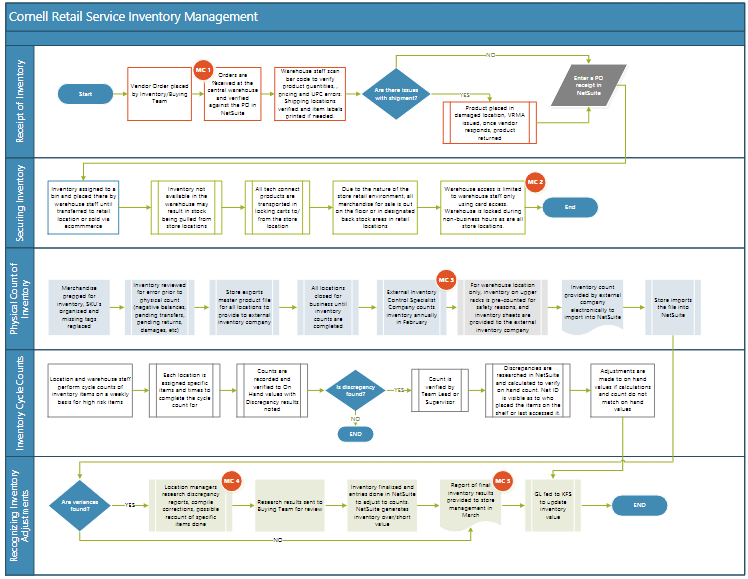
Cornell Retail Services Inventory Process Flow Chart
| Process Testing | |
| Date: 7/02/24 | |
| Name of process being tested: | Cornell Retail Service Inventory Management |
| Staff observed for process: | |
| Staff Name/Title | Robert Ervin, Sr. Manager, Warehouse, Order Fulfillment & Print Services |
| Staff Name/Title | Rick Lattin, Material Handler S10 |
| Staff Name/Title | Hunter Oblinski, Material Handler S07 |
| Staff Name/Title | Jody Lynn Marnell, Assoc. Director of Retail Services |
| Control Points: | |
| Confirm all key control points are being followed | Yes |
| Are there workarounds being used in lieu of documented process? | No |
| Observations: | |
| Identify/list any deviations to established process in narratives: | None identified |
| Recommendations: | |
| Recommendation for improvements to process: | Process is being followed as written and we were able fine-tune additional steps not fully noted in the process flow diagram/narrative. The only recommendation would be to consider doing "blind counts" of higher value inventory items upon occasion so staff counting do not know what count they are supposed to have on hand. |
| Action Plan: | |
| Assign responsibilities and deadlines for implementing recommendations. | Robert Ervin |
| Plan for addressing any issues or deficiencies identified during the audit. | None noted |
| Wrap-up | |
| Schedule follow-up audit to monitor implementation of recommendations and track progress. | N/A |
| Provide a pass/fail assessment of process compliance | Pass, great job, please thank your team for walking us through what they do! |
| Note all source documents used for testing here: | |
| Cornell Retail Service Inventory Management Process Flow diagram | |
| Retail Inventory Management process narrative |