Sorority and Fraternity Life Transaction Narrative
Date Created: February 2, 2024 Last Updated: May 28, 2024
Overview:
50 fraternity and sorority chapters comprised of one-third (approximately 3,000+ students) are recognized by Cornell University. This population is educated about hazing prevention held accountable for their hazing related behaviors. Chapter leadership is required to submit an attestation around hazing awareness and education and register their chapter annually. Presidents and New Member Educators of Greek letter organizations are required to attend a hazing prevention and education training annually, delivered by staff in the Skorton Center for Health Initiatives and the Office of Student Conduct and Community Standards, after the chapters have elected their new leadership. Potential new members must complete How to Recognize and Respond to Hazing and 15% of membership from each chapter is required to attend National Hazing Prevention Week activities organized by the Office of Sorority and Fraternity Life. Prevention education and opportunities for involvement are geared towards safety and community standards expected of all campus individuals and groups. Trainings provide education around the disciplinary process should there be an active investigation following an allegation and the consequences for not complying with mandated sanctions set by the Campus Code of Conduct, National Organization Headquarters and/or their Cornell recognized organization. The Office of Student Conduct and Community Standards, in collaboration with Campus and Community Engagement, manages appropriate follow up for non-compliance.
Criticality: High | Frequency: Other | Turnaround: Other |
Key Parties / Contacts: Campus and Community Engagement; Office of Sorority and Fraternity Life: Responsible for developing training resources and coordinating logistics with the chapter’s leadership team to provide education and support resources. Monitors and oversees completion statuses in Campus Groups and Canvas. Sets and monitors expectations for advisors and chapter leadership. Meets with the Office of Student Conduct and Community Standards to review and manage post-incident sanction completion and behavior mitigation. Provides resource information to organizations and individual members in need of support. Advisors: Responsible for setting expectations and monitors around chapter and individual behavior. Addresses misconduct and makes appropriate referrals. Student Conduct and Community Standards: Investigates and manages hearings then delivers and monitors sanction completion. Notifies National Chapter Headquarters, as needed. Reports criminal behaviors to law enforcement. Skorton Center for Health Initiatives: Provides institutional leadership on hazing prevention strategies (e.g., Cornell's Hazing Prevention Model), delivers prevention focused educational trainings to students and employees on hazing, bystander intervention and how to recognize and respond to hazing , manages the University’s hazing.cornell.edu website, collaboratively implements communication strategies and campaigns about hazing prevention, conducts research on students’ knowledge, attitudes, and behaviors related to hazing among Cornell students, uses data driven-strategies to address hazing, and participates in public engagement and collaborative opportunities with national hazing prevention organizations and universities across the country to address hazing. The Skorton Center also collaborates with the Office of Sorority and Fraternity Life to provide educational trainings on hazing and bystander intervention education (e.g., Intervene, How to Recognize and Respond to Hazing). National Chapter Headquarters: Set expectations and monitor chapter behavior. Administer and manage sanctions for hazing violations. Provide or revoke funding, housing eligibility, and recognition as warranted. |
Key Documents / Sources of Information:
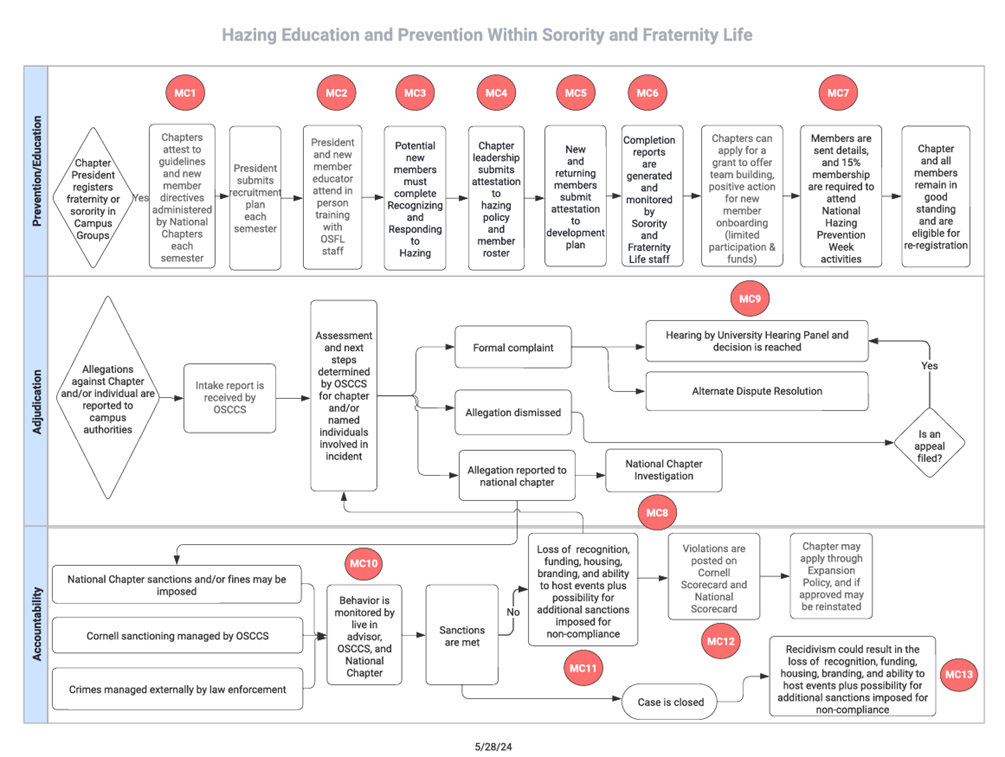
- Hazing Prevention Within Greek Life flowchart
- Cornell Student Code of Conduct
- OSCCS flowcharts
- Cornell Sorority and Fraternity Life Expansion Policy 2021
- Hazing Scorecard
- Penn State National Scorecard
- Hazing online training
- Help Us Stop Hazing – Fraternal Law
- Sorority and Fraternity Life resources and Bid link
- University recognized Chapter list
- How to Recognize and Respond to Hazing (Spring 2024 online version of Skorton Center training for students)
- National Hazing Prevention Week IntraGroup Activity Resources
- Cornell University’s Hazing Website
- Cornell University’s Hazing Prevention Model
- JACH Publication on Cornell University’s Hazing Prevention Model
- Stop Hazing’s Hazing Prevention Consortium (Cornell participated from 2013 – 2016 in the first cohort)
System Access Needed:
- Campus Groups
- Canvas
- Campus Kaizen Guardian
Common Problems or Issues Encountered:
- Chapter and individual behaviors around identifying and responding to hazing behaviors, comprehension of training materials, and available resources will vary per individual.
- Chapter and individual behaviors may be influenced based on the training focus and expectations set by their president, new member educator, and Chapter Advisor.
- Advisors strategize and use discretion of when and where to address chapter and individual behaviors.
- Chapter Advisor is chosen by National Headquarters and is subject to change.
- Violations of the Campus Code of Conduct may result in loss of recognition and the inability of the chapter to acquire funding, provide housing, host events, and qualify for chapter insurance, but investigations may not result in an identification of involved individuals. When this occurs, individual offenders are permitted to remain on campus and may repeat behavior.
- Collusion, resulting in inappropriate disclosure of information between victims and perpetrators, may occur during the investigation.
- Educational trainings on hazing, bystander intervention, and culture change strategies for positive group team building (that does not involve hazing) are not tied to eligibility to join groups, teams, or organizations or serve in leadership positions within an organization and there are no consequences or sanctions for not completing trainings.
- National Hazing Prevention Week takes place in September. Cornell’s robust Greek Life new member process takes place in January.
- Eligibility requirements and training for live-in advisors was not known at the time of this report; details will be incorporated in future updates.
Step by Step Procedures:
Education/Prevention:
- Chapter President registers fraternity or sorority in Campus Groups.
- Chapters attest to guidelines and new member directives administered by National Chapters each semester.
- President submits recruitment plan each semester.
- President and new member educator attend in person training with staff from OSFL, the Skorton Center for Health Initiatives and OSCCS.
- Potential new members must complete How to Recognize and Respond to Hazing.
- Chapter leadership submits attestation to hazing policy and member roster.
- New and returning members submit attestation to development plan.
- Completion reports are generated and monitored by Sorority and Fraternity Life staff.
- Chapters can apply for a grant to offer positive team building (non-hazing activities), positive action for new member onboarding (limited participation & funds).
- Members are sent details, and 15% membership are required to attend National Hazing Prevention Week activities.
Adjudication:
- Anyone can make a confidential or anonymous report of hazing against a chapter either online or by contacting one of the offices listed on the University website: https://hazing.cornell.edu/reporting
- Hazing reports made against Chapter and/or individual are reported to campus authorities.
- Intake report is received by OSCCS.
- Assessment, investigation, and next steps determined by OSCCS and involved parties. In conjunction with President Pollack’s reforms for Greek Life at Cornell 2019 enforcement is applied when “any violations, at events or otherwise, pose health and safety risks (including but not limited to underage alcohol consumption, insufficient event monitoring/controls, or failure to register an on- or off-campus event), the chapter will be immediately placed on interim suspension, with all chapter activities ceased pending the outcome of a Greek judicial proceeding. Should the outcome of that proceeding substantiate the violations, the final sanction will range from a minimum of a three-year suspension to permanent dismissal from university recognition.”
- Incident is resolved through formal complaint, alternate dispute resolution or dismissed.
- When warranted, incident is reported to National Organization Headquarters who may launch an external investigation concurrent with campus and/or legal sanctioning.
- Criminal behavior is reported to law enforcement for external proceedings, concurrently with campus sanctioning.
Accountability:
- National Chapter sanctions and/or fines may be imposed.
- Cornell sanctioning by OSCCS.
- Criminal behavior managed externally by law enforcement.
- Loss of recognition, funding, housing, branding, and ability to host events plus possibility for additional sanctions imposed for non-compliance.
- Violations are posted on Cornell Scorecard and National Scorecard.
- Violations are also posted on the University’s Hazing website because transparency of violations is a key strategy of Cornell’s Hazing Prevention Model.
- If a Chapter loses university recognition, then the Chapter is required to apply and be approved through Expansion Policy to be reinstated.
- Individual(s) may be removed from chapter and/or campus.
Key Risks | Key Controls |
Hazing prevention education is available but not all opportunities for engagement are required. Additionally, hazing prevention education is not tied to eligibility to participate in groups, teams, or organizations or leadership roles within the organization. | 1. Participation in National Hazing Prevention Week (held in September) is required for 15% membership from each chapter. 2. Prospective new members must complete online training that was developed by the Skorton Center for Health Initiatives and is currently programmed in Canvas. The current version of this online program is called How to Recognize and respond to Hazing and includes a variety of topics including hazing, bystander intervention, alcohol and other drug safety. It uses a self-enrollment link so anyone with a Cornell net id can self-enroll into the training. 3. Presidents and New Member Educators are required to attend a training on hazing prevention annually (typically in-person led by staff from the Skorton Center for Health Initiatives and OSCCS) usually in November/December after chapters have elected their new leadership and before the Spring recruitment process. |
Live-in advisors strategize and use discretion of when and where to address chapter and individual behaviors. | 1. Reported allegations are handled centrally by the Office of Student Conduct and Community Standards, separately from organization expectations and enforcement. |
Semester recruitment plans are required and include education around hazing and an attestation, but completion is only required for chapter leadership plus 15% of the membership. | 1. All organizations must register annually. 2. Leadership must pass an educational quiz during the registration process to move registration to approval phase. |
Collusion during an investigation | 1. Confidential and anonymous reporting is available through Campus Kaizen Guardian or the Cornell Ethics and Compliance Hotline. 2. OSCCS uses different investigative strategies to reduce the risk of collusion during an investigation. |
Loss of reputation to Chapter Loss of reputation to Cornell University | 1. Violations are posted on Cornell Scorecard and National Scorecard, in an effort to be transparent about the history of hazing within organizations as well as to demonstrate the University’s enforcement of the hazing policy at Cornell. 2. Cornell’s Hazing Prevention Model is a visible commitment to addressing hazing and serves as a guiding framework for universities across the United States. |
Powerful role of alumni | 1. OSFL and OSCCS staff are available to consult with Chapter Presidents and New Member Educators to discuss culture change strategies and how to navigate challenging relationships with alumni. |
Metrics:
- Office of Sorority and Fraternity Life to track hazing prevention education completion and crosscheck leadership, advisor, and member rosters.
- Office of Student Conduct and Community Standards track # of reported allegations with their outcomes.
- Office of Student Conduct and Community Standards track recidivism.
- The Skorton Center for Health Initiatives administers surveys to assess students’ knowledge, attitudes, and behaviors related to hazing.
Glossary of Key Terms/Acronyms:
- CCE: Office of Campus and Community Engagement
- OSFL: Office of Sorority and Fraternity Life
- OSCCS: Office of Student Conduct and Community Standards
- Bid link: registration and attestation for potential new members to accept an invitation to join chapter.
- MC: Mitigating Control
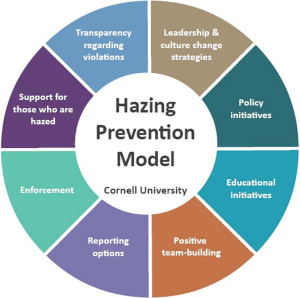
Between 2001 and 2015, Cornell University developed a comprehensive (i.e. multi-component) public health hazing prevention model that addresses individuals, organizations, and the broader environment. This model includes eight elements: leadership and culture change strategies; policy initiatives; educational initiatives; positive team building; reporting options; enforcement; support for victims; and transparency regarding violations. For more information visit www.hazing.cornell.edu
Process Flow Chart