Date Created: May 23, 2024
Last Updated: June 5, 2024
Overview:
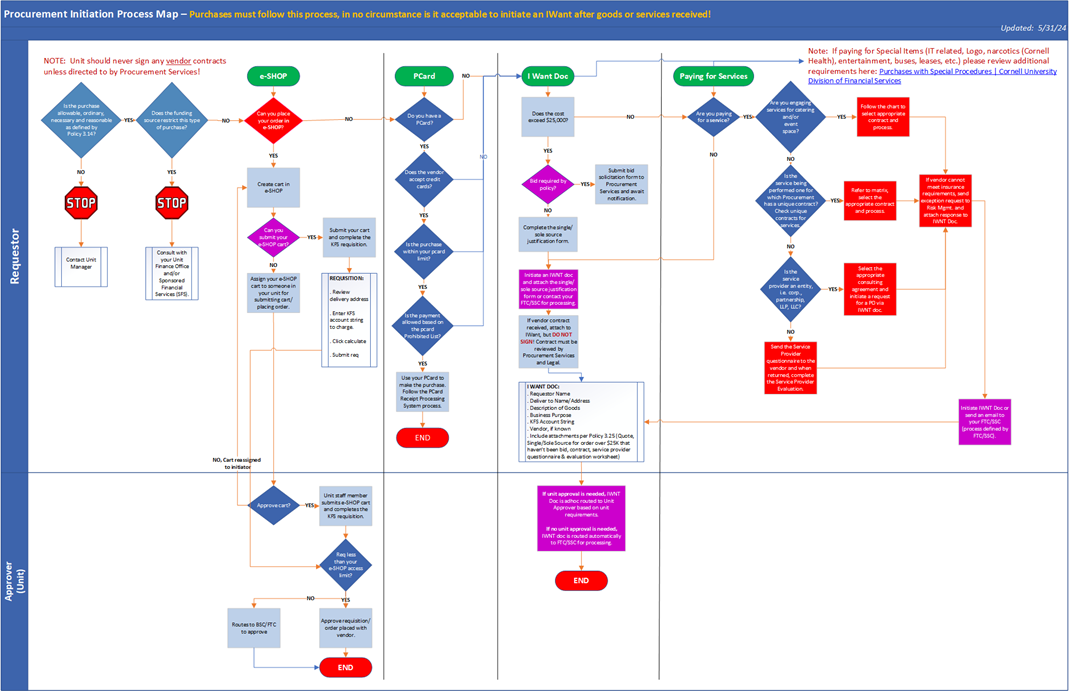
SCL staff can make purchases on non-delegated spend through several methods, including e-shop, P Card, and IWant edoc requests. Payments to vendors are processed in KFS by the SCL FTC, SCL Procurement, or the central Shared Services Center (SSC) procurement team. Segregation of duties exists between purchasing, receiving and invoice/payment processing.
Criticality: High | Frequency: Daily | Turnaround: Other |
Key Parties / Contacts:
SCL Staff Member: Initiates eshop order, p-card purchase or IWant request for goods or services. Staff member is not allowed to sign vendor contracts but can sign as the unit on university contract templates. Staff must initiate the buying process through one of the three approved methods. In absolutely no circumstance should a staff member engage services or order goods outside of these systems. This is an unauthorized purchase. Unauthorized purchases skirt internal controls and may be considered fraudulent activity. In addition, they put the university at risk if insurance is not provided, and university terms and conditions requirements are not agreed to in advance with the vendor.
Vendor: Fulfills orders and requests for services with reasonable accuracy, adheres to university terms in order/PO, provides proof of insurance coverage for all services, and delivers items to buyer or buyer’s location. Ensures invoicing and any credits for returns are processed promptly if applicable.
Financial Transaction Center (FTC), SCL Procurement, or Shared Services Center (SSC) – based on customer serviced: Reviews eshop orders over limit established by the university and approves if correct. Processes IWant requests, places orders on Super Pcard (SSC only) if applicable. Works with Procurement Services as needed to meet customer requests, participates in RFP’s, bids and works with customer to ensure all proper paperwork has been provided. Compares invoice received from vendor to PO and receiving for all PREQ edocs over $5K.
Procurement Services: Issues requests for proposal (RFP’s), issues bids, and awards orders as appropriate, reviews submission for appropriate completeness and follows up or rejects if any information has not been provided.
Key Documents / Sources of Information:
- Procurement Gateway: Procurement Gateway (cornell.edu)
- Buying Manual: Paying for Goods and Services that do not require a Purchase Order Paying for Goods and Services Not Requiring a Purchase Order | Cornell University Division of Financial Services
- Prohibited P Card Transactions: Buying Manual: PCard Prohibited Transactions (cornell.edu)
- Buying Manual PO Proces:s Purchase Order Process | Cornell University Division of Financial Services
- Buying Manual Purchases requiring special procedures: Purchases with Special Procedures | Cornell University Division of Financial Services
- Buying Manual IT Governance Process: Buying Manual: Information Technology Governance Process (cornell.edu)
- Buying Manual Paying for Services: Purchases with Special Procedures: Paying for Services | Cornell University Division of Financial Services
- Bid solicitation request: Bid Solicitation | Cornell University Division of Financial Services
- University Policy 3.14 Business Expenses; University Policy 3.14, Business Expenses (cornell.edu)
- University Policy 3.2 Travel Expenses: University Policy 3.2, Travel Expenses (cornell.edu)
- University Policy 3.25 Procurement of Goods and Services: Procurement of Goods and Services (cornell.edu)
- University Policy 3.9 Capital Assets: University Policy 3.9, Capital Assets (cornell.edu)
- University Policy 4.10 Use of Cornell’s Name, Logos, Trademarks, Insignias: Cornell University Policy Template
- University Policy 4.14 Conflict of Interest: pdf (cornell.edu)
- University Policy 4.2, Transaction Authority and Payment Approval: University Policy 4.2, Transaction Authority and Payment Approval University Policy 4.2, Transaction Authority and Payment Approval (cornell.edu)
- Invoices, credits, returns and packing slips from vendors
System Access Needed:
- Kuali Financial System (KFS)
- OAS Reporting Dashboard (KDW)
- SpendViz
- Procureware bidding software
Common Problems or Issues Encountered:
- Credits and returns tracking
- Mismatch between PO/Receiving and vendor invoice
- After the fact purchases
- Units signing vendor contracts when they have no authority to do so.
- Conflict of Interest
Step by Step Procedures: Ordering Goods or Services (non-travel related): (Note: Certain types of purchases may require additional steps or procedures not outlined below including logo items, IT equipment/software/services, narcotics (Cornell Health), entertainment, buses, leases, etc. Please see this link for more information Purchases with Special Procedures | Cornell University Division of Financial Services
FTC/SSC Procedures: 1. Eshop orders must be approved over established limits by the FTC or SSC based on SCL customer to place the order with the vendor. Orders under this limit will be placed immediately. 2. P Card receipts will be audited and approved by the SSC team for unit purchases made via P Card. 3. IWant edocs will be routed to a queue for processing by the FTC or SSC as appropriate (disbursement voucher payment, SSC Super P Card, PO). 4. FTC/SSC follows up with unit for missing information. Procurement Services Procedures: 1. Reviews and processes IWant requests needing PO’s 2. Approves and/or rejects IWant if missing business purpose, documentation and attachments 3. Issues RFP’s (request for proposal) 4. Issues Bids on items or services over $25K limit 5. Evaluates bid results and confers with unit to select appropriate vendor. |
Key Risks | Key Controls |
Risk of the same individual ordering and receiving product, allowing opportunity for fraud | 1. Ordering and receiving processes should be segregated. 2. FTC reconciles PO and receiving document with vendor invoice. |
Conflict of Interest (COI), when staff is working closely with vendors, there are some inherent risks. There is a risk that staff does not self-disclose relationship with vendor. There is a risk that once the risk is disclosed that a unit does not follow up with staff to investigate the COI further. | 1. Unit trains staff on COI and self-disclosure; unit manages and investigates COI in accordance with University Policy 4.14, Conflicts of Interest and Commitment (Excluding Financial Conflict of Interest Related to Research): vol4_14.pdf (cornell.edu). 2. Annual certification is required by all regular staff effective for FY25. |
Risk that invoice has been submitted to Accounts Payable by vendor, department, or Shared Services Center previously for payment (duplicate payments). | 1. Unit reviews accounts and checks for potential duplicate payments. Kuali Financial System requires purchase order number, invoice number, invoice date, and amount for all payment requests and automatically checks for potential duplicates for purchase order payment requests; KFS cannot check for duplicates across payment methods. 2. Timely assurance audits identify duplicate payments made after the fact so reimbursement or credit memo can be requested. |
After the fact PO’s - ATFPO’S | 1. This process has been widely shared with the entire SCL division. 2. This process dictates that purchases of items outside of delegated spend are initiated according to this process narrative in eshop, on P Card or an IWant edoc. 3. FTC/SSC must be diligent in looking at the invoice for after the fact orders to see if it shows PAID before processing. 4. All violations are tracked and reported to senior management. |
Unit signing contracts without delegated spend authority | 1. Unit trains staff on proper procedures for non-delegated spend per this process document and process flow diagram. 2. In the rare instance that this happens, SCL AVP is notified of violations for further action. |
Metrics:
Cornell Finance Staff
- After-the-fact PO counts
- Budget vs Actual expense
- P Card transactions counts
- eShop vendors paid via P Card or DV
- Conflict of interest identified
Glossary of Key Terms/Acronyms:
- Non-delegated spend – SCL Purchasing has delegated purchase authority for Dining inventory items. The Cornell Store buying team has delegated purchase authority for Cornell Retail Services inventory items.
- KFS – Kuali Financial System
- OAS – Oracle Analytics Server, financial reporting tool (formerly known as OBIEE)
- GL – General Ledger
- FTC – Student and Campus Life Financial Transaction Center that processes IWant transactions for Enterprise, Student Orgs and Affiliates, and works with SSC, SCL Procurement, or university Procurement Services to place orders.
- SSC – Shared Services Center that processes eshop, P Card and IWant procurement transactions for all other SCL units, approves SCL P Card transactions and holds the Super PCards for purchases over individual cardholder limits. Works with Procurement Services to place orders.
- SCL Procurement – Approves eshop orders for enterprise, student and affiliate orgs, uses procurement P Card to pay for orders within their limit. Assists with requirements, RFP’s and bids for non-delegated spend for customers.
General Procurement Process Flow Chart