Date Created:  February 2, 2024               Last Updated:  March 6, 2025

Overview:

Athletics provides hazing prevention education and holds 1000+ Varsity student athletes on Cornell’s 37 varsity team’s accountable for their hazing related behaviors. Athletes active on a varsity team roster are required to view a baseline educational video, familiarize themselves with the student-athlete handbook, which includes information specific to hazing and athletic disciplinary action, and attest to having received and understood the information as part of the eligibility process. In addition, at the start of the academic year, athletes are required to attend team meetings where expectations for behavior, and educational resources, including those specific to hazing, are shared.  Student athletes are also required to attend an all-department orientation and resource fair typically held the first night of classes during the fall semester where campus partners are invited to share relevant hazing information as part of the greater athlete student leadership event. Given their leadership roles, in-person hazing education is required by all team captains and provided regularly to coaches. Throughout the academic year, athletics works closely with campus partners (Skorton Center for Health Initiative, Equity, Empowerment, and Belonging, CUPD, etc) to provide required team training of their coach’s choosing, any and all of which are geared towards safety and community standards expected of all campus individuals and groups, one of which includes education specific to hazing. Intermittent communications to the full student-athlete population, including education on how to report hazing, the investigation and disciplinary process, and possible consequences are provided at times throughout the year and remain accessible as part of the Student-Athlete Support Services Canvas course.  Athletics, in consultation with the Office of Student Conduct and Community Standards (OSCCS) is responsible for investigating Varsity athletic team hazing reports, determining sanctions, and managing appropriate follow-up for team-based allegations. The Office of Student Conduct and Community Standards manages individual cases and collaborates with Athletics as needed on follow up for non-compliance related to individuals.

Criticality: High

Frequency: Other

Turnaround: Other

Senior Deputy AD for Student-Athlete Experience:  Responsible for developing and coordinating overall plan to provide education on hazing within athletics.

Athletics Sport Administrator: Responsible for supporting the Director of Athletics and the Senior Deputy AD for the Student-Athlete Experience, coaches and student-athletes in completion of team training and, with guidance from OSCCS, may be asked to consult with, lead and/or track adjudication and sanctioning efforts relative to team conduct and incidents. The Athletics Sport Administrator monitors completion of required training.  Meets weekly with the Office of Student Conduct and Community Standards to review and manage post-incident sanction completion and behavior mitigation. In the event of team allegations, upon request, collaborate with Athletics Director or his or her designee (Sr. Deputy AD for Student-Athlete Experience), and sport administrator to determine next steps, sanctioning and adjudication process for team conduct.

Coaches: Responsible for setting team expectations and rules for individuals on their team.  All expectations are expected to be consistent with Federal and New York State law, NCAA, Ivy League and other sport governing bodies’ rules, the Cornell University Student Code of Conduct and Student Code of Conduct ProceduresPolicy 6.4 (Prohibited Bias, Discrimination, Harassment, and Sexual and Related Misconduct) and the Procedures for Resolution of Reports Against Students under Cornell University Policy 6.4, and the Code of Academic Integrity .  Coaches:

  • Select and administer (in partnership with campus partners) annual educational training from a list of options, which may include hazing;
  • Address misconduct and make appropriate referrals or report; involve Sport Administrator immediately with regard to any hazing allegations or concerns to ensure appropriate report and follow-up;
  • Are responsible for setting the team culture, communicating that the team does not tolerate hazing; Conduct intermittent check-ins with student-athletes to take pulse on current team conduct and behaviors.

Athletics Compliance: In conjunction with coaching staff, monitors and tracks attestation completions in ARMS.

Student Conduct and Community Standards: Investigates hazing reports, manages case resolution, and delivers and monitors sanction completion for individuals. Reports criminal behaviors to law enforcement.

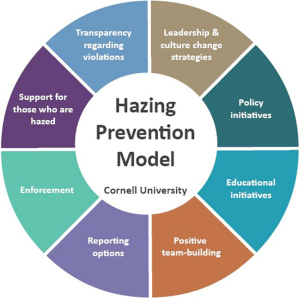
Skorton Center for Health Initiatives: Provides institutional leadership on hazing prevention strategies (e.g., Cornell's Hazing Prevention Model), delivers prevention focused educational trainings to students and employees on hazing, bystander intervention and how to recognize and respond to hazing, collaborates with SCL Communications team to curate the University hazing website (hazing.cornell.edu), collaboratively implements communication strategies and campaigns about hazing prevention, conducts research on students’ knowledge, attitudes, and behaviors related to hazing among Cornell students, uses data driven-strategies to address hazing, and participates in public engagement and collaborative opportunities with national hazing prevention organizations and universities across the country to address hazing. The Skorton Center also collaborates with Athletics to provide educational trainings on hazing and bystander intervention education (e.g., Intervene, How to Recognize and Respond to Hazing) as requested.

Student and Campus Life Communications: Coordinate with colleagues in the Skorton Center around timely and accurate communications (may include, but not limited to: website posts, community messaging) of hazing related incidents.

Cornell Clery Compliance Office: Responsible for conducting annual training for all identified Campus Security Authorities and including the campus hazing policy statement and Clery reportable statistics of hazing in the Annual Security Report.

  • Teamworks: Compliance and Recruiting (formerly ARMS)
  • Campus Kaizen Guardian
  • Canvas
  • Drupal website
  • Real Response
  1. Team and individual behaviors around identifying and responding to hazing behaviors and comprehension of training materials and available resources will vary per individual.
  2. Coaches’ knowledge, attitudes, and behaviors regarding hazing may vary per individual.
  3. Team captains’ knowledge, attitudes, and behaviors regarding hazing may vary per individual.
  4. Coaches are required to enforce participation of their athletes in one training per year, but the training is selected by the coach from a list of offerings and may not include hazing prevention and awareness training.
  5. If the team does not select hazing education, required education is limited to a baseline video and associated acknowledgement of hazing policy.
  6. Team and individual behaviors may be influenced based on the training focus and expectations set by their coach.
  7. Coaches may use discretion of when and where to address team and individual behaviors.
  8. Although student-athletes, upon being added to a roster, must attest to having received baseline education to be eligible, students may be added to rosters at any time and therefore may miss team and department education provided at specific points in time.
  9. The sport administrator is chosen by the Athletic Director and is subject to change.
  10. Investigations by OSCCS or Athletics may not result in identification of involved individuals. When this occurs, individual offenders are permitted to remain on campus and may repeat behavior.
  11. Collusion, resulting in inappropriate disclosure of information between those who have been hazed and perpetrators, may occur during the investigative process.
  12. Campus Kaizen Guardian allows for anonymous reporting (which is a best practice), but does not allow user-friendly, encrypted communication with individuals who desire ongoing communication and support.

Education/Prevention:

  1. Athlete submits Student Athlete Handbook and associated student-athlete rights and responsibilities attestation upon activation to roster and before participation.
  2. Athlete reviews and attests to receipt of baseline hazing specific education upon activation to roster and before participation.
  3. Athlete attends athletic orientation kick-off on the first night of classes during fall semester. Hazing materials are available at the resource fair.
  4. Athletes attend or review recordings of team meetings and receive and commit to team expectations (reviewed by sport administrator).
  5. Athletes attend other training(s) of their coach’s choosing each year (trainings range from conflict resolution, diversity, equity, and inclusion efforts, how to recognize and respond to hazing, Intervene, Friend 2 Friend, Cultivating Your Well-Being Toolkit, etc.).
  6. Athletes are enrolled in the Student Athlete Support Services Canvas course, which includes information directing students to University hazing prevention resources and messages.
  7. Sport Administrator and Coach, in consultation with Sr. Deputy AD for Student-Athlete Experience and Associate AD for Support, Development and Inclusion monitor team and individual behavior and provide resources as needed.


Adjudication:

  1. Intake report (Campus Kaizen Guardian, Ethics Hotline, or Real Response) is received by OSCCS and/or Athletics.
  2. Athletics, in consultation with the Office of Student Conduct and Community Standards (OSCCS) is responsible for investigating Varsity athletic team hazing reports, determining sanctions, and managing appropriate follow-up for team-based allegations. 
  3. Assessment and next steps determined by OSCCS, Athletics, and Involved Parties.
  4. Individual incident resolved through formal complaint, alternate dispute resolution or dismissed; Team incidents referred to Athletics
  5. Criminal behavior is reported to law enforcement for external proceedings, concurrently with campus sanctioning.


Accountability:

  1. Cornell sanctioning for individuals is managed by OSCCS.
  2. Cornell sanctioning for team conduct is managed by Athletics.
  3. Criminal behavior managed externally by law enforcement.
  4. Team violations are posted on Cornell University’s hazing.cornell.edu website by OSCCS in collaboration with Athletics and SCL Communications.
  5. Athletics sanctions to be determined based on investigation and in consultation with OSCCS, but could include:
    • Verbal and/or Written reprimand/warning, including probation
    • Harm Repairing Actions
    • Individual Reflection
    • Additional Training/Education
    • Suspension from practice or games (can differ for team vs individuals)
    • Suspension from all athletic privileges
    • Dismissal from team (individual)
    • Cancellation of season (team)

Key Risks

Key Controls

Some hazing education is provided at points in time (i.e., beginning of year team meetings, department-wide kick-off resource fair, team trainings, etc.) that may ultimately miss staff and student-athletes depending on when they join a team or the department.


.

  • The Skorton Center for Health Initiatives offers in-person and online trainings options for student athletes and coaching staff.
  • Intermittent communications/reminders are provided to the student-athlete population at agreed upon points throughout the academic year.
  • Upon being activated to a roster, all athletes are required to attest to having received baseline education on hazing as part of the eligibility process upon being activated to a roster.
  • All athletes are required to participate in one training per semester, which is chosen by each team. There is a gap when a team does not select hazing prevention.
  • Athletes attend or review recordings of team meetings and receive and commit to team expectations
  • Athletes living in on campus housing have access to educational opportunities in their residence halls. These hazing prevention educational opportunities may include poster campaigns and/or bulletin boards that the Skorton Center provides.


Coaches may not recognize hazing behavior and therefore, incidents may go unreported. Training is not consistently scheduled.

  • Coaches receive education provided by the Skorton Center. Efforts are underway for requiring hazing prevention education upon their hire and then annually.
  • Coaches follow reporting protocol and requirements as directed by Athletics.
  • In-person hazing education is required by all team captains. Additional planning is occurring to bring consistency and accountability to the requirement.

Anonymous two-way communication with the institution's reporting mechanism in Campus Kaizen Guardian has limited functionality.

  • Athletics manages an instance of Real Response to close the gap for communicating with anonymous reporters.

Collusion during an investigation

  • Contact information for identifiable or anonymous reporting is made available on the hazing website for reporting through the Campus Kaizen Guardian, Cornell Ethics and Compliance Hotline, Real Response or by phone call to the Athletics Department @255-8832, OSCCS 255-8460 or the University Ombudsman.

Loss of reputation to Athletic Team and/or loss of reputation to Cornell University

  • Violations are posted on Cornell University’s hazing.cornell.edu website.
  • Cornell’s Hazing Prevention Model is a visible commitment to addressing hazing and serves as a guiding framework for universities across the United States.
  • Athletics staff to track hazing prevention education completion against team rosters.
  • Athletics staff to track topic of educational programming selected by coach.
  • Athletics conducts end of season surveys in Real Response.
  • Office of Student Conduct and Community Standards track # of reported allegations with their outcomes for individuals.
  • Office of Student Conduct and Community Standards track violations for individuals and teams.
  • Office of Student Conduct and Community Standards collaborates with the University hazing website programmers to post team violations.
  • The Skorton Center for Health Initiatives administers surveys to assess students’ knowledge, attitudes, and behaviors related to hazing.
  • OSCCS: Office of Student Conduct and Community Standards
  • NCAA: National Collegiate Athletics Association

Between 2001 and 2015, Cornell University developed a comprehensive (i.e.  multi-component) public health hazing prevention model that addresses individuals, organizations, and the broader environment.  This model includes eight elements: leadership and culture change strategies; policy initiatives; educational initiatives; positive team building; reporting options; enforcement; support for victims; and transparency regarding violations.  For more information visit www.hazing.cornell.edu