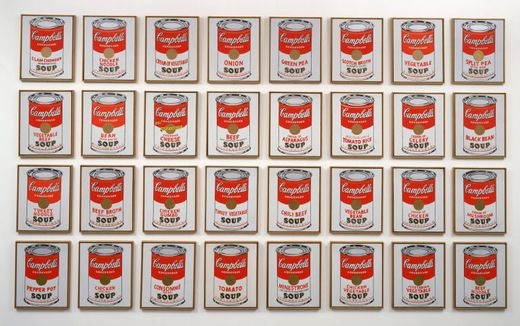
Andy Warhol, Campbell's Soup Cans, 1962, MoMA
Andy Warhol, Campbell's Soup Cans, 1962, MoMA
Link to short video clip about MoMA's Campbell's Soup Cans, 1962 by Andy Warhol http://www.moma.org/explore/multimedia/audios/57/1098
Andy Warhol's Factory model of the 1960s, 1970s and 1980s now has its counterpart in the work of Damien Hirst, Jeff, Koons and Takashi Murakami.
Of course, centuries earlier, painters such as Velasquez adopted factory models as well, hiring painters to work on his large scale history paintings.
Read Don Thompson's chapters on Hirst, Warhol and Koons as well as Sarah Thornton's chapter on Murakami to get a sense of how today's artists are
exploiting the so-called factory model. Choose one of these factory-style artists and comment on their particular marketing strategies and market appeal.
Robert Hughes's comments on Hirst may come back into play as you consider the slipping market share of this once coveted trend-setter. We will
examine Hirst's Beautiful Inside My Head Forever auction (Christie's, London, 2008) as an in depth case study in the last week of the course. Provide
links to articles, interviews with artists, and/or examples of particular factory produced works to support your post.
Don Thompson: ARTH 4696 FINLEY Damien Hirst and the Shark THOMPSON.pdf
Don Thompson: ARTH 4696 FINLEY Warhol Koons and Emin THOMPSON.pdf
Sarah Thornton: ARTH 4696 FINLEY The Studio Visit THORNTON.pdf
|
Vincent Anthony Falkiewicz For over a decade now people around the world have been appreciating the art of Japanese contemporary artist Takashi Murakami. His invented style "Superflat" has become renowned worldwide. He is represented by a couple dealers, one being the recently discussed Larry Gagosian. In 2008, he was the only visual artist to achieve Time Magazine's "Top 100 Most Influential People." His unique style and superior marketing strategies give him a market appeal unlike any other, as he is able to reach buyers and art appreciators on a whole new level. Not only has Murakami invented his own style, he runs his own art business called Kaikai Kiki Co. out of Japan and New York. This is where he separates himself as an artist, aside from just with his personal art. His business "is involved in what dealers call an "insane" range of activities (Thornton 185)." Due to this wide ride of activities, Murakami, his business, and his art are able to reach out to the art community in a way unlike most artists can. Aside from displaying Murakami's work, Kaikai Kiki Co. "makes art, designs merchandise, acts as a manager agent and producer for seven other Japanese artists...and it does multi-million dollar freelance work for fashion, TV, and music companies (Thornton 185)." The diversity of activity appeals to a wide range of people. This creates a market place where buyers are not only exposed to the work simply through galleries and art shows, they are also exposed to the art in all facets of the creative world. This marketing strategy really opens up his potential market, and enables him to reach an abnormal amount of art lovers, buyers, and simply citizens in general. oval buddha Takashi Murakami |
|
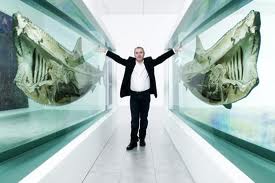
Erica Gilbert-Levin Damien Hirst is the wealthiest artist alive. He is also "more famous, and maybe even more powerful, than any living artist" (Thompson, 20). How did he achieve this status?
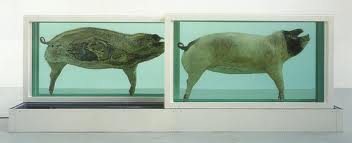
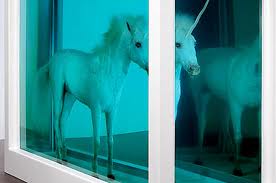
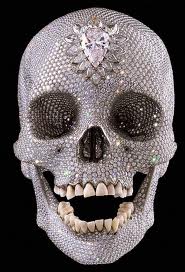
Hirst in his gallery, followed by several photos of his works: |
|
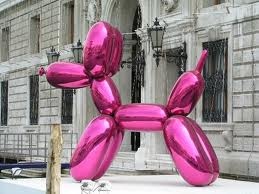
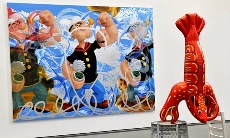
Kimberly Ann Phoenix Jeff Koons sees nothing wrong with the way his art is produced. He basically oversees the arts creations; he designs it and any where from 95 to 120 technicians sculpts or cast objects. In some of his early work common household object placed in water or mounted on lights to become art. He is unashamed of his work or the way it is produced comparing himself to the masters (Dannatt) or Andy Warhol. His marketing strategy could be larger then life. Many of his sculptures are large meant to be viewed in large spaces or out doors. http://supermarkart.blogspot.com/2010/03/jeff-koons-and-his-art-factory.htm http://www.npr.org/templates/story/story.php?storyId=92873040 http://nymag.com/nymetro/arts/art/reviews/9172/, stevens
http://en.wikipedia.org/wiki/Jeff_Koons This is a video of Jeff Koons talking about his facory: |
Consider & comment:
What did you think of today's readings and wiki features? What issues if any did they raise for you? How did the audio visual material provided support your understanding of this topic? Comment on your classmates' posts. Leave your comments in the box below.