After the failure of the second experiment in which distilled water was used, the team decided that calcium carbonates were probably not the source of the problem. It was thought instead that reaction kinetics were the limiting factor and that lime/water contact area needed to increase. The idea for the third experiment was to dramatically increase the volume of the lime in the reactor in order to provide more solid lime surface area. With the same flow rate as was used in experiment two (120 ml/min), 200 grams were added instead of 20, a ten-fold increase. In an effort to determine what the failure mode would be if lime were continually added without cleaning the reactor in between, the team decided to add an additional 200 grams whenever the effluent pH dropped below saturation. Because it seemed to perform better than the original, particularly with large amounts of lime, only the large reactor was used in order to save water.
The 200 grams lime were mixed with distilled water and stirred to form a slurry. This was fed through the vertical column. The flow rate was 120ml/min. All the other procedures were the same as described on materials and methods.
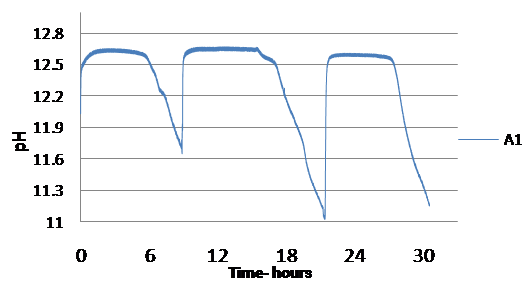
As can be seen from figure 1 below, the effluent pH remained at saturation for approximately six hours after lime was added each time. Because excess lime was not removed from the reactor before adding the next 200 grams, a total of 600 grams of lime had been added to the reactor by the beginning of the third segment seen in the graph. Despite the fact that the reactor was overloaded, it seemed to perform no better with the new addition of lime than it did with the first, when there was far less solid lime in suspension. This suggests that only the "new" lime is effective in saturating the effluent.
Possible failure modes could be:
Fig 1. Experiment 3
This experiment used only the large reactor to test overloading the apparatus with lime, adding 200 grams of lime initially and whenever the pH dropped.