The purpose of this research subteam is to develop a sustainable backwash system for granular filtration, which will be incorporated into the AguaClara water treatment process. The backwash system must meet the following requirements:
h5. Basic Operation
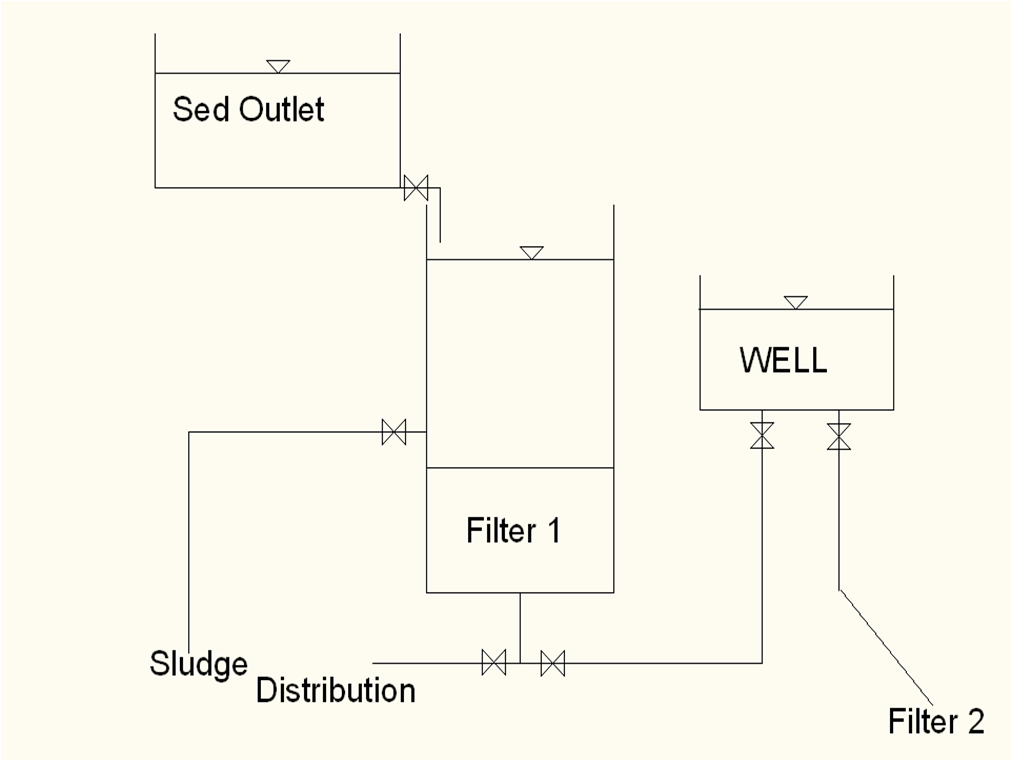
Our Clear Well Backwash system is completely gravity-driven. Our entire filtration system will consist of two granular filter beds, one clear well, an outlet for effluent water for distribution, an outlet for dirt particles removed from water, and a system of valves to control the flow of water between the above mentioned different components shown in Figure 1. (Your visual describes the system but could be improved.) In the AguaClara water treatment plant, the filtration system will be the final treatment process after the sedimentation tanks. During regular filtration operations, effluent from the sedimentation tank will flow through the filter which is set at a lower elevation than the sedimentation tank. The filter media is a rapid sand filter composed of a bed of anthracite coal, sand, and gravel entrapping colloid sized particles through a variety of mechanisms in the pore space. The effectiveness of the filter will be determinate in the final clarity of the water that is sent to the distribution system.
h5. Clear Well Operation
For filtered water to accumulate in the clear well, effluent water from the filter bed is diverted to the clear well by closing the valve leading to the distribution system and opening the valve leading to the clear well leading to the accumulation of water in the clear well after filtration. The water level in the filter will eventually rise until the elevation of water in the clear well is sufficient for backwashing. Consequently, one of the tests of feasibility is to determine the elevation differences between the sedimentation tank, clear well, and the granular filter for backwashing to be effective. An outrageously large difference would make this system unfeasible. (Expand slightly. What is an outrageous difference and why would it make the system unfeasible) When the clear well is filled to the proper elevation, the valve leading to the clear well will be closed off.
h5. Backwash Operation
When the filter becomes clogged with dirt and needs to be cleaned, the plant operator will shut off the flow entering the filter and allow the remaining water drain out. Next, the clear well valve is opened and the backwash water from the clear well will backwash the filter bed. This water fluidizes sand particles in the filter, loosening the dirt particles caught in the sand carries away the dirt particles into the backwash pipe. The backwash pipe will be at such an elevation so that the larger and heavier sand particles will remain in the sand filter. The sand bed will expand around 30% for optimal cleaning. Once finished, the operator will close the backwash valve and begin filtration again or recharge the clear well.
Our attempt to validate our clear well design consisted of three stages: 1) review of existing filtration/backwash technology and research, 2) development of a MATHCAD file that can generate backwash and filtration design parameters for both an actual AguaClara plant and a bench-scale or pilot plant model of the plant for testing and 3) experiments of bench-scale or pilot plant model to confirm design success.
During the first stage, we conducted a literature and online review of existing filtration technology and research. We determined the flow rate needed to sufficiently expand and clean the sand filter bed. This will help us determine how high the clear well needs to be above the filter, how large the flow pipes should be, and how much water should be in the clear well.
Research of Existing Work.
Important parameters for the final design of the filtration and backwash system for an actual AguaClara plant and for bench-scale or pilot plant-scale testing are in the following MATHCAD file.
MATHCAD File and description.
The accuracy of our MATHCAD generated design parameters is based upon empirical fluidization velocity equations. We developed a bench-scale model of our filtration system and conducted an experiment measuring the expansion of a filter bed as backwash velocity is varied. We then compared the empirically calculated fluidization velocities with the actual fluidization velocities required.
Fluidization Velocity Experiment.
We had mixed results with regards to Weber's equation for filter bed expansion. At low levels of filter bed expansion, the Weber equation accurately predicted the fluidization velocity required to achieve the targeted bed expansion. As the target bed expansion increased, so did the degree of error. At 9% expansion, the degree of error was at 14%. At 38% expansion, the degree of error was at 37%.
We believe the following to be sources of error:
Future Research should be devoted to the following objectives: