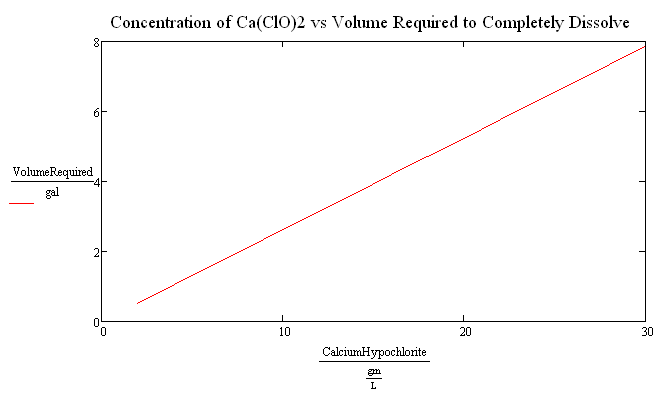
Figure 1. Volume of water required to dissolve a specific concentration of Ca(ClO)2 into solution.
Recommendations for Honduran Communities that are Experiencing Flow Restriction Problems in the Chlorine Feed System
1) Safety: I understand that priorities are different in the Honduran culture, and safety is not always the number one issue, but I think as a whole the number one thing that we could pass along to Honduran communities is education about health and safety. This would not be limited to the health advantages of safe drinking water, but also comprise of the advantages of working together to meet these public needs in a safe and compassionate way. Aguaclara should be very active in encouraging that operators take steps to protect themselves when dealing with chemicals like aluminum sulfate and especially calcium hypochlorite. This would include always wearing rubber gloves and being in a very well ventilated area when mixing the chemicals and performing the mixing in short intervals so as to not be exposed to the chemical for long periods of time. It may even go as far as encouraging the use of some type of breathing apparatus.
2) Initial Settling and Filtration: The fist action that all communities that are having a flow controller device(FCD) restriction of flow problem should be to mix the calcium hypochlorite(Ca(ClO)3 solution in a container that has a volume great enough to dissolve all Ca(ClO)3 into solution, which can be determined from Figure 1 or from the attached Mathcad program on the Aguaclara wiki titled Volume of Water Required to Completely Dissolve a Concentration of Ca(ClO)2.
Figure 1. Volume of water required to dissolve a specific concentration of Ca(ClO)2 into solution.
Calcium hypochlorite has a solubility of 210 grams per liter. For most communities a 5 gallon drum will be sufficient, but as a rule of thumb I think I would be appropriate to implement the policy that states; if your having a precipitation problem, then the initial settling in a separate container, should be split into two containers if a the container being used is a 5 gallon bucket. The total weight of Ca(ClO)2 needed for the 55 gallon drum is split in two and placed into two separate 5 gallon buckets and then mixed with water.
The containers of Ca(ClO)3 should be produced 2-3 days before they are to be added to the chlorine solution stock tank in order to ensure that the precipitation and settling of calcium carbonate(CaCO3) is complete. The entire amount of CaCO3 does not settle to the bottom. Portions of it float to the top and float in flocs that are suspended within the solution. To deal with this occurrence it is recommended that the supernatant of solution suspended above the settled out precipitant be filtered out by pouring the supernatant through two layers of cloth folded over each other, when pouring the solution into the chlorine stock tank. A cotton tee-shirt will suffice for the cloth.
3) Float Valve Modification: To prevent further precipitant from forming
around the orifice and restricting flow, it is recommended that communities that are having a problem with precipitation remove the float valve from the constant head bottle and flip it from a position pointing downward and can be observed in Figure 2, to a position pointing upward as can be observed in Figure 3. This task involves someone to loosen the nut on the float valve arm and rotate the float upwards. The float should be lifted up high enough so that the solution level in the constant head bottle is above the orifice height that allows solution to pour into the bottle. It may require a few instances of guess and check to meet this height. Some of the floats being used for Aguaclara look different than the float located in Figures 2 and 3. The same procedure applies to any shaped float.
4) Chlorine Stock Tank Modification: Realistically there is going to be impossible to settle and filter out all of the precipitation that forms as a result of using Ca(ClO)3 as a source of chlorine. If all the solution was to be settled out, more will form as the solution comes into contact with carbon dioxide and other chemical species found in surface and ground waters. To deal with this it is recommended that communities raise the level of the bulkhead solution located at the bottom of the chlorine stock tank to at a minimum of 6 cm above the bottom of the tank. This would keep the level of the bulkhead above the level of the CaCO3 that has precipitated and settled out to the bottom of the tank as can be observed in Figure 4. It would also be recommended that plant operators wash out the bottom of the chlorine stock tanks on a regular basis.
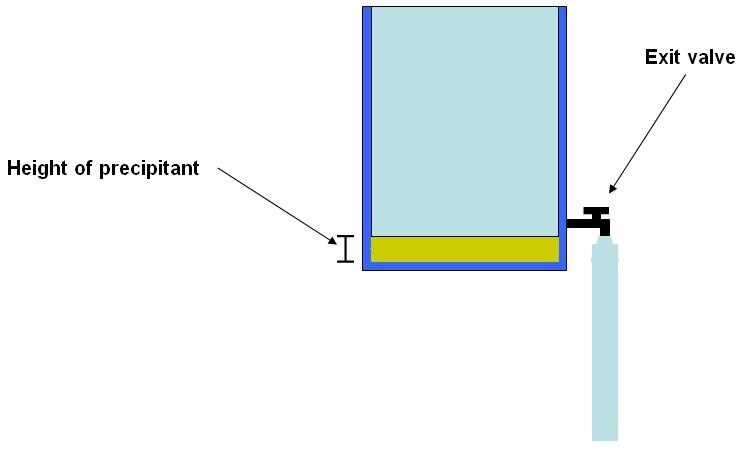
Figure 4. Chlorine stock tank with a bulkhead(out flow valve) located a safe distance above any percipitatioin that would form with a maximum Ca(ClO)2 concentration of 30 g/L.