*** This version of Confluence is for testing only and contains a copy of content from June 29th 2026. No changes will be preserved. ***

Date Created: January 16, 2024 Last Updated: July 2June 9, 20242026
Overview:
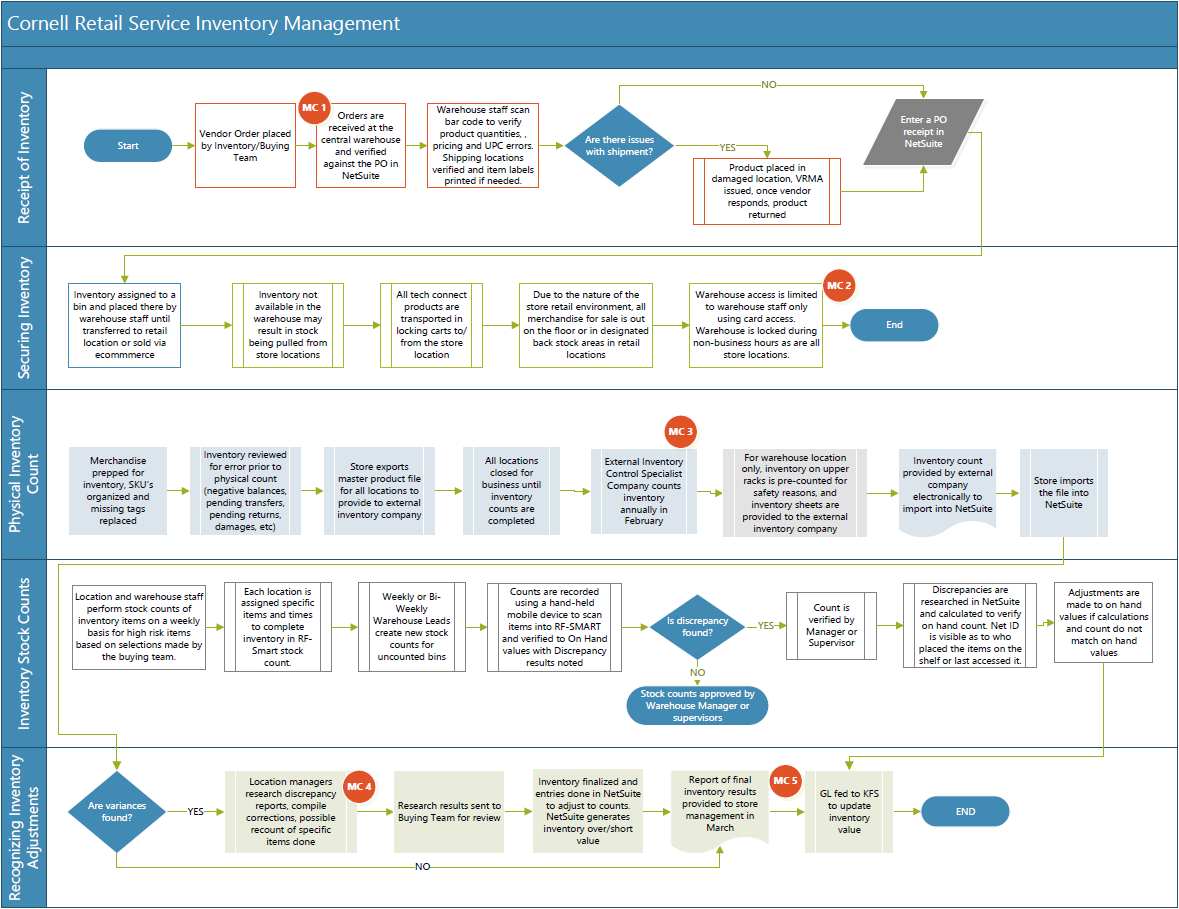
Cornell Retail Services maintains a significant inventory in their warehouse and in each store location. Inventory is tracked in NetSuite and updated as items are sold. Cycle counts are performed regularly, and an annual inventory count is completed each fiscal year. Additional processes and controls for ordering, storage, and access are in place to protect inventory and to prevent opportunities for fraud or theft.
Criticality: High | Frequency: Other | Turnaround: Other |
| Expand | ||
|---|---|---|
|
Buying Team: Responsible for placing orders, monitoring inventory levels and reviewing any pricing or delivery discrepancies. Buying team also updates SharePoint documents to identify inventory items for cycle counts and validates the final physical inventory counts. Warehouse Leads: Create Stock Counts based on bins. A spreadsheet tracking bins counted and uncounted is in SharePoint. Warehouse Team: |
Receives product at the warehouse, verifies item counts and pricing on orders. Identifies items for return to vendors (damaged, wrong item, etc.) and manages the return process. Assigns inventory to specific bins and manages transfer of inventory to store locations. Ensures inventory security at the warehouse and conducts assigned cycle counts in the warehouse regularly |
. Warehouse Manager: Approves stock counts and stock count recounts. Store Location Staff: Assist in completing inventory cycle counts and annual physical inventory. Monitors inventory on the sales floor. Inventory Associate: Responsible for processing inventory adjustments for the store locations. NetSuite System Analyst: Responsible for reviewing and exporting file to provide to the inventory service provider and importing inventory results for inventory service provider into NetSuite. Security Coordinator: Reviews security protocols and monitors inventory in the main store and the Commons’ locations through surveillance camera footage. Inventory Service Provider: Complete annual physical inventory and provides reporting to store management to review and adjust inventory balances if needed. Financial Transaction Center ( |
FTC): Responsible for processing vendor invoices and credits timely and recording inventory adjustment entries. |
| Expand | ||
|---|---|---|
|
|
|
| Expand | ||
|---|---|---|
|
|
| Expand | ||
|---|---|---|
|
|
| Expand | ||
|---|---|---|
|
Ordering Product:
|
|
|
|
|
Inventory |
Stock Counts: |
|
|
|
|
|
|
|
|
|
|
Annual Physical Inventory Count:
Key Risks | Key Controls |
Risk of the same individual ordering and receiving product, allowing opportunity for fraud | 1. Ordering and receiving processes are segregated to two different teams in the Cornell Store (Buying Team and Warehouse Team). 2. Unit trains staff on proper procedures for purchasing in accordance with the Buying Guide and university policy. 3. Unit ensures that the intended purchase is an allowable business expense for which University funds may be expended. |
Conflict of Interest (COI), when staff is working closely with vendors, there are some inherent risks. There is a risk that staff does not self-disclose relationship with vendor. There is a risk that once the risk is disclosed that a unit does not follow up with staff to investigate the COI further. | 1. Unit trains staff on COI and self-disclosure; unit manages and investigates COI in accordance with University Policy 4.14, Conflicts of Interest and Commitment (Excluding Financial Conflict of Interest Related to Research): vol4_14.pdf (cornell.edu). 2. Annual certification and ethics training is required in the MOU for delegated spend. |
Risk of individuals having too much control in the inventory process. | 1. Buying Team determines items to be counted for cycle counts. 2. Inventory Associate processes inventory adjustments when necessary. |
Risk of inventory misappropriation | 3. Inventory cycle counts are done weekly and compared to on hand values in NetSuite to monitor items that are at risk. 4. External inventory company counts inventory on an annual basis. 5. Building Security Coordinator monitors surveillance cameras in main store and Commons location. Ware Warehouse manager monitors surveillance cameras at the warehouse location. |
Value of inventory could be incorrect due to costing entry errors | 1. Buying Team and Financial Manager reviews inventory adjustments together monthly. 2. FTC monitors the value of inventory versus the amount within the stock register monthly. 3. FTC completes monthly reconciliation that compares item receivers completed by warehouse staff to bills processed for any value differences. 4. When the invoice for received goods is entered, all the items, quantities and prices are again compared to the PO – not the receiver. If anyone changed the PO – especially the price – since the goods were received, the amount that gets invoiced will not match the entry for the goods that were received. This leaves a reconciling item that needs to be fixed for every PO. The FTC staff would then follow-up with the Buying Team on difference. |
Returns may not be processed timely for credit | 1. Warehouse identifies items to be returned and creates a VRMA in NetSuite to track. 2. Items are moved to a specific location in the warehouse designated for vendor returns. 3. The buying team packages the return, and the FTC processes the bill credit in NetSuite. |
Annual Physical Inventory Count:
|
| Expand | ||
|---|---|---|
| ||
|
Key Risks
|
|
|
|
|
|
|
|
|
|
|
|
|
|
|
|
|
|
|
|
|
|
|
|
|
|
| Expand | ||
|---|---|---|
|
Cornell Finance Staff
|
| Expand | ||
|---|---|---|
|
|
|
| Expand | ||||||||||||||||||||||||||||||||||||||||||||||||||||||||||||||
|---|---|---|---|---|---|---|---|---|---|---|---|---|---|---|---|---|---|---|---|---|---|---|---|---|---|---|---|---|---|---|---|---|---|---|---|---|---|---|---|---|---|---|---|---|---|---|---|---|---|---|---|---|---|---|---|---|---|---|---|---|---|---|
| ||||||||||||||||||||||||||||||||||||||||||||||||||||||||||||||
|
