*** This version of Confluence is for testing only and contains a copy of content from June 29th 2026. No changes will be preserved. ***

...
...
Definition of Weir : A type of small overflow dam that can be used for flow measurement. The Linear Flow Orifice Meter is a mimic of this weir.
Definition of Sutro Weir : The discharge (flow) through the weir is proportional to the head (water depth above a reference plane located at one third of the depths of the crest of the base weir).
Development : The linear-proportional weir was developed by Stout in 1897 and was theoretically based, the design stipulated the width at the base as infinite. In 1908 Sutro modified the design to create a practical linear-proportional weir. The weir has a rectangular base and the flow through the weir is proportional to the height of the water through the curved portion of the weir plus
| Latex |
|---|
Research h2. Introduction *Definition of Weir* : A type of small overflow dam that can be used for flow measurement. The Linear Flow Orifice Meter is a mimic of a weir. *Definition of Sutro Weir* : The dicharge (flow) through the weir is proportional to the head (water depth above a reference plane located at one third of the depths of the crest of the base weir). *Development* : The linear-proportional weir was developed by Stout in 1897 and was theoretically based, the design stipulated the width at the base as infinite. In 1908 Sutro modified the design to create a practical linear-proportional weir, known as the sutro weir. The sutro wier has a rectangular base and the flow through the wier is proportional to the height of the water through the curved portion of the weir plus {latex} $$ 2\over 3 $$ {latex} |
of
...
the
...
height
...
of
...
the
...
rectangular
...
base
...
ie.
...
| Latex |
|---|
...
$$ Q = c [h + {2 \over 3} s] $$ |
...
...
...
...
...
...
...
...
...
...
...
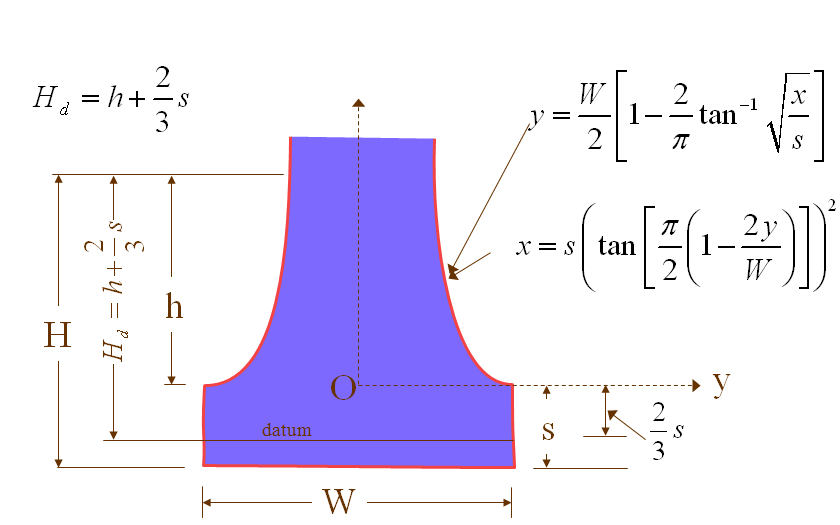
Figure 1: Sutro weir with constraining equations.
W = base of rectangular weir
s = height of rectangular weir
h = weir height above rectangular weir
c = constant of proportionality
| Latex |
|---|
[website|http://nptel.iitm.ac.in/courses/Webcourse-contents/IIT-MADRAS/Hydr/pdfs/Unit14/proportional-weir.pdf] !Sutro Weir Picture.bmp||width=300,height=250! Figure 1: Sutro weir with constraining equations. * Note: The rectangular base is present in the design merely to simplify evaluation and analysis. Flow proportional to water height begins above the rectangular weir. h5. Variables W = base of rectangular weir s = height of rectangular weir h = wier hight above rectangular weir c = constant of proportionality {latex} $$ C_d $$ {latex} |
=
...
coefficient
...
of
...
discharge,
...
ranges
...
from
...
0.0597
...
to
...
0.619
| Latex |
|---|
} $$ q_w $$ {latex} |
=
...
Flow
...
through
...
rectangular
...
weir
| Latex |
|---|
} $$ q_u $$ {latex} |
=
...
Flow
...
through
...
upper
...
portion
...
of
...
weir,Important
...
Parameter
...
Q
...
=
...
Total
...
Discharge
| Latex |
|---|
} $$ C_0 $$ {latex} = Proportionality constant, average value is |
= vena contracta area ratio, average value is 0.62
...
g = acceleration due to gravity
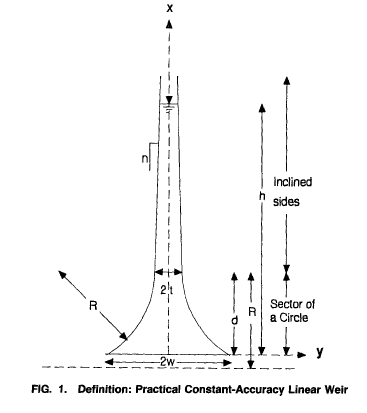
The paper explores a different weir design that also results a discharge that is proportional to the depths of head. The design has two parts, one is the outside edge of part of a circle and the rest of the weir is a sloped straight line. The redesign was tested because the changes would make construction easier. The results showed a high level of accuracy, +/- 1% in the head range 0.5R <= h <= 7.9R (R is the radius of sector of circle, the coefficient of discharge was experimentally shown to be 0.619. Figure 1 is a visual representation of the design.
Note sources 2 and 3 were found through the ASCE research library at http://scitation.aip.org/hyo/