*** This version of Confluence is for testing only and contains a copy of content from June 29th 2026. No changes will be preserved. ***

...
The Fall '09 ANC Control team had worked on the development of a lime feeder for hydrated lime. Including constraints such as non-electricity use, low cost and replicable design; the team had founded found some important parameters.
1. It is possible to assimilate assume the particles behavior particle behaviors in the lime feeder are similar to the behavior of flocs into from the plate settlers of the sedimentation tank. A description of the theory is detailed in Experiment 3.
2. The main variables to consider in the lime feeder operation are the upflow velocity, the lime quality and the water composition.
3. The required lime needs to have be very fine particles to avoid clogs in the apparatus clog caused by big large lime chunks.
4. It is required a water with The water must have a low presence of carbonate system, to facilitate the dissolution of lime and induce a pH change.
Despite this these findings more research is required in order to confirm the theories and to find the an explanation for some variables that are not enough clear yet.
...
The following are proposed challenges for the next team:
1. Determine the optimal lime particles particle size and an easy way to reach itseparate it from the rest of the lime.
2. Determine the optima optimal upflow velocity which will maintain the suspension bed for the required particle size.
3. Compare different chemical compositions or commercial lime, especially those available in Honduras, and evaluate the apparatus behavior with them.
...
For the current experiment, the Fall '09 ANC Control team changed the variables and made runs to compare the behavior. However there was not enough time and there is just one trial for every combination of variables combination. It is suggested to that the next team run more trials conserving the design but changing the variables. In this way it is possible to confirm the theory and scale up to the design for the actual water treatment plant in Honduras.
The first experiment required is should be finding the optimal upflow velocity. It is required to sieve the lime and use fine particles, with the sieve diameter is possible to calculate the lime particles size. The lime Using a sieve, the lime particles can be filtered so that there are only uniform fine particles. The lime then has to be dissolved in enough water before go going into the apparatus. Start Starting with low upflow velocities and figure out visually is all lime is in suspension through the apparatus, lime bed suspension can be seen visually and then noted. In addition, take the pH measures can be measured and compare compared the pH entire duration (at 12 units). Is It is necessary to leave the lime settle settled down or to replace it before making a new experiment with different upflow velocities.
...
• A specific commercial lime composition + tap water.
• A specific commercial lime composition + distilled water.
Is suggested Another path to pursue is to change the apparatus and use tubes with big a bigger diameter, that will allow to increase the allowing for the increase of upflow velocity and to experiment with a higher amount of lime, making easy for . This would also let the water to flow in the vertical direction and avoiding avoid the fast expulsion of lime.
2. Change of apparatus design:
Another option is to develop a complete completely new design. As a suggestion, there is a lime feeder design described in the book "Surface Water Treatment for Communities in Developing Countries" by Schultz and Okun, 1992. According with to the authors, this apparatus was used in a water treatment plant in Brazil. The design doesn't involves electricity does not involve electricity, just hydraulic considerations.
Figure 1. Brazilian design
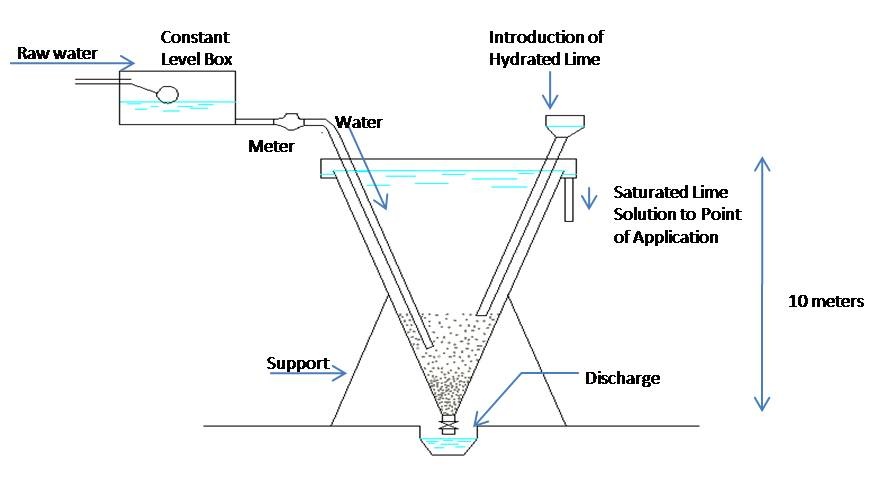
Figure created by ChengFeng Wu, based on the referenced book