*** This version of Confluence is for testing only and contains a copy of content from June 29th 2026. No changes will be preserved. ***

...
The test was run for two different tube lengths, 1 m and 44.5 cm. The test was run at many different flow rates from head loss of 3 cm to 25 cm. The plants in Honduras use, at the most, a head loss of 20 cm. The testing of up to 25 cm head loss allowed for an analysis of even higher flow rates, in case there was little to no deviation at the lower flow rates<<<<intert image here. Use a line, no grey back ground, and change legend labels>
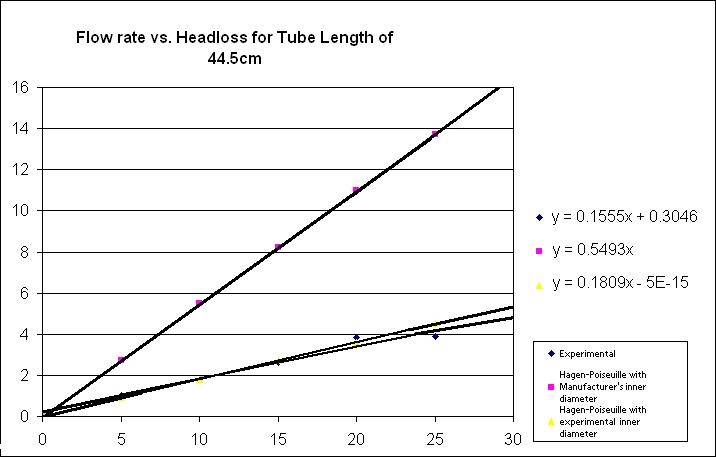
Figure 1: Flow rate vs. Headloss for 44.5 cm Tube
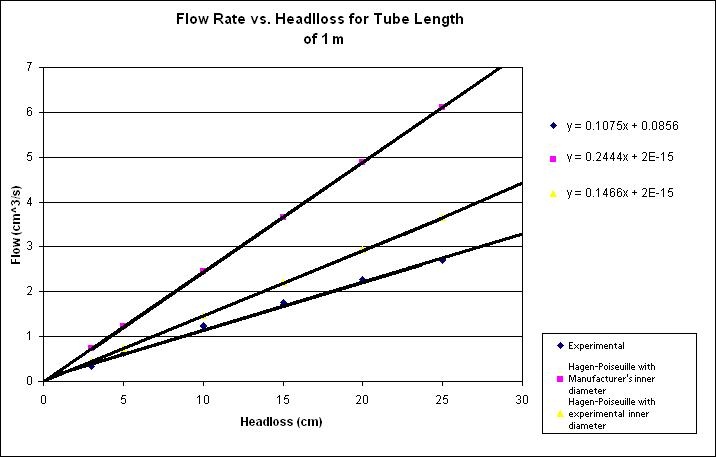
Figure 2: Flow rate vs. Headloss for 1 m Tube
The head losses were taken from the experiment such that one hole below the base hole was only 1 cm of head loss. The length of the tubes, 44.5 cm and 1 m, were measured. The inner diameter was 1/8 in as given by the manufacturer for the experimental. The correction was applied to this diameter.
As can be noted from the graphs, calculated flow rates was consistently lower than the estimated low rate using the Hagen-Poiseuille equation. However, once the correction was added to the diameter of the tubing in the equation, the data matched much better.
...
This experiment confirmed that the Hagen-Poiseuille equation overestimated the actual flow rate and thus was providing an inaccurate estimate. However, the extent of this over estimation was previously difficult to determine. However, what is most interesting is the validity of the tubing inner diameter correction. Using the values calculated from the experiments regarding the tube diameter provided a drastic improvement which makes the equation a better model. Also, because the inner diameter of the tube was 1/8th of an inch, small variation in inner diameter produce large changes in terms of particle movement within the tube and thus head loss and the Hagen-Poiseuille equation. Getting a more accurate image of the inside of the tube allows for the equation to operate more predicatively. Varying tube diameters should be tested to find if these minor inner diameter variations are negligible at larger diameters. Varying tube lengths should be tested to consider the possibility of non-negligible minor head losses.