| HTML |
|---|
<div style="background-color: yellow; border: 2px solid red; margin: 4px; padding: 2px; font-weight: bold; text-align: center;">
This page has been moved to <a href="https://courses.ansys.com/index.php/courses/turbulent-pipe-flow-rans/">https://courses.ansys.com/index.php/courses/turbulent-pipe-flow-rans/</a>
<br>
Click in the link above if you are not automatically redirected in 10 seconds.
</div>
<meta http-equiv="refresh" content="10; URL='https://courses.ansys.com/index.php/courses/turbulent-pipe-flow-rans/'" />
|
| Include Page |
|---|
| FLUENT Google Analytics |
|---|
| FLUENT Google Analytics |
|---|
|
| Include Page |
|---|
| Turbulent Pipe Flow - Panel |
|---|
| Turbulent Pipe Flow - Panel |
|---|
|
Turbulent Pipe Flow
Created using ANSYS 13.0
| Note |
|---|
This tutorial has videos. If you are in a computer lab, make sure to have head phones. |
Problem Specification
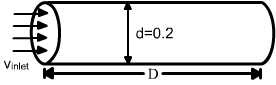
Let's revisit the pipe flow example considered in the previous exercise. As before, the inlet velocity is 1 m/s, the fluid exhausts into the ambient atmosphere and density is 1 kg/m3. For µ = 2 x 10 -5 kg/(ms), the Reynolds no. based on the pipe diameter and average velocity at the inlet is
| Latex |
|---|
| Wiki Markup |
|---|
{latex}
\large
$$
{Re} = {\rho VD \over \mu} = 10,000
$$
{latex} |
This change of viscosity has taken us from a Reynolds number of 100 to 10,000. At this Reynolds number, the flow is usually completely turbulent.
...
 Sign-up for free online course on ANSYS simulations!