 Sign-up for free online course on ANSYS simulations!
| HTML |
|---|
<div style="background-color: yellow; border: 2px solid red; margin: 4px; padding: 2px; font-weight: bold; text-align: center;">
This page has been moved to <a href="https://courses.ansys.com/index.php/courses/turbulent-pipe-flow-rans/">https://courses.ansys.com/index.php/courses/turbulent-pipe-flow-rans/</a>
<br>
Click in the link above if you are not automatically redirected in 10 seconds.
</div>
<meta http-equiv="refresh" content="10; URL='https://courses.ansys.com/index.php/courses/turbulent-pipe-flow-rans/'" />
|
| Include Page | ||||
|---|---|---|---|---|
|
| Include Page | ||||
|---|---|---|---|---|
|
Turbulent Pipe Flow
Created using ANSYS 13.0
| Note |
|---|
This tutorial has videos. If you are in a computer lab, make sure to have head phones. |
Problem Specification
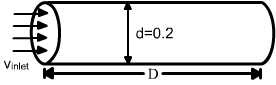
Let's revisit the pipe flow example considered in the previous exercise. As before, the inlet velocity is 1 m/s, the fluid exhausts into the ambient atmosphere and density is 1 kg/m3. For µ = 2 x 10 -5 kg/(ms), the Reynolds no. based on the pipe diameter and average velocity at the inlet is
| Latex |
|---|
| Wiki Markup |
{include: FLUENT Google Analytics} {include: Turbulent Pipe Flow - Panel} h1. Turbulent Pipe Flow Created using ANSYS 13.0 h2. Problem Specification !Fluent_pipeflow.jpg! Let's revisit the pipe flow example considered in the previous exercise. As before, the inlet velocity is 1 m/s, the fluid exhausts into the ambient atmosphere and density is 1 _kg/m{_}{_}{^}3{^}_. For µ = 2 x 10 ^\-5^ _kg/(ms_), the Reynolds no. based on the pipe diameter and average velocity at the inlet is {latex} \large $$ {Re} = {\rho VD \over \mu} = 10,000 $$ {latex} |
This
...
change
...
of
...
viscosity
...
has
...
taken
...
us
...
from
...
a
...
Reynolds
...
number
...
of
...
100
...
to
...
10,000.
...
At
...
this
...
Reynolds
...
number,
...
the
...
flow
...
is
...
usually
...
completely
...
turbulent.
...
We'll
...
solve
...
this
...
problem
...
numerically
...
using
...
ANSYS
...
FLUENT.
...
Among
...
the
...
results
...
we'll
...
look
...
at
...
are
...
centerline
...
velocity,
...
skin
...
friction
...
coefficient
...
and
...
the
...
axial
...
velocity
...
profile
...
at
...
the
...
outlet.
...
...
...
...
...