A Differential relates the angular positions and forces of three gears on a common axis of rotation. They are commonly used in car steering systems to make sure that when a car rounds a corner, the inside wheel spins less than the outside wheel. In our erg, we use the differential to split an input force from the handle to the two output forces that act on flywheel and the tires.
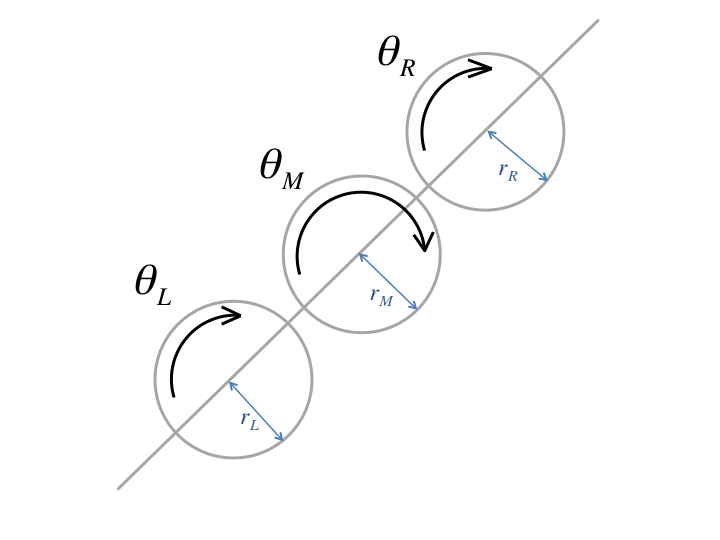
Subscripts
| Wiki Markup |
|---|
| Latex |
|---|
{latex} \large L, R, M{latex} |
correspond the left half-shaft, right half-shaft, and middle gear, respectively.Three observations:
...
The results can be summarized as such:
| Latex |
|---|
| Wiki Markup |
|---|
{latex}
\large\begin{align*}
\theta_{\text{M}} = \frac{1}{2}\theta_{\text{L}} + \frac{1}{2}\theta_{\text{R}}
\end{align*}
{latex} |
where
| Wiki Markup |
|---|
| Latex |
|---|
{latex} \large $\theta$ {latex} |
represents angular position. In other words, the
position of the middle gear is half the sum of the left and right gears. Say that
| Wiki Markup |
|---|
| Latex |
|---|
{latex} \large $\omega$ {latex} |
represents angular velocity,
| Wiki Markup |
|---|
| Latex |
|---|
{latex} \large $\alpha${latex} |
represents angular acceleration, and
| Wiki Markup |
|---|
| Latex |
|---|
{latex} \large $\tau$ {latex} |
represents torque.
| Wiki Markup |
|---|
| Latex |
|---|
{latex} \large $r$ {latex} |
is the radius of the gear, and
| Wiki Markup |
|---|
| Latex |
|---|
{latex} \large $v$ {latex} |
is the linear velocity at the edge of a gear. From the first equation, we can find the relationships between the angular and linear velocities of the gears.
| Latex |
|---|
| Wiki Markup |
|---|
{latex}
\large

\begin{align*}
\omega_{\text{M}} =& \frac{1}{2} \left( \omega_{\text{L}} + \omega_{\text{R}} \right)
\\
\omega_{\text{M}} r_{\text{M}} =& \frac{1}{2} ( \omega_{\text{L}} r_{\text{M}} +
\omega_{\text{R}} r_{\text{M}})
\\
v_{\text{M}} =& \frac{1}{2} \left( \omega_{\text{L}} r_{\text{M}} \frac{r_{\text{L}}}{r_{\text{L}}} +
\omega_{\text{R}} r_{\text{M}} \frac{r_{\text{R}}}{r_{\text{R}}} \right)
\\
v_{\text{M}} =& \frac{1}{2} \left( v_{\text{L}} \frac{r_{\text{M}}}{r_{\text{L}}} +
v_{\text{R}} \frac{r_{\text{M}}}{r_{\text{R}}} \right)
\end{align*}
{latex} |
We assume that these ideal gears are frictionless and massless. Therefore, we can use conservation of energy to say that input power equals output power. Say
| Wiki Markup |
|---|
| Latex |
|---|
{latex} \large $P$ {latex} |
represents power as a function of time.
| Latex |
|---|
| Wiki Markup |
|---|
{latex}
\large
\begin{align*}
&P_{\text{M}} = P_{\text{L}} + P_{\text{R}} \\
&\tau_{\text{M}} \cdot \omega_{\text{M}} = \tau_{\text{L}} \cdot \omega_{\text{L}} +
\tau_{\text{R}} \cdot \omega_{\text{R}} \\
&\tau_{\text{M}} \cdot \left[ \frac{1}{2} \left( \omega_{\text{L}} + \omega_{\text{R}} \right) \right]
= \tau_{\text{L}} \cdot \omega_{\text{L}} +
\tau_{\text{R}} \cdot \omega_{\text{R}}
\end{align*}
{latex} |
If we consider
| Wiki Markup |
|---|
| Latex |
|---|
{latex}\large $\omega_{\text{L}}$ {latex} |
and
| Wiki Markup |
|---|
| Latex |
|---|
{latex} $\omega_{\text{R}}$ {latex} |
separately, we find that
| Latex |
|---|
| Wiki Markup |
|---|
{latex}
\large
\begin{align*}
\frac{1}{2} \tau_{\text{M}} \omega_{\text{L}} &= \tau_{\text{L}} \omega_{\text{L}}, \;\;\;
\frac{1}{2} \tau_{\text{M}} \omega_{\text{R}} = \tau_{\text{R}} \omega_{\text{R}}
\\
\frac{1}{2} \tau_{\text{M}} &= \tau_{\text{L}}, \;\;\;\;\;\;\; \;\; \; \;\; \frac{1}{2} \tau_{\text{M}} = \tau_{\text{R}}
\end{align*}
{latex} |
Therefore, we can conclude that the relationships between torques is the same as the relationships between angular position; a torque on the middle gear is evenly divided between the torque on the left gear and the torque on the right gear.
| Latex |
|---|
| Wiki Markup |
|---|
{latex}
\large
\begin{align*}
\tau_{\text{M}} &= \tau_{\text{L}} + \tau_{\text{R}} \\
\tau_{\text{L}} &= \tau_{\text{R}} = \frac{1}{2} \tau_{\text{M}}
\end{align*}
{latex} |
Prof Ruina's favorite video on how a differential works
...
