*** This version of Confluence is for testing only and contains a copy of content from June 29th 2026. No changes will be preserved. ***

...
According to the predictive flocculation model proposed by Swetland et. al., 2012, large flocs do not significantly contribute to turbidity removal -- only small colloids can collide effectively and aggregate to a size that will be removed by sedimentation. Based on the hypothesis that "large “large flocs are useless"useless”, a floc breakup procedure was devised. Results obtained using a coiled tube flocculator and flocculation residual turbidity analyzer (FReTA) shows that higher turbidity removal was achieved after breaking the flocs, comparing to results using the same method but without floc breakup. Therefore breaking flocs at regular intervals to maintain continuous growth will promote better performance of flocculation. This research finding provided a good reference for future hydraulic flocculator design.
...
Figure 2 demonstrates the comparative results of residual turbidity with floc breakup and without floc breakup. Obviously, the residual turbidity is lower after floc breakup device was installed. At the alum dose 4, 4.6 and 5.2 mg/L, the difference of residual turbidity between the 2 groups of data reaches 10 NTU. Both curve seems to fit into the logarithmic trend line. The results indicate that our hypothesis "large “large flocs are useless" useless” may be correct and offers insight into improving AguaClara's current flocculator design.
...
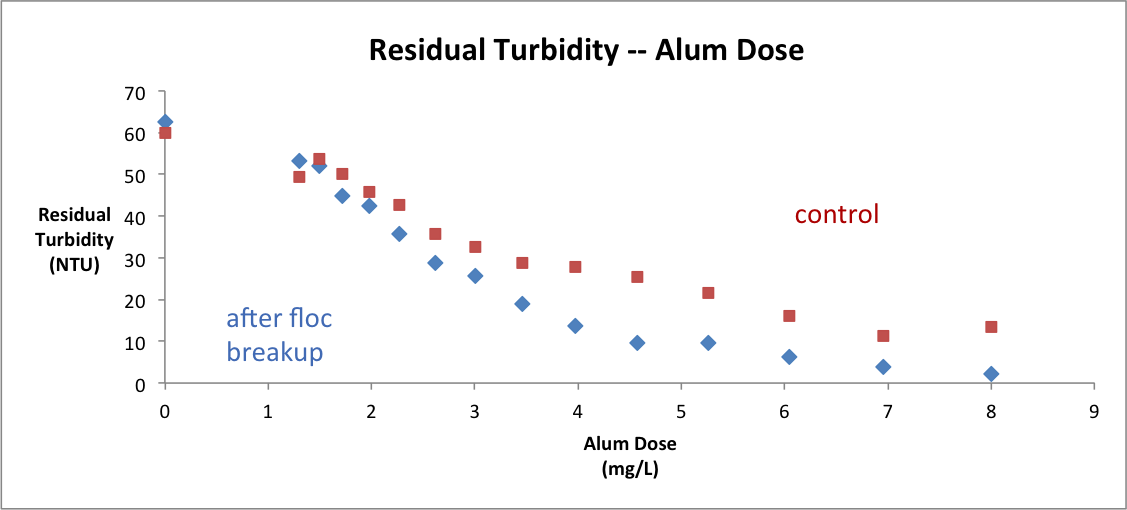 Figure 2 Comparative results of residual turbidity vs. alum dose
...
...
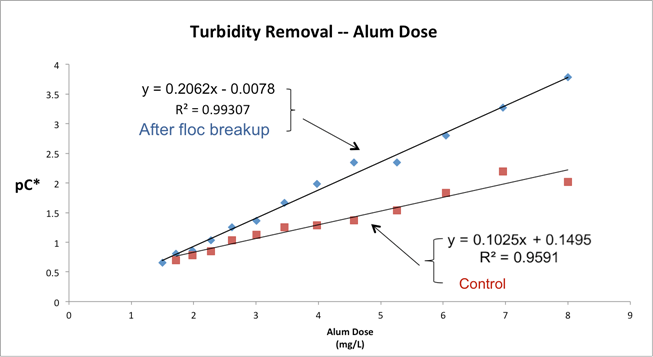
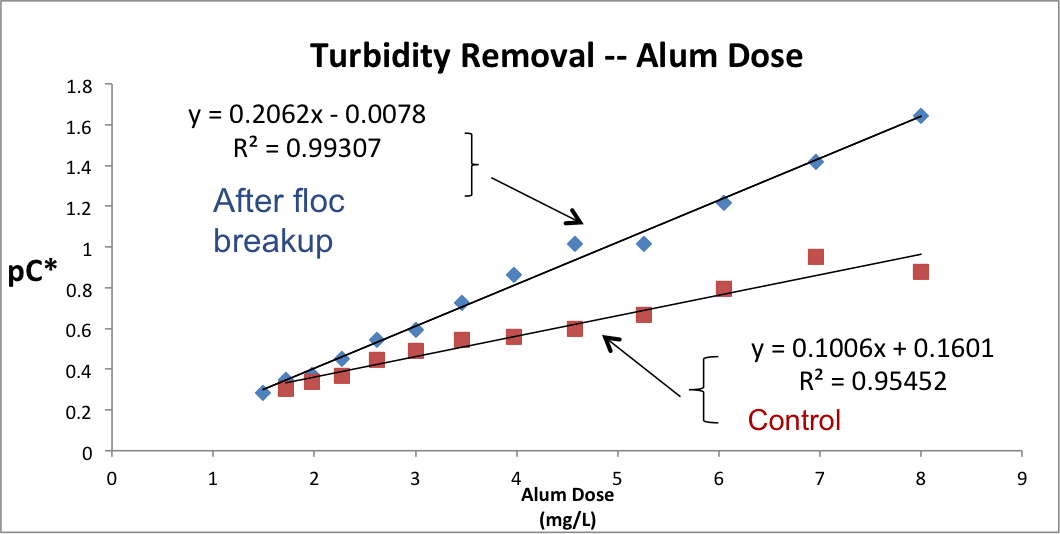
The Predictive model is supposed to be updated based on the experimental data after floc breakup device was installed. An approach to update existing model is to insert trend line to our existing experimental data and pick the best relationship for turbidity removal versus alum dose curve. Next we need to check how variables are changed after installation of floc breakup. Figure 3 indicates that the logarithmic type fits the data the best with a regression equation of y = 0.2062x -0.0078 and a relation coefficient of 0.9931.
...
(Note: 2 experiment points at the beginning were not shown due to graphical trend line fitting)
The capacity of flocculator is based on it's ability to cause collisions between particles. Breaking large flocs that allow more collisions to happen may be helpful to achieve higher turbidity removal. Thus we need to design a special component that can break up flocs at regular intervals. For laboratory experiments, this special component can be an orifice or a wire mesh set at a size that correlates with the desired energy dissipation rate.