*** This version of Confluence is for testing only and contains a copy of content from June 29th 2026. No changes will be preserved. ***

...
The
...
change
...
in
...
gear
...
ratios
...
really
...
does
...
help
...
!
...
We know
...
that
...
the
...
amount
...
of
...
torque
...
supplied
...
to
...
each
...
half-shaft
...
is
...
equal
...
and
...
determined
...
solely
...
by
...
the
...
input
...
torque
...
on
...
the
...
middle
...
differential
...
gear
...
due
...
to
...
the
...
handle
...
chain.
...
| Latex |
|---|
\large \begin{equation*} F = \frac{\tau}{r} \end{equation*} |
...
...
decreased
...
the
...
radius
...
for
...
the
...
wheel
...
sprocket
...
on
...
the
...
differential,
...
which
...
corresponds
...
to
...
a
...
larger
...
force,
...
and
...
this
...
increased
...
force
...
is
...
palpable
...
when
...
I
...
rowed
...
on
...
our
...
newly
...
modified
...
erg.
...
Our
...
bungee
...
cord
...
set-up
...
is
...
supposed
...
to
...
look
...
like
...
this: 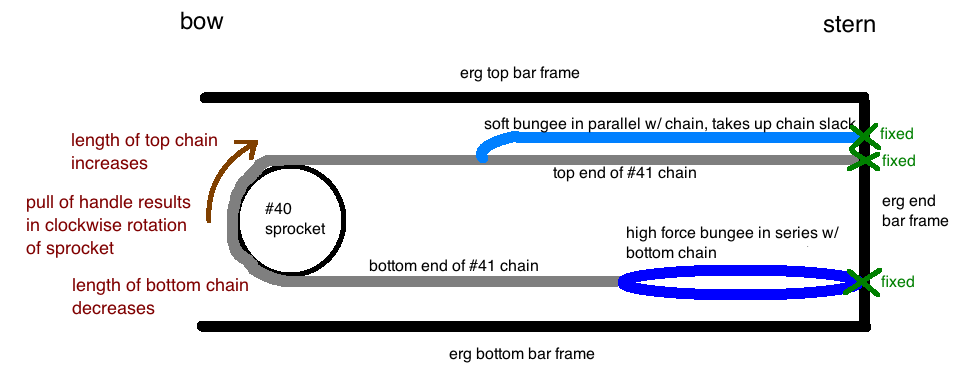
That diagram is about as crude as our current set-up, swathed in steel cable and masking tape: 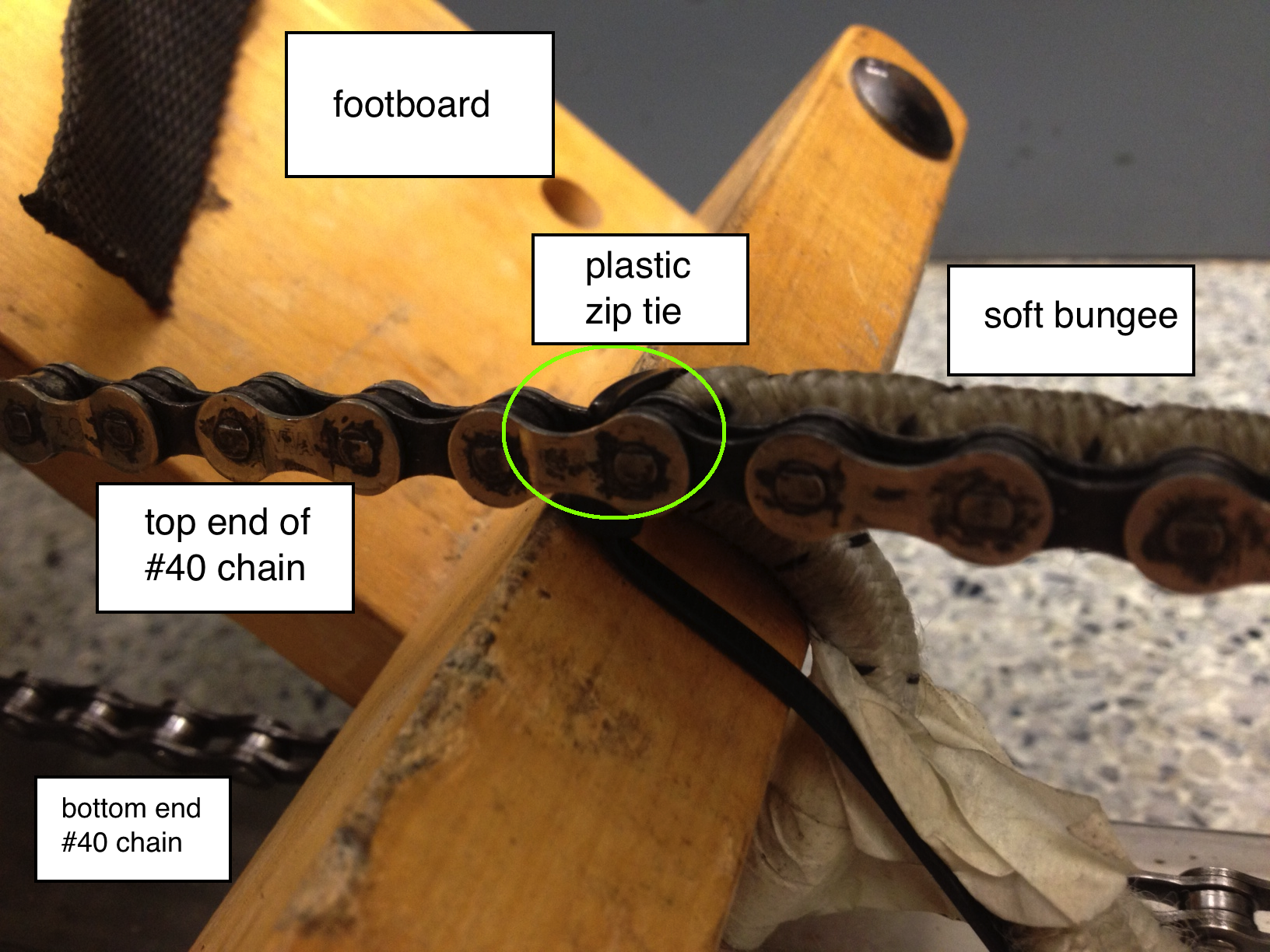
The plastic zip tie should keep a point on the top bungee fixed to a chain link on the top #40 chain. It has held so far...
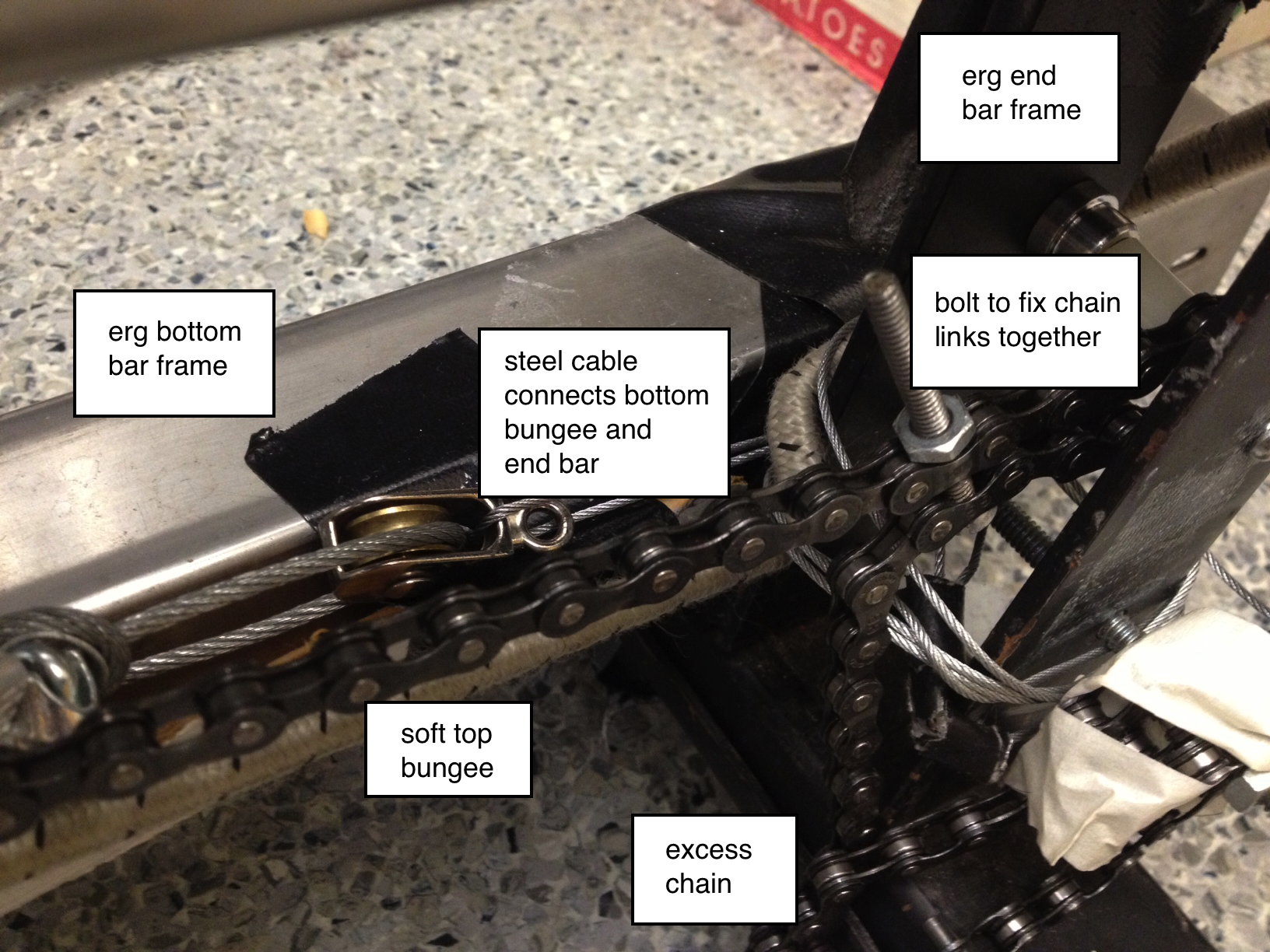
The bottom high-force bungee is not in the above picture, but it would be connected to the left end of the steel cable that is looped around a pulley.
By turning the wheel to stretch the bottom bungee cord as much as we could, we estimated, crudely, that the maximum displacement of the #41 chain is 12 inches. Therefore, the top bungee cord has about 12 inches of prestretch in order to take up all possible slack in the chain. The bottom bungee cord currently has about 4 inches of prestretch. We may have to change these pre-stretch values.