*** This version of Confluence is for testing only and contains a copy of content from June 29th 2026. No changes will be preserved. ***

...
Previous experiments have consisted of 10 inches of a single porosity of foam. We believe that by layering porosities, we can improve filter performance and increase run time. The idea is similar to a Rapid Sand Filter design in which anthracite (0.70 mm diameter) is layered on top of sand (0.45 mm diameter). Larger pore sizes are on the top of the filter, which capture large particles, and prevents a straining mechanism in the smaller pore sizes at the bottom of the filter. While we know the small porosity foam (larger pore size) will be on the top of the filter, we would like to determine the optimal number of one inch layers of each type of foam (30, 60, 90 ppi).
First, the team performed a control experiment with 60 ppi foam, 10 inch foam depth and a 1.5 mg/L alum dose to compare the layering results with.
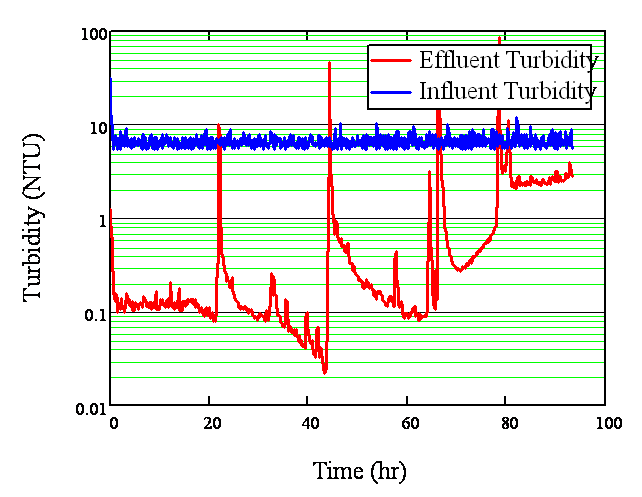
Figure 1: 60 ppi, 10 inch, 1.5 mg/L
The filter performed very well (Effluent Turbidity < 1 NTU) for approximately 60 hours. We are not sure what the cause of the spikes in the data are, this will need to be investigated. Because our turbidimeters can only provide accurate turbidity readings for a turbidity greater than 0.2 NTU, a second way we can analyze filter performance is the length of time that the filter can produce effluent turbidities less than 1. This, in combination with the effluent turbidity results will be used to determine the optimal layering for the filter
...
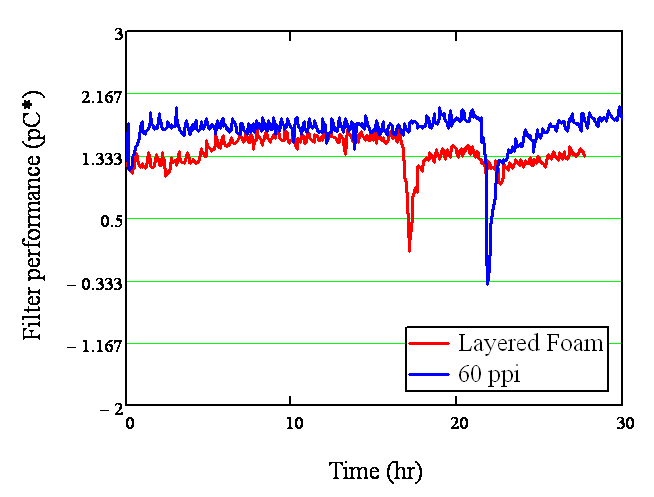
Figure 2: pC* vs time
...