*** This version of Confluence is for testing only and contains a copy of content from June 29th 2026. No changes will be preserved. ***

...
A few hypotheses seem plausible explaining floc break up in the flocculator. Flocs could break up because of interactions between particles and the wall or particles and the fluid or particles and particles. Comparing mean sedimentation velocities found for an influent water of 100 NTU and 500 NTU for the same length of flocculator (figure 13), it appears that the maximum mean sedimentation velocities are lower for a 500 NTU water than for a 100 NTU water. This result seems to validate the hypothesis that floc can be broken up because of particles-particles interactions. However, further investigation should be done in order to figure out what interactions confirm the existence of this kind of interactions.
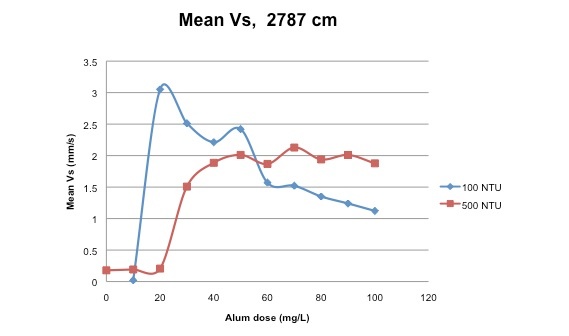
Figure 13: Plot of the mean sedimentation velocities as a function of alum dose, flocculator 2787 cm long, for an influent water of 100 NTU and 500 NTU
...