*** This version of Confluence is for testing only and contains a copy of content from June 29th 2026. No changes will be preserved. ***

...
...
Definition of Weir : A type of small overflow dam that can be used for flow measurement. The Linear Flow Orifice Meter is a mimic of this weir.
Definition of Sutro Weir : The discharge (flow) through the weir is proportional to the head (water depth above a reference plane located at one third of the depths of the crest of the base weir).
Development : The linear-proportional weir was developed by Stout in 1897 and was theoretically based, the design stipulated the width at the base as infinite. In 1908 Sutro modified the design to create a practical linear-proportional weir. The weir has a rectangular base and the flow through the weir is proportional to the height of the water through the curved portion of the weir plus
| Latex |
|---|
Research h2. Introduction *Definition of Weir* : A type of small overflow dam that can be used for flow measurement. The Linear Flow Orifice Meter is a mimic of this weir. *Definition of Sutro Weir* : The dicharge (flow) through the weir is proportional to the head (water depth above a reference plane located at one third of the depths of the crest of the base weir). *Development* : The linear-proportional weir was developed by Stout in 1897 and was theoretically based, the design stipulated the width at the base as infinite. In 1908 Sutro modified the design to create a practical linear-proportional weir. The weir has a rectangular base and the flow through the wier is proportional to the height of the water through the curved portion of the weir plus {latex} $$ 2\over 3 $$ {latex} |
of
...
the
...
height
...
of
...
the
...
rectangular
...
base
...
ie.
...
| Latex |
|---|
...
$$ Q = c [h + {2 \over 3} s] $$ |
...
...
...
...
...
...
...
...
...
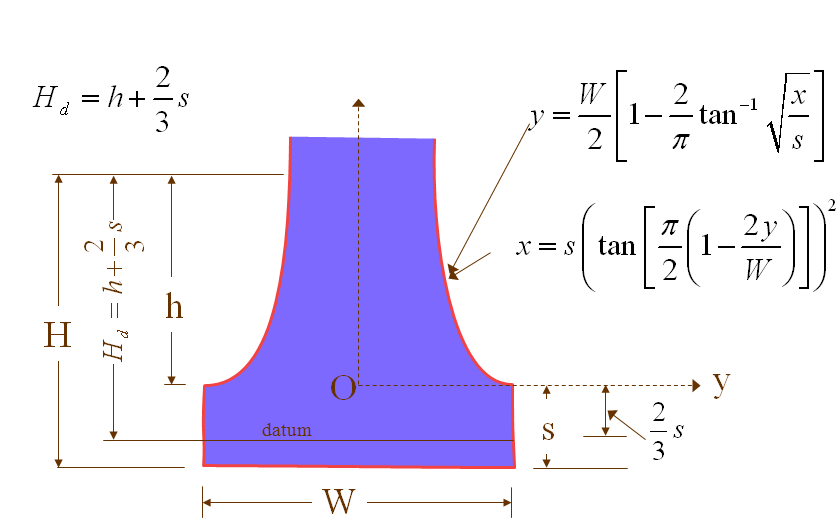
Figure 1: Sutro weir with constraining equations.
W = base of rectangular weir
s = height of rectangular weir
h = weir height above rectangular weir
c = constant of proportionality
| Latex |
|---|
[website|http://nptel.iitm.ac.in/courses/Webcourse-contents/IIT-MADRAS/Hydr/pdfs/Unit14/proportional-weir.pdf] !Sutro Weir Picture.bmp||width=300,height=250! Figure 1: Sutro weir with constraining equations. * Note: The rectangular base is present in the design merely to simplify evaluation and analysis. Flow proportional to water height begins above the rectangular weir. h5. Variables W = base of rectangular weir s = height of rectangular weir h = wier hight above rectangular weir c = constant of proportionality {latex} $$ C_d $$ {latex} |
=
...
coefficient
...
of
...
discharge,
...
ranges
...
from
...
0.0597
...
to
...
0.619
| Latex |
|---|
} $$ q_w $$ {latex} |
=
...
Flow
...
through
...
rectangular
...
weir
| Latex |
|---|
} $$ q_u $$ {latex} |
=
...
Flow
...
through
...
upper
...
portion
...
of
...
weir,Important
...
Parameter
...
Q
...
=
...
Total
...
Discharge
| Latex |
|---|
} $$ C_0 $$ {latex} |
=
...
vena
...
contracta
...
area
...
ratio,
...
average
...
value
...
is
...
0.62
...
g
...
=
...
acceleration
...
due
...
to
...
gravity
...
...
...
...
...
...
...
...
...
...
...
...
...
...
...
...
...
...
...
...
...
...
...
...
...
...
...
...
...
...
...
...
...
...
...
...
...
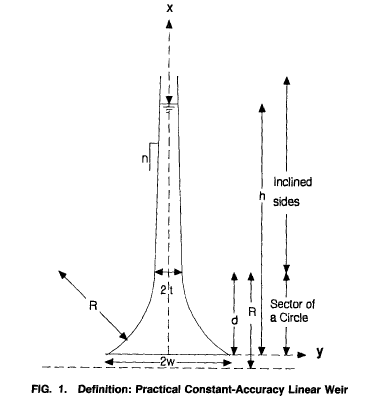
The paper explores a different weir design that also results a discharge that is proportional to the depths of head. The design has two parts, one is the outside edge of part of a circle and the rest of the weir is a sloped straight line. The redesign was tested because the changes would make construction easier. The results showed a high level of accuracy, +/- 1% in the head range 0.5R <= h <= 7.9R (R is the radius of sector of circle, the coefficient of discharge was experimentally shown to be 0.619. Figure 1 is a visual representation of the design.
Note sources 2 and 3 were found through the ASCE research library at http://scitation.aip.org/hyo/
...