*** This version of Confluence is for testing only and contains a copy of content from June 29th 2026. No changes will be preserved. ***

...
...
...
The current theory of plate settlers predicts the failure for a specific sedimentation tank and plate settler spacing based on a failure mechanism called floc roll-up.
...
The
...
floc
...
roll-up
...
theory
...
states
...
that
...
a
...
floc
...
hitting
...
the
...
bottom
...
plate
...
will
...
experience
...
both
...
a
...
fluid
...
velocity
...
at
...
its
...
edge
...
and
...
a
...
settling
...
velocity.
...
If
...
the
...
fluid
...
velocity
...
is
...
higher
...
than
...
the
...
settling
...
velocity,
...
then
...
the
...
floc
...
will
...
roll
...
up
...
the
...
plate
...
and
...
will
...
exit
...
the
...
plant
...
without
...
being
...
captured.
...
This
...
theory
...
is
...
based
...
on
...
the
...
following
...
assumptions:
...
...
...
...
...
...
...
...
...
...
...
...
...
...
...
...
...
...
...
...
...
...
...
...
...
...
...
...
...
...
...
...
...
...
...
...
...
...
...
...
...
...
...
...
...
...
...
...
...
...
...
...
...
The
...
current
...
theory
...
predicts
...
failure
...
by
...
the mean
...
of
...
a
...
dimensionless
...
| Latex |
|---|
...
\huge $$\Pi$$ |
...
...
which
...
is
...
explained
...
on
...
this
...
page:
...
...
...
...
...
...
...
.
...
When
...
this
...
ratio
...
is
...
less
...
than
...
one,
...
then
...
the
...
effluent
...
turbidity
...
should
...
be
...
above
...
0.25
...
NTU. This means that the spacing for a given flow rate is going to be above the maximum allowed turbidity.
Our first experimental results showed that this ratio is able to predict effluent turbidity that will be above 0.25 NTU but it is unable to predict the magnitude of failure.
Therefore, the PSS team concluded that a numerical simulation taking more phenomenon into account is needed in order to be able to better understand the failure mechanisms and be able to assess the effluent turbidity.
The code works on a Velocity-Verlet algorithm which computes all particles paths based on their experienced local velocities. The code takes particles sizes, the tube (or plate) geometry, and the up flow velocity as an input. The figure below summarizes the steps taken by the algorithm:
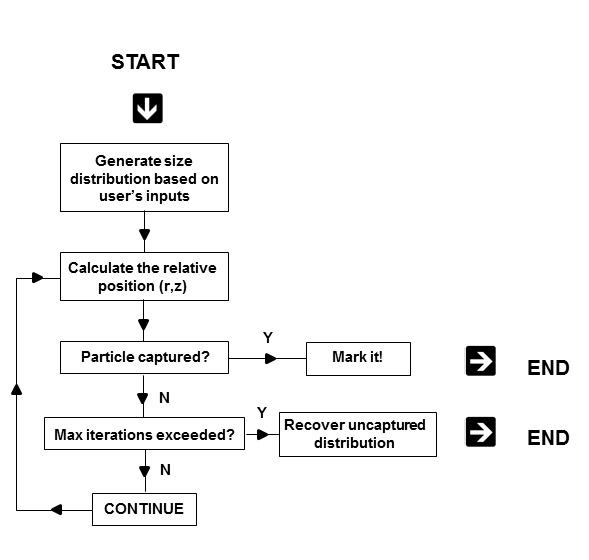
The output of the program is the number of particles that were not captured and their respective paths.
The team plans to adjust some of the parameters in order to be able to compare (at least roughly) the results and predictions of the numerical model with the experiments.
Further steps include implementing more interactions than floc roll up (e.g. floc break-up, floc recombination and how flocs influence the local velocity profile. Hence, the plate settler performance).
trajectory9.m ||The main file. Contains the input parameters as well as the velocity-Verlet algorithm
Vfluid.m || Function that computes the velocity profile as a function of the distance inside a tube or plate settler
Re.m || Function that computes the Reynolds number (required for modeling the entrance region)