*** This version of Confluence is for testing only and contains a copy of content from June 29th 2026. No changes will be preserved. ***

...
A
...
common
...
parameter
...
used
...
to
...
describe
...
sedimentation
...
is
...
the
...
capture
...
velocity.
...
Capture
...
velocity
...
is
...
the
...
velocity
...
of
...
the
...
floc
...
that
...
is
...
only
...
barely
...
settled-out,
...
or
...
"captured",
...
during
...
the
...
sedimentation
...
process.
...
To
...
gain
...
a
...
more
...
profound
...
understanding
...
of
...
this
...
crucial
...
parameter,
...
we
...
will
...
walk
...
through
...
the
...
derivation
...
of
...
the
...
capture
...
velocity
...
equation.
...
The
...
figure
...
below
...
illustrates
...
the
...
longest
...
path
...
that
...
a
...
floc
...
is
...
able
...
to
...
travel
...
in
...
a
...
sedimentation
...
tube
...
and
...
still
...
be
...
captured.
...
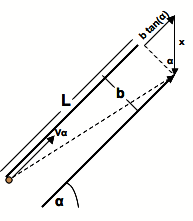
Figure 1.
...
Longest
...
possible
...
path
...
of
...
a
...
floc
...
through
...
a
...
sedimentation
...
tube.
...
The
...
capture
...
velocity
...
is
...
the
...
velocity
...
that
...
the
...
particle
...
must
...
travel
...
to
...
fall
...
a
...
distance
...
'x'
...
(see
...
figure
...
above)
...
in
...
the
...
same
...
amount
...
of
...
time
...
that
...
a
...
particle
...
traveling
...
at
...
| Latex |
|---|
...
\large\[V_\alpha\] |
...
...
travel
| Latex |
|---|
\large\[L + |
...
b\tan (\alpha )\] |
Now, we know that one way to determine the travel time of a particle is to divide the distance travelled by the particle by the particle velocity. Therefore, we can equate the following travel times:
| Latex |
|---|
\large\[\frac{d}{{V_c \cos (\alpha )}} = \frac{{L + d\tan(\alpha )}}{{V_\alpha }} = \frac{{L\sin (\alpha ) + \frac{b}{{\cos (\alpha )}}}}{{V_{up} }}\] |
Solving for the capture velocity by equating the first and third expressions, we find that:
| Latex |
|---|
\large\[V_c = \frac{{dV_{up} }}{{L_{tube} \sin (\alpha )\cos(\alpha ) + d}}\] |
Where L is the length of the tube, d is the inner diameter of the tube, Vup is the vertical velocity through one tube, and
| Latex |
|---|
\large\[\alpha \] |
From the capture velocity equation just derived, it is evident that capture velocity is dependent on the diameter, length, and angle of the tube settlers, as well as the flow rate through the settlers.