*** This version of Confluence is for testing only and contains a copy of content from June 29th 2026. No changes will be preserved. ***

...
In the new set up, it was important to test certain procedures that were aimed to minimize restriction of the pipes. One procedure involved the production of the calcium hypochlorite solution. After the combination of the calcium hypochlorite and water, the solution was allowed to settle for a minimum of a day. After the settling period, the supernatant of the solution was filtered through a cotton rag. This filtered solution was then attached to the constant head tank and allowed to run through the system.
A second procedure that was tested involved an alteration to the float valve in the constant head tank. One theory was that the float valve was clogging (and the calcium carbonate was forming) due to the contact of the solution in the lines with atmospheric carbon dioxide. In the original set up (shown in figure 3), the massive amounts of atmospheric carbon dioxide was able to rush through the orifice in the float valve and contact the solution in the pipes of the set up. A proposed solution to this phenomenon was to change the angle of the arm of the float valve. This would keep the orifice of the float valve submerged in solution so that the atmospheric carbon dioxide would not have the same effect on precipitation. This set up is shown in figure 4. After making this change, the experiment was run. A 5 L solution of 30 g/L calcium hypochlorite was produced and mixed well. It was allowed to settle for a minimum of 24 hours. The supernatant of the solution was filtered through a cotton rag, and then allowed to run through the experimental set up. The peristaltic pump was set to 35 mL/min.
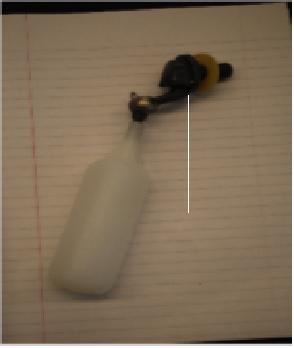
Figure 3
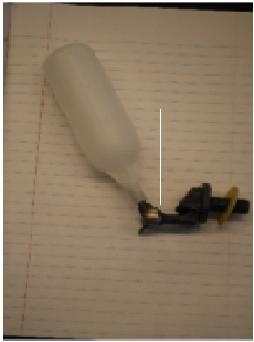
Figure 4
...