*** This version of Confluence is for testing only and contains a copy of content from June 29th 2026. No changes will be preserved. ***

...
If precipitation forms in the stock tank or at the surface of the constant head bottle over time after the initial settlement, it would flow out of the tanks with the rest of solution or settle out at the bottom of the containers, as was observed in the Final Restriction of Flow of Hypochlorinators experiment. If it continued through the system with the flow of solution we are confident that this small amount of precipitate would not build up, or impede flow at any point in the system. This leaves us with the float valve orifice. Every instance where we were able to restrict flow from the orifice in the float valve there was a buildup of precipitate all over the surface of the float and the arm holding the float to the rest of the valve. It appears that precipitate is slowly forming in the orifice where the solution first comes into contact with the atmosphere after leaving the tube that flows from the stock tank, eventually restricting flow (Figure 4).
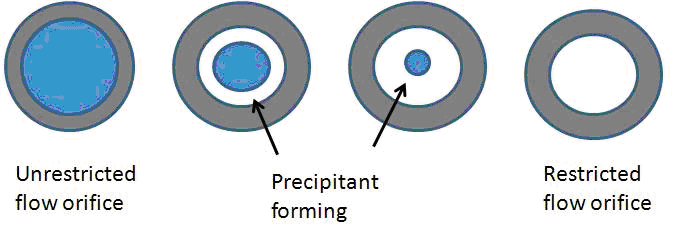
Figure 4. Restriction of flow through an orifice over time by the formation of a precipitant of CaCO3.
It was decided that to deal with this occurrence, we would raise the level of the solution in the constant head bottle to a level above the orifice. This would result in the solution not coming into contact with the atmosphere at the orifice. The orifice would be submerged and individual calcium molecules would not come into contact with CO2 until getting close to the surface of the solution in the constant head bottle.
In our laboratory experiments this has kept the system functioning with relatively high concentrations of Ca(ClO)2 for periods of time lasting more than a week. Presumably the experiment would have continued to function, but it was terminated premature to an obstruction of flow so a new test could be organized.
Another issue involved with the use of Ca(ClO)2, is safety. Calcium hypochlorite is considered a strong oxidizer. It is corrosive and causes burns to any area of the body it comes into contact with. It harmful if swallowed or inhaled and it will react with water. The MSDS recommends goggles, a ventilated hood, and proper gloves when in contact with this chemical. Specifically when inhaled it is extremely destructive to tissues of the mucous membranes and upper respiratory tract. Symptoms may include a burning sensation, coughing, wheezing, laryngitis, shortness of breath, headache, nausea and vomiting. Inhalation may be fatal as a result of spasm inflammation and edema of the larynx and bronchi, chemical pneumonites and pulmonary edema (J.T. Baker, MSDS 2008). There were instances this semester where individuals that were working with this chemical in the laboratory here at Cornell felt sick and or nauseous after accidental inhalation. These occurrences were the result of improper fume hood practices.
Another issue that was considered is if the Ca(ClO)2 solution is going to be pre-settled before being applied to the chlorine solution stock tanks, a sufficient volume of water must be added to the chemical in the container that the solution is being settled out of to completely dissolve the Ca(ClO)2 in solution. The solubility of Ca(ClO)2 is 210 g/L. In certain communities the concentration of Ca(ClO)2 required for chlorination of the water supply necessitates a large enough weight of Ca(ClO)2 that the amount will not dissolve in a 5 gallon drum of water ( Figure 6), which is the procedure that some operators have been implementing.