*** This version of Confluence is for testing only and contains a copy of content from June 29th 2026. No changes will be preserved. ***

...
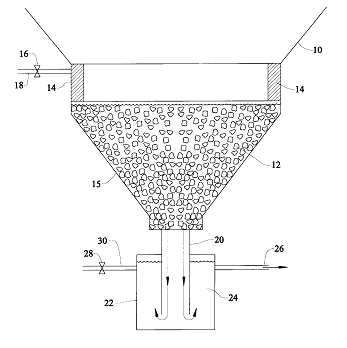
Next, the thought of settling out the CaCO3 before it enters the hypochlorinator was investigated. If the precipitated CaCO3 could be removed or reduced from solution before it comes into contact with the flow control device (FCD), this would ideally solve the problem. The fact that this chlorination treatment process will be expanding to many more communities, made investigating these problems more crucial, especially in communities that do not operate with full Aguaclara water treatment plants. We began by examining the flow restrictions that may arise in the Honduran communities that expressed interest in adding an Aguaclara FCD to their chlorine treatment systems. The first solution proposed was to design a settlement basin that could be implemented into the system which would allow the CaCO3 to precipitate out before it entered the FCD like the one that can be observed in (Figure 1).
 settling tank.bmp
Figure 1. Calcium Hypochlorite Feeder designed by Ralph Morrison and company (US Patent Number 6,045,706).
...
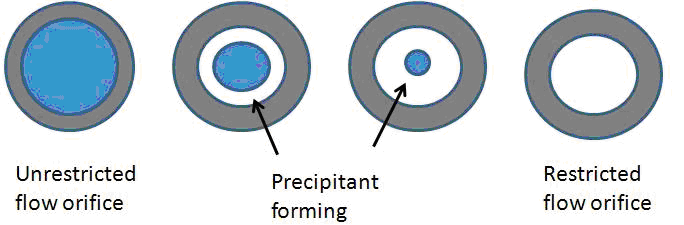
If precipitation forms in the stock tank or at the surface of the constant head bottle over time after the initial settlement, it would flow out of the tanks with the rest of solution or settle out at the bottom of the containers, as was observed in the Final Restriction of Flow of Hypochlorinators experiment. If it continued through the system with the flow of solution we are confident that this small amount of precipitate would not build up, or impede flow at any point in the system. This leaves us with the float valve orifice. Every instance where we were able to restrict flow from the orifice in the float valve there was a buildup of precipitate all over the surface of the float and the arm holding the float to the rest of the valve. It appears that precipitate is slowly forming in the orifice where the solution first comes into contact with the atmosphere after leaving the tube that flows from the stock tank, eventually restricting flow (Figure 4). orifice.bmp