*** This version of Confluence is for testing only and contains a copy of content from June 29th 2026. No changes will be preserved. ***

...
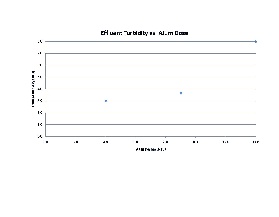
The team had difficulty finding the correct alum dose at low temperatures and incoming turbidity this semester. The team determined a relationship between the WFP's PAC (polyaluminum chloride) dosage and the alum dose at the plant. The composition of PAC is a trade secret and its chemical formula is unknown. The relationship was determined between the percent active ingredients in PAC and alum. At the plant 48.8% of 11.1 lb/gal alum is active and 33% of 10.84 lb/gal of PAC is active. Therefore 1 ppm of PAC should have the same effects on flocculation as 0.182 mg/L alum.
...
A turbidity profile for the uniform and tapered flocculator was determined using this alum dose. The results are inconclusive- neither configuration produced an effluent with a lower turbidity than the raw water entering the flocculator. The flocculator was clearly working as can be seen by the increase in turbidity along the profile. Flocs that were too small to settle out but large enough increase the turbidity were formed. The tapered flocculator showed slightly better effluent quality than uniform.
The alum dose set based on plant PAC dosage gave the best results for an incoming turbidity of 2.3 NTU. If this relationship is confirmed to work at a broad range of incoming turbidities, it can hopefully be used by future semesters. The plant operators obviously have much more experience determining alum dosing and this relationship can help us take advantage of their expertise.