*** This version of Confluence is for testing only and contains a copy of content from June 29th 2026. No changes will be preserved. ***

...
...
...
In
...
this
...
experiment,
...
we
...
filled
...
three
...
1
...
liter
...
graduated
...
cylinders
...
with
...
varying
...
concentrations
...
of
...
Calcium
...
Hypochlorite.
...
The
...
graduated
...
cylinders
...
consisted
...
of
...
a
...
10g/L,
...
20g/L,
...
and
...
30g/L
...
solution
...
of
...
Calcium
...
Hypochlorite
...
solution.
...
The
...
solutions
...
were
...
mixed
...
well
...
and
...
allowed
...
to
...
sit
...
for
...
3
...
days
...
in
...
order
...
to
...
observe
...
the
...
height
...
and
...
weight
...
of
...
precipitate
...
forming
...
in
...
the
...
bottom
...
of
...
each
...
cylinder
...
after
...
each
...
day.
...
The
...
weight
...
of
...
precipitate
...
in
...
each
...
solution
...
was
...
found
...
using
...
vacuum
...
filtration.
...
The
...
contents
...
of
...
each
...
cylinder
...
were
...
poured
...
through
...
a
...
filter
...
and
...
the
...
liquid
...
was
...
vacuumed
...
out.
...
The
...
precipitate
...
left
...
on
...
the
...
filter
...
paper
...
was
...
then
...
weighed.
...
...
...
...
For
...
the
...
first
...
three
...
days,
...
the
...
height
...
of
...
precipitate
...
in
...
the
...
bottom
...
of
...
each
...
cylinder
...
increased.
...
At
...
day
...
four,
...
the
...
amount
...
of
...
precipitate
...
did
...
not
...
increase
...
from
...
day
...
three.
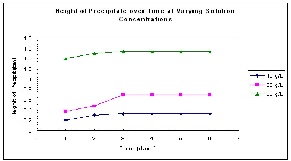
Using that after 3 days, no more precipitate settles out, gives a good estimate of time to wait before using the calcium hypochlorite solution. Waiting 3 days to use the solution and pouring out only the liquid at the top of solution should decrease the amount of precipitate in the system and help to eliminate clogging.