*** This version of Confluence is for testing only and contains a copy of content from June 29th 2026. No changes will be preserved. ***

...
Result: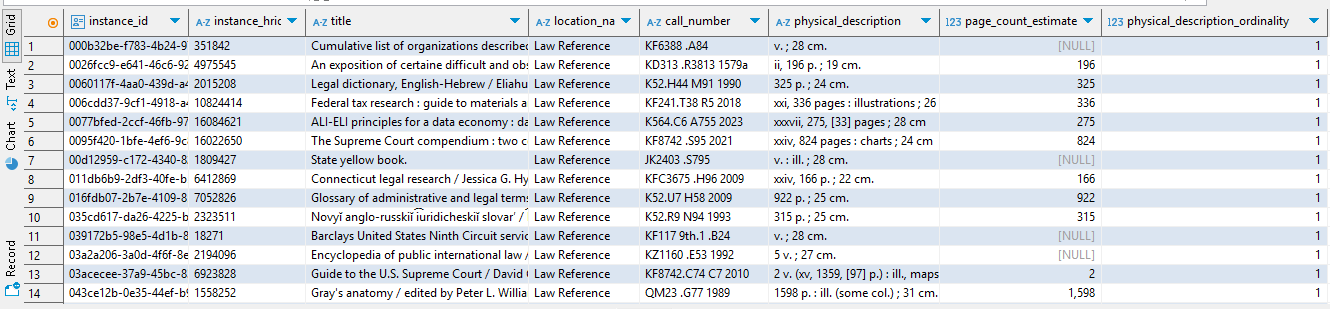
Code to extract the physical description from the instance table using a data array extraction function
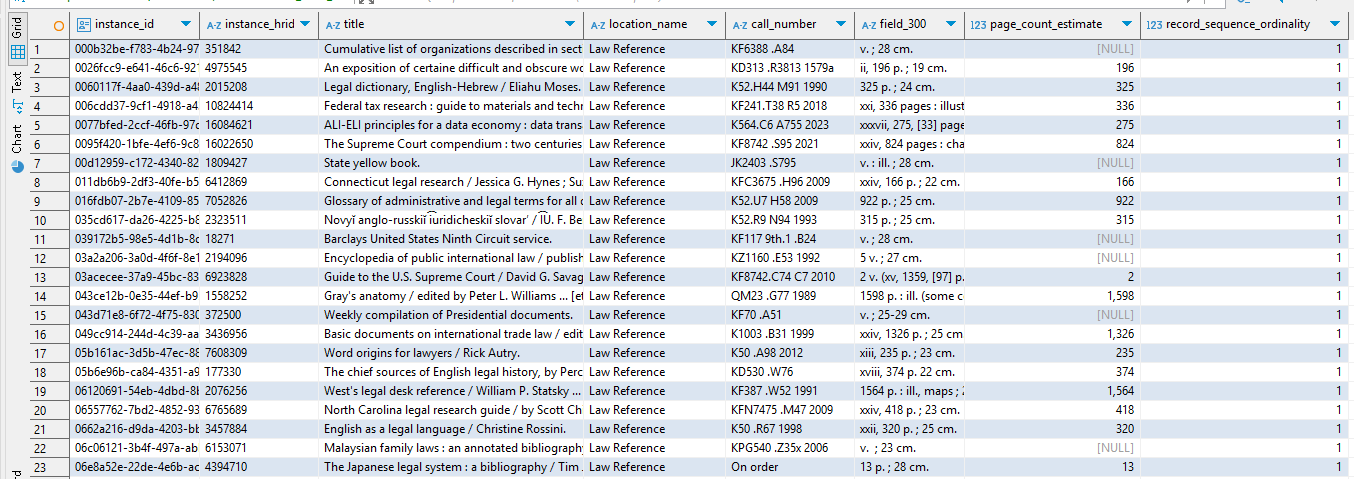
This method extracts the "physical descriptions" array from the instance record; records that do not have a physical descriptions array will NOT drop out, because the "left join lateral" function used in this query will keep all instance records in the results set, including those that do not have array values for physical descriptions.
As stated above, because the physical description field of the instance record is a text-entry field that has no enforced data entry format, the parsing statement will not yield highly accurate results. It works in cases where a page count number is followed by "p." or "pages" or "leaves" or "l." and when the first number in the description field (reading from left to right) is the actual number of pages or leaves, and not some other value.
| Code Block | ||
|---|---|---|
| ||
--define a parameters Common Table Expression (subquery or CTE) so the location filter can be easily changed in one place
--enter a location code between the quote marks below
--if left blank, the query will get all locations except for 'serv,remo'

WITH parameters AS
    (
    SELECT
        'law,ref' AS location_code_filter
        --Enter a location code between the quote marks
        --If left blank, the query will return all locations except 'serv,remo'
    )

--Select distinct rows to reduce duplicates that may result from the joins
--and bringing in data fields from holdings records (in this case)
SELECT DISTINCT
    instance.id AS instance_id,                          --Instance UUID
    instance.jsonb#>>'{hrid}' AS instance_hrid,           --Extract instance HRID from JSONB
    instance.jsonb#>>'{title}' AS title,                  --Extract title from JSONB
    location__t.name AS location_name,                   --Human-readable location name
    holdings_record__t.call_number,                      --Call number from holdings
    phys.jsonb#>>'{}' AS field_300,                      --Full text of each physical description (MARC 300 equivalent)

    CASE
        --Check whether the physical description contains a 1- to 4-digit number
        WHEN substring(phys.jsonb#>>'{}', '\d{1,4}') IS NOT NULL

        --Check whether the description appears to refer to pages or leaves
        AND (
            phys.jsonb#>>'{}' LIKE '%page%'
            OR phys.jsonb#>>'{}' LIKE '%p.%'
            OR phys.jsonb#>>'{}' LIKE '%leaves%'
            OR phys.jsonb#>>'{}' LIKE '% l.%'
        )

        --If both conditions are true, extract the first number and cast to integer
        THEN substring(phys.jsonb#>>'{}', '\d{1,4}')::INT

        --Otherwise return null when no usable page count is found
        ELSE NULL
    END AS page_count_estimate,

  --ordinality shows the order of the physical description entry from the record
  --in cases where there is more than one
    phys.ordinality AS record_sequence_ordinality

--Start from the instance table, which stores JSONB records for bibliographic instances
FROM folio_inventory.instance

--LEFT JOIN LATERAL allows you to extract the physical descriptions array
--for each instance record whether or not it has values in that array
    LEFT JOIN LATERAL
        jsonb_array_elements(
            jsonb_extract_path(instance.jsonb, 'physicalDescriptions')
        ) WITH ORDINALITY AS phys(jsonb)
        ON true

    --Join to holdings to bring in call number and location reference
    LEFT JOIN folio_inventory.holdings_record__t
        ON instance.id = holdings_record__t.instance_id

    --Join to location table to get location names and codes
    LEFT JOIN folio_inventory.location__t
        ON holdings_record__t.permanent_location_id = location__t.id

--Apply the location filter based on the parameter value
WHERE
    CASE
        --If the parameter is blank, return all locations except 'serv,remo'
        WHEN (SELECT location_code_filter FROM parameters) = ''
            THEN location__t.code != 'serv,remo'

        --Otherwise return only rows matching the specified location code
        ELSE location__t.code = (SELECT location_code_filter FROM parameters)
    END
;
|
...
Result:
Physical Descriptions array example from the instance table: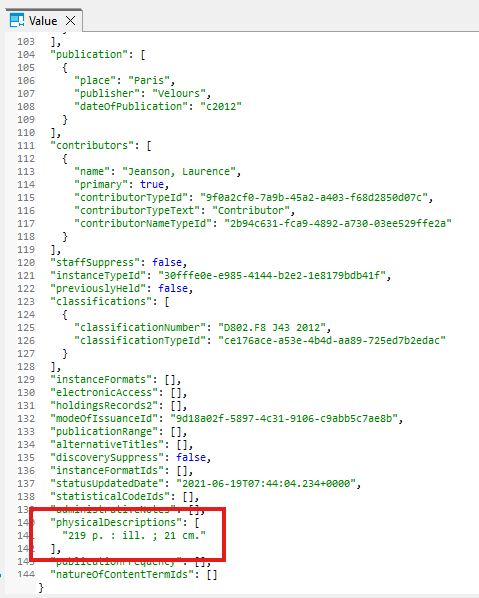
...