*** This version of Confluence is for testing only and contains a copy of content from June 29th 2026. No changes will be preserved. ***

...
Filmed-With resources share many of the same characteristics and instructions as printed Bound-withs, but for microfilm and microfiche materials. As with printed Bound-Withs, any new Filmed-With records should be cataloged using the title citation method described above , but there are many CUL films cataloged with the ordinal citation method (e.g. "No.5 of 7 titles on Microfilm 4665, Reel 3."), or as partially analyzed serials.
One major difference is that staff may need to use a film or fiche reader to examine the content, though in many cases, we can perform the appropriate record maintenance without having to view all of the material on a reel. Another major difference is that, because of their large capacity, it is possible for some Filmed-with parent records (or partially analyzed serial records) to have hundreds or even thousands of child records (or analyzed monographs) associated with them.
...
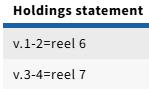


See Also: Instance Instances 3972209, 15293475.
| Anchor | ||||
|---|---|---|---|---|
|
...
Examples:


Special categories of Bound-with and Filmed-with material: Serial Title Changes and Partially Analyzed Serials.
| Anchor | ||||
|---|---|---|---|---|
|
Many CUL serials are bound together in large collected volumes. When a serial changes its title, a new bibliographic record is made/imported for the new (succeeding) title (see also 780/785 fields MARC), and all issues published under that title are assigned to the Holdings record of the new (succeeding) title. Frequently, however, the final issue published under the previous title has been bound together with the first issues of the new title. The same serial may change its title several times, and each title's Holdings may have a parent and/or a child Item record attached to it, indicating that issues of the previous titles were bound with issues of the succeeding titles.
...
3. Vista Volunteer (Instance 1334443):

| Anchor | ||||
|---|---|---|---|---|
|
Some serials have individual issues (or sets of issues) published with their own distinct title. CUL has cataloged many of these issues on both the serial record and on a separate monographic record, which uses the serial's title as the series statement, and the distinct title of the issue(s) as the main title of the monograph. Adding these parallel monographic records, or 'analytics', means that those issues were 'analyzed', making the overall serial 'partially analyzed'. There are even fully analyzed serials, where every issue is cataloged on a parallel monographic record. The purpose of analyzing is to widen the field of searchable terms for content which would not be adequately described by the serial record alone. This greatly increases accessibility to patrons, who may be searching by a specific title, author, or subject, and would otherwise not discover the content if it were "hidden" in the serial record exclusively.
...

END OF CURRENT PROCEDURE DRAFT. THE FOLLOWING MATERIAL IS YET TO BE DELETED OR REVISED AND ADDED ABOVE, OR REPRESENT ODD/EXCEPTIONAL CASES/QUESTIONS THAT DON'T ALIGN WITH THE ABOVE
Exceptional Examples:
Filmed-With where Instance records do NOT share the same call no.:
 Filmed-With Partially Analyzed Serials can be seen on Instances 5973681 and 1568971. While technically monographs, both are set up very much like parent records of an analyzed serial, with thousands of child titles associated with them.
