...
- Create a new item record
- Leave the barcode field BLANK.
- The Material Type field should be set to the same type as the first title in the item (e.g. Book, Map, Microform, etc.)
- Type "Bound with" in the Enumeration field of the record.
- If the item is part of a microfilm, microfiche, microcard, microprint or other film type, type "Filmed with" in the Enumeration field of the item record (see Filmed-With section below).
- Save and Close the Item record.
...
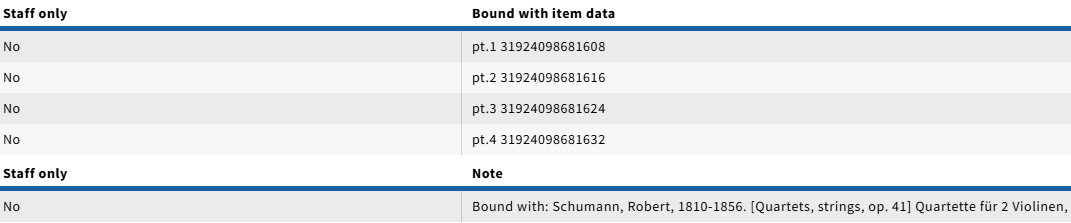
In this next example, the individual parts for the instruments of a work of classical music by Mendelssohn are bound separately in different bound-with resources, with the first part in each bound-with resource being by Schumann:. Accordingly, the

In general, use the same captioning used in the holdings for the serial or multi-part holdings string ("vol.", "pt.", "no."). If necessary, a note pertaining to the physical arrangement can also be added, as in the above example.
...
A. After entering the volume information with the "parent" barcode in the Holdings note, we similarly add the enumeration/chronology information in the corresponding "empty" Item record:
- Create the Item record following steps 4.A.1.a-e above, leaving the Barcode field BLANK.
- For Volume or Part statements, add the appropriate volume/part information to the Enumeration field, AFTER the "Bound With:" note.
Examples: If the Holdings Note says "v.1 31924XXXXXX...", we would enter it as "Bound with: v.1"in the Enumeration field of the corresponding "empty" Item record. Other captions can be entered as appropriate to match, so if part of a bound-with is a "pt.4" of a given serial or multi-vol, the Item Enumeration field in its "empty" item record would say "Bound with: pt.4".- NOTE: The phrasing can look confusing here, but in these examples, the Enumeration field note is showing that the title is inside a Bound-With resource
...
- , and that it is v.1 (or pt.2, etc.) of its title. It is NOT meant to show that the part is bound with v.1 (or bound with pt.2, etc.) as a verb phrase, because this part is v.1, or pt. 2.
- If there are only dates in the Holdings Statement (e.g. 1999 or 1829), the date corresponding to the part in the bound-with should be entered in the Chronology field of the empty Item record. The "Bound with:" note, including the colon, should still be in the Enumeration field, of empty item record, without anything after it.
- If the Holdings Statement has BOTH both volume and date information (e.g. "Bd.6 (1946)"), then the volume information should go after the "Bound with:" note in the Enumeration field (e.g. "Bound with:Bd.6"), and the date would go in the Chronology field, without the parentheses.
- If the Holdings Statement has Supplement or Index data, these would also transfer to the Enumeration and Chronology fields of the Item record. For example: If there is Holdings statement with "no.1-2", and a Statement for the supplement "1929", the volume caption data would be entered as "Bound with:no.1-2" in the Enumeration field, and the supplement data would appear as, "includes supplement 1929" in the Chronology field.
- If the Holding Statement shows dates ONLY, e.g. "1986", and the Statement for Supplements shows "1986:Dec.", the "Bound with:" note still goes in the Enumeration field of the Item record, by itself, and the Chronology field will show as "1986 (includes supplement 1986:Dec.)"
...
- Parent records:
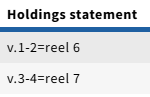
- If the Holdings statement of the parent Instance shows volume information, then there should be a Holdings note showing which volumes of the first title are on the reel, and citing the next title/part on the reel, OR a note saying that it's the first on a reel with other titles.
- The parent Item record should have the barcode number on the film box in the Barcode field.
- The Enumeration field of the parent Item record should have ONLY the main reel number on the box (if present), and NOT the individual enumeration/vol. numbers of the first title.
- Child Records:
Should contain Holdings Note (note type: Bound with item data) with the barcode from the Item record of the first title (or directly from the film box).
- A Holdings Note (note type: Note) designating which specific volumes are filmed with others. Older cataloged material may have the ordinal citation, but new Filmed-with records should use title citation notes.
- NOTE: Sometimes it's necessary to create a separate Holdings for issues or volumes which are second or subsequent parts in a Filmed-With, as with printed Bound-with, because of the call number difference between the volume(s) in the Filmed-with, vs. those in the NON-Filmed-with. In the case of Filmed-with, it's also possible that the issue(s) on the microfilm will have a Holdings on the print record, and the print record holdings statement should note that certain issues are on a microfilm. (See Instance 318711 or 1894447 or 1901969).
- The Item record should follow the same guidelines as for Bound-With (see section 6A above), with "Filmed with:" in the Enumeration field, followed by the volume information of the specific issue.
EXAMPLES:

STILL WORKING ON THIS PART, PLUS NEED TO ADD: EXPLANATION OF ABBREVIATED/RETCON RECORDS, COMPLICATED OVERSIZE SCENARIOS, AND A PLACE TO INCLUDE THE ANNEX CHILD-RECORD ITEM LOCATION CLAUSE (NOT NECESSARY TO CHANGE IT TO ANNEX FOR TRANSFERS OR NEW BWs?
...