*** This version of Confluence is for testing only and contains a copy of content from June 29th 2026. No changes will be preserved. ***

...
A Holdings Note (note type: Bound with item data) with the barcode of first title item record. ]

3. If one or more of the subsequent titles on the microfilm reel are not monographic, single-part materials, additional information may need to be added to the 87X information. For a single serial volume or issue, or a part of a multi-part title filmed with other unrelated materials, volume information should be recorded in the 87X $3 to indicate which part or parts of the title represented by that holdings record are included on the "filmed with" reel. In general, use the same format for the $3 information that has been used in the holdings for the serial or multi-part holdings string. If necessary, a note pertaining to the filmed arrangement can be added to the 87X field in a$z.
Ex.: 876 ## $3 v.3:no.1 (1855:Jan.) $p 31924084331675
Ex.: 876 ## $3 score + 3 parts $p 31924084331889 $z Each of the 4 pieces (score, violin, viola, violoncello) of the Mendelssohn have been filmed with its equivalent in the Weber.
For retrospective conversion records: If Cornell has cataloged one or more titles but has not cataloged all titles that have been bound together (subsequent to publication) in a single physical volume, select the first cataloged title as your primary title (Note: it may not be the first title in the volume), add a holdings record to this instance, and to all the other cataloged titles in the volume, with appropriate ‘bound with’ and "Bound with item data" notes. Ignore all the uncataloged titles in the volume. In addition, add the following staff note in the holdings record for the primary title:

However, if Cornell has not cataloged any titles that have been bound together subsequent to publication in a single physical volume, create a instance and holdings record for the first title in the volume. Add the following staff note in the holdings:

4. For retrospective conversion only: If Cornell has cataloged one or more titles (but has also not cataloged one or more titles) that have been filmed together in a single physical reel, select the first cataloged title as your primary title (Note: it may not be the first volume on the reel), add a MFHD to this, and to all the other cataloged titles in the volume, with appropriate ‘bound with’ notes and 876s. Ignore all the uncataloged titles on the reel. In addition, add the following staff note in the MFHD for the primary title:
Ex.: 852 ... $x Some titles on physical reel will not be cataloged.
However, if Cornell has not cataloged any titles that have been filmed together on a single physical reel, create a bib record and MFHD for the first title in the volume. Add the following staff note in the MFHD:
Ex.: 852 ... $x Other titles on physical reel will not be cataloged.
Item Records Without Barcodes for Bound With and Filmed With at the Annex
Ex. Boundwith:v.4-8
Note: “Empty” items should only be created after the parent holding has been accessioned. Otherwise this causes problems for staff at the Annex. - NO LONGER TRUE. Empty Item records are fine to create before sending to Annex, as long as Holdings notes / bound-with data is accurate. (May have been true under Barb? but now, Cammie says it's much better to have them for patron requests, as it won't direct them to "Ask a Librarian". It will go directly to a staff member who can track the item down and figure out if something is incorrect in the records.
---------------------------
b. In the case of a partially analyzed serial, use the enumeration from the piece itself, when appropriate (Is this reflected in one of the original examples below? Numbering gets very confusing very quickly (see also bib 444353).
(7/22) Different "types" of bound-with: (should we add sections for these in detail, and then further sub-divide the procedure accordingly, or just reference for now?)
Drafts for the separate page of examples:
...
I. Serial Title-Changes within bound volumes:
Many CUL serials are bound together in large collected volumes. When a serial changes its title, a new bibliographic record is made/imported for the new (succeeding) title (see also 780/785 fields MARC), and all issues published under that title are assigned to the Holdings record of the new (succeeding) title. Frequently, however, the final issue(s) published under the previous title have been bound together with the first issues of the new title. The same serial may change its title several times, and each Holdings may have a parent and/or a child Item record attached to it, indicating that issues of the previous titles were bound with issues of the succeeding titles.
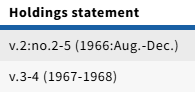
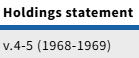
For example: the serial "VISTA Volunteer" (Instance 1334440) changed its name to "VISTA" (Instance 1334441) for a year, and then back to "Vista Volunteer" (Instance 1334443). The later issues of the first title were bound with a volume of the middle title, which in turn had its later issues bound with the third title:
1. Vista Volunteer (Instance 133440):

Holdings:
 Holdings Notes: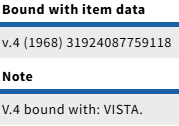
2. Vista (Instance 1334441, "middle title"):

Holdings:
 Holdings Notes: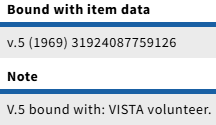
3. Vista Volunteer (Instance 1334443):

...
Some serials have individual issues (or sets of issues) published with their own distinct title. CUL has cataloged many of these issues on both the serial record and on a separate monographic record, which uses the serial's title as the series statement, and the distinct title of the issue(s) as the main title of the monograph. Adding these parallel monographic records, or 'analytics', means that those issues were 'analyzed', making the overall serial 'partially analyzed'. The purpose of analyzing is to widen the field of searchable terms for content which would not be adequately described by the serial record alone. This greatly increases accessibility to patrons, who may be searching by a specific title, author, or subject, and would otherwise not discover the content if it were "hidden" in the serial record exclusively.
While LTS no longer analyzes serials at selector request, staff should be familiar with the processing methods, as they still come up for maintenance . Partially analyzed serials are not always bound together physically, (although they can be), but the records share many properties with "true" bound-with material, as we're similarly cataloging one title on two different sets of records, which need to be linked together by single barcode.
A. Basic properties (analyzed issues are single-part monographs):
This section covers cases where each serial with a distinct title gets a parallel single-part monographic record:
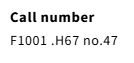
Basic Example (single-part monograph analytics):

B. Analyzed multi-volumes spanning 2 or more serial issues:
When the analyzed monographic title in a serial has multiple volumes and spans multiple issues, the Monographic Holdings and Item records should reflect the details as follows:
Holdings Records:
Item Records:
Example 1:
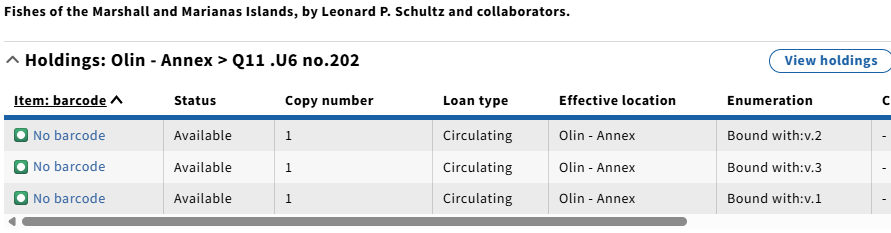
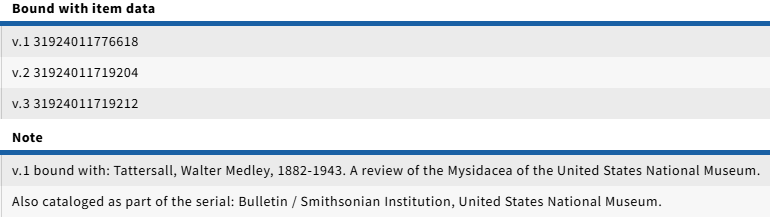
The serial "Bulletin /Smithsonian Institution (Instance 2013888) is a partially analyzed serial, and no. 202 of the serial is a 3-volume analyzed set with the title "Fishes of the Marshall and Marianas Islands" (Instance 1117089). v.1 is physically bound with the previous issue (201), which is also an analyzed serial, while vols. 2 and 3 have their own "solo" item records and barcodes in the Serial record. In
...
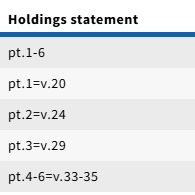
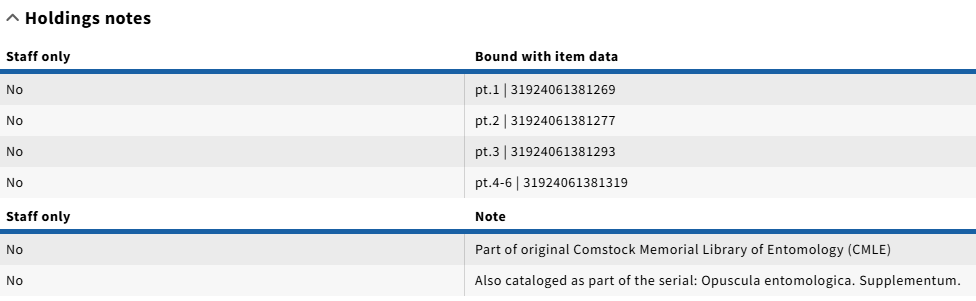
The monographic multi-volume title “The ground-beetles (Carabidae, excl. Cicindelinae) of Canada and Alaska” (instance 1114770) is a 6-part monograph analyzed from the serial “Opuscula entomologica. Supplementum.” , volumes 20, 24, 29, 33-35 (Instance 1948271). The monographic Holdings of the multi-vol. within the serial has the following properties:


Exceptional Examples:
Filmed-With where Instance records do NOT share the same call no.:

Does Bib 15293475 need an empty Item Record?
Should the Mann Film Holdings on Bib 1901153 have the Holdings note from the Mann print holdings?
Should Bib 3142779 have a second Item record for reel 6, with no barcode?
...
STILL WORKING ON THIS PART, PLUS NEED TO ADD: EXPLANATION OF ABBREVIATED/RETCON RECORDS, COMPLICATED OVERSIZE SCENARIOS?
Drafts for the other categories (possibly for separate page?):
| Anchor | ||||
|---|---|---|---|---|
|
I. Serial Title-Changes within bound volumes:
Many CUL serials are bound together in large collected volumes. When a serial changes its title, a new bibliographic record is made/imported for the new (succeeding) title (see also 780/785 fields MARC), and all issues published under that title are assigned to the Holdings record of the new (succeeding) title. Frequently, however, the final issue published under the previous title has been bound together with the first issues of the new title. The same serial may change its title several times, and each title's Holdings may have a parent and/or a child Item record attached to it, indicating that issues of the previous titles were bound with issues of the succeeding titles.
For example: the serial "VISTA Volunteer" (Instance 1334440) changed its name to "VISTA" (Instance 1334441) for a year, and then back to "Vista Volunteer" (Instance 1334443). The later issues of the first title were bound with a volume of the middle title, which in turn had its later issues bound with the third title:
1. Vista Volunteer (Instance 133440):
Holdings:
Holdings Notes:
2. Vista (Instance 1334441, "middle title"):
Holdings:
Holdings Notes:
3. Vista Volunteer (Instance 1334443):
II.
Partially Analyzed Serials:Anchor D D
Some serials have individual issues (or sets of issues) published with their own distinct title. CUL has cataloged many of these issues on both the serial record and on a separate monographic record, which uses the serial's title as the series statement, and the distinct title of the issue(s) as the main title of the monograph. Adding these parallel monographic records, or 'analytics', means that those issues were 'analyzed', making the overall serial 'partially analyzed'. The purpose of analyzing is to widen the field of searchable terms for content which would not be adequately described by the serial record alone. This greatly increases accessibility to patrons, who may be searching by a specific title, author, or subject, and would otherwise not discover the content if it were "hidden" in the serial record exclusively.
While LTS no longer analyzes serials at selector request, staff should be familiar with the processing methods, as they still come up for maintenance . Partially analyzed serials are not always bound together physically, (although they can be), but the records share many properties with "true" bound-with material, as we're similarly cataloging one title on two different sets of records, which need to be linked together by single barcode.
A. Basic properties (analyzed issues are single-part monographs):
This section covers cases where each serial with a distinct title gets a parallel single-part monographic record:
Basic Example (single-part monograph analytics):
B. Analyzed multi-volumes spanning 2 or more serial issues:
When the analyzed monographic title in a serial has multiple volumes and spans multiple issues, the Monographic Holdings and Item records should reflect the details as follows:
Holdings Records:
Item Records:
Example 1:
The serial "Bulletin /Smithsonian Institution (Instance 2013888) is a partially analyzed serial, and no. 202 of the serial is a 3-volume analyzed set with the title "Fishes of the Marshall and Marianas Islands" (Instance 1117089). v.1 is physically bound with the previous issue (201), which is also an analyzed serial, while vols. 2 and 3 have their own "solo" item records and barcodes in the Serial record. In
Example 2:
The monographic multi-volume title “The ground-beetles (Carabidae, excl. Cicindelinae) of Canada and Alaska” (instance 1114770) is a 6-part monograph analyzed from the serial “Opuscula entomologica. Supplementum.” , volumes 20, 24, 29, 33-35 (Instance 1948271). The monographic Holdings of the multi-vol. within the serial has the following properties:
END OF CURRENT PROCEDURE DRAFT. THE FOLLOWING MATERIAL IS YET TO BE DELETED OR REVISED AND ADDED ABOVE, OR REPRESENT ODD/EXCEPTIONAL CASES/QUESTIONS THAT DON'T ALIGN WITH THE ABOVE
Exceptional Examples:
Filmed-With where Instance records do NOT share the same call no.:
Does Bib 15293475 need an empty Item Record?
Should the Mann Film Holdings on Bib 1901153 have the Holdings note from the Mann print holdings?
Should Bib 3142779 have a second Item record for reel 6, with no barcode?
Instance 318711 is an example of a serial with most issues (print) on one holdings, and a single issue on a film on a separate Holdings.
3. If one or more of the subsequent titles on the microfilm reel are not monographic, single-part materials, additional information may need to be added to the 87X information. For a single serial volume or issue, or a part of a multi-part title filmed with other unrelated materials, volume information should be recorded in the 87X $3 to indicate which part or parts of the title represented by that holdings record are included on the "filmed with" reel. In general, use the same format for the $3 information that has been used in the holdings for the serial or multi-part holdings string. If necessary, a note pertaining to the filmed arrangement can be added to the 87X field in a$z.
Ex.: 876 ## $3 v.3:no.1 (1855:Jan.) $p 31924084331675
Ex.: 876 ## $3 score + 3 parts $p 31924084331889 $z Each of the 4 pieces (score, violin, viola, violoncello) of the Mendelssohn have been filmed with its equivalent in the Weber.
For retrospective conversion records: If Cornell has cataloged one or more titles but has not cataloged all titles that have been bound together (subsequent to publication) in a single physical volume, select the first cataloged title as your primary title (Note: it may not be the first title in the volume), add a holdings record to this instance, and to all the other cataloged titles in the volume, with appropriate ‘bound with’ and "Bound with item data" notes. Ignore all the uncataloged titles in the volume. In addition, add the following staff note in the holdings record for the primary title:
However, if Cornell has not cataloged any titles that have been bound together subsequent to publication in a single physical volume, create a instance and holdings record for the first title in the volume. Add the following staff note in the holdings:
...
4. For retrospective conversion only: If Cornell has cataloged one or more titles (but has also not cataloged one or more titles) that have been filmed together in a single physical reel, select the first cataloged title as your primary title (Note: it may not be the first volume on the reel), add a MFHD to this, and to all the other cataloged titles in the volume, with appropriate ‘bound with’ notes and 876s. Ignore all the uncataloged titles on the reel. In addition, add the following staff note in the MFHD for the primary title:
Ex.: 852 ... $x Some titles on physical reel will not be cataloged.
However, if Cornell has not cataloged any titles that have been filmed together on a single physical reel, create a bib record and MFHD for the first title in the volume. Add the following staff note in the MFHD:
Ex.: 852 ... $x Other titles on physical reel will not be cataloged.
Item Records Without Barcodes for Bound With and Filmed With at the Annex
Ex. Boundwith:v.4-8
Note: “Empty” items should only be created after the parent holding has been accessioned. Otherwise this causes problems for staff at the Annex. - NO LONGER TRUE. Empty Item records are fine to create before sending to Annex, as long as Holdings notes / bound-with data is accurate. (May have been true under Barb? but now, Cammie says it's much better to have them for patron requests, as it won't direct them to "Ask a Librarian". It will go directly to a staff member who can track the item down and figure out if something is incorrect in the records.
---------------------------
b. In the case of a partially analyzed serial, use the enumeration from the piece itself, when appropriate (Is this reflected in one of the original examples below? Numbering gets very confusing very quickly (see also bib 444353).
(7/22) Different "types" of bound-with: (should we add sections for these in detail, and then further sub-divide the procedure accordingly?)
