...
Filmed With (Microfilm Titles)
Empty item record creationItem Records for second (or subsequent) titles in a Bound-with (i.e. "empty" item records)
Item Records Without Barcodes for Bound With and Filmed With at the Annex
...
- Locate, import, or create a matching Instance record. Edit the Instance with administrative notes and/or statistical codes as applicable, and Save the record.
- Locate or create a Holdings record and add the appropriate Holdings Type, location, and call number* information for that first title.
- Make sure the first title is represented in
any - any Holdings Statements, if applicable (see below for more on Holdings Statements
, and/or add- , Enumerations, etc.)
- Add Oversize designation for the overall volume, if applicable.
- In the Holdings Notes section, add a note, with Note type: Note, indicating what identifying the NEXT (second) work is part in the volumepiece. Use the format "Bound with: [author name] (if available (last name, first)). Title of resource" (or enough of the title to allow for a reasonable search (see examples 1 and 2 below). NOTE: the Holdings notes should be public. Do NOT check the "staff only" box at the end of the note field.
- Save and close the record.
- We may also encounter a Bound-with resource whose Holdings note indicates that the title is the first in a volume that has a certain spine title. The term "lettered" is used to note what the spine title is (see examples 3 and 4). This approach is often seen with Rare materials in the database. When creating new Bound-with records, LTS staff should follow step 4 above (as illustrated in the first 2 examples), but we should be aware of this second approach for "lettered" resources when maintaining or correcting records.
...
- Enter the barcode number in the Barcode field.
- This single item record will represent the entire physical volume, so be sure to record the proper enumeration and/or chronology for the bound volume (if applicable) in the item record. ← From previous version: Re-word for clarity? is it referring to the individual enum/chron of the first title (from the Holdings statement), or first part, or if there's enum/chron on the spine of the whole volume (for the "lettered" ones)? I'm guessing it's the latter?
Instance , and Holdings , and Item Records for second (and subsequent) titles in a Bound-with resource ("child records")
...
- Locate, import, or create a matching Instance record, adding administrative notes or statistical codes as applicable, and Save.
- Locate or create the corresponding Holdings record. As with the parent record, Does the call number have to be the same as the first title/holdings? and no sequence numbers? (see above note) if the second title is smaller-than-oversize, but bound in an oversize item, should its call no. be oversize?
- Add a Note, with Note type: Note, saying "Bound with [Author/title information of the FIRST resource in the volume]".
- Add a second Holdings Note, but with the Note Type: Bound with item data, and enter the barcode number from the piece in-hand, or from the Item record of the first title in the resource. This is the ONLY place the barcode will be recorded for second and subsequent titles in a bound-with resource.
- All of the titles AFTER the first (parent) title will have some version of these 2 Holdings notes (among any other notes specific to that title): one referring back to the FIRST title in the resource, and one citing the barcode on the piece as Bound-with data.
- For bound-with items that were processed with the alternate scheme, second or subsequent titles in the resource will simply follow the sequence in which the title appears, e.g. "no. 3 in a volume lettered...", or "no. 4", etc.
Example:

Additional guidelines for Holdings Notes and Enumeration/Chronology of :
The above instructions apply mostly to printed bound-with materials where each part or 'title' in the volume is a single-part monograph. In many cases, however, the parts that make up a bound-with item may be issues of a serial, or volumes of a multi-part set. In these cases, additional information needs to be recorded in the
For a single serial volume or issue, or a part of a multi-part title bound with other unrelated materials, volume or other identifying information should be recorded with the barcode as "Bound With Item Data"to indicate which part or parts of the title represented by that holdings record are included in the "bound with" volume. In general, use the same format for that information that has been used in the holdings for the serial or multi-part holdings string. If necessary, a note pertaining to the physical arrangement can be added to the 87X field as well in a $z
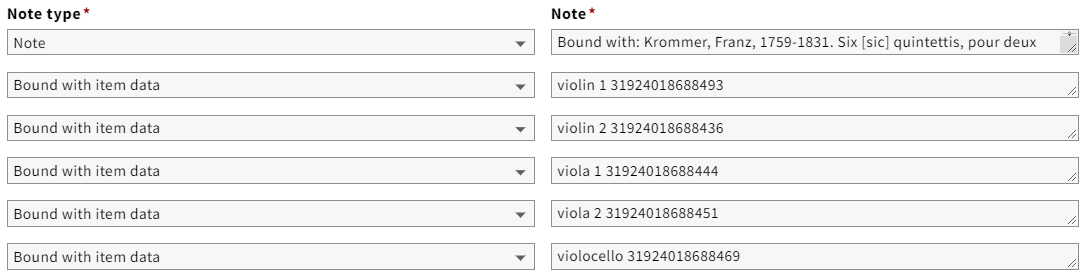 Image Removed
Ex.: 876 ## $3 v.3:no.1 (1855:Jan.) $p 31924084331675
Ex.: $3 score + 3 parts $p 31924084331889 $z Each of the 4 physical pieces (score, violin, viola, violoncello) of the Mendelssohn is hard-bound with its equivalent in the Weber. All pieces stored in one box.
4. This technique can also be used to link holdings for analyzed portions of serials to the serial record when a separate item record is not required or desired for the monographic records for the analyzed pieces.
5. For retrospective conversion only: If Cornell has cataloged one or more titles but has not cataloged all titles that have been bound together subsequent to publication in a single physical volume, select the first cataloged title as your primary title (Note: it may not be the first title in the volume), add a holdings record to this instance, and to all the other cataloged titles in the volume, with appropriate ‘bound with’ and "Bound with item data" notes. Ignore all the uncataloged titles in the volume. In addition, add the following staff note in the holdings record for the primary title:
 Image Removed
Item Records for second (or subsequent) titles in a Bound-with (i.e. "empty" item records)
- If the Holdings record has no Holdings Statement info for volumes, supplements, or indexes:
- Create a new item record
- Leave the barcode field BLANK (no barcode)
- The Material Type field should be set to the same type as the first title in the item (e.g. Book, Map, Microform, etc.)<--REALLY?
- Type "Bound with" in the Enumeration field of the record.
- If the item is part of a microfilm, microfiche, microcard, or some other film type, type "Filmed with" in the Enumeration field of the item record (see below).
Additional guidelines for Holdings Notes and Enumeration/Chronology of Bound-with materials:
The above instructions apply mostly to printed bound-with materials where each part or 'title' in the volume is a single-part monograph. In many cases, however, the parts that make up a bound-with item may be single issues of different serials, or volumes of multi-part sets, or both. In these cases, additional information needs to be recorded in both the Holdings notes and the Enumeration and Chronology fields of the Item records related to the bound-with resource.
Holdings Notes:
For a single serial volume or issue, or a part of a multi-part title bound with other unrelated materials, the volume (or issue, or other identifying information) should be recorded with the barcode as "Bound With Item Data" to indicate which part or parts of the title represented by that holdings record are included in the "bound with" volume.
In general, use the same format for that information that has been used in the holdings for the serial or multi-part holdings string. If necessary, a note pertaining to the physical arrangement can be added to the 87X field as well in a $z
Image Added
Ex.: 876 ## $3 v.3:no.1 (1855:Jan.) $p 31924084331675
Ex.: $3 score + 3 parts $p 31924084331889 $z Each of the 4 physical pieces (score, violin, viola, violoncello) of the Mendelssohn is hard-bound with its equivalent in the Weber. All pieces stored in one box.
4. This technique can also be used to link holdings for analyzed portions of serials to the serial record when a separate item record is not required or desired for the monographic records for the analyzed pieces.
5. For retrospective conversion only: If Cornell has cataloged one or more titles but has not cataloged all However, if Cornell has not cataloged any titles that have been bound together subsequent to publication in a single physical volume, create a instance and holdings record for select the first title in the volume. Add cataloged title as your primary title (Note: it may not be the first title in the volume), add a holdings record to this instance, and to all the other cataloged titles in the volume, with appropriate ‘bound with’ and "Bound with item data" notes. Ignore all the uncataloged titles in the volume. In addition, add the following staff note in the holdings record for the primary title:
Image Added
However, if Cornell has not cataloged any titles that have been bound together subsequent to publication in a single physical volume, create a instance and holdings record for the first title in the volume. Add the following staff note in the holdings:

...
Filmed With (Microfilm Titles)
1. Identify which title is first on the microfilm reel from the 533 note in the bibliographic record(s), [the 843 $n or 852 $z note in the Mfhd record(s)], either with a viewer, or from the Instance Notes, Holdings Notes (type: Reproduction), or from a call number search. If it is not clear which is the first title on the reel, choose one of the titles as the "primary" title. For that title:
...
Item Records for second (or subsequent) titles in a Bound-with (i.e. "empty" item records)
If the Holdings record has no Holdings Statement info for volumes, supplements, or indexes:Create a new item recordLeave the barcode field BLANK (no barcode)The Material Type field should be set to the same type as the first title in the item (e.g. Book, Map, Microform, etc.)Type "Bound with" in the Enumeration field of the record.If the item is part of a microfilm, microfiche, microcard, or some other film type, type "Filmed with" in the Enumeration field of the item record.
- If the Holdings record has volume and/or date information in the Holdings Statement, it will be noted in the appropriate Enumeration and/ and or Chronology fields of the Item record:
- Create the Item record following steps "i" through "iii" above
- For Volume or Part statements, add the appropriate volume/part information (from the Holdings Statement) to the Enumeration field, AFTER the "Bound With:" note.
Examples: If the Holdings Statement says "v.1", we would enter it as "Bound with: v.1"in the Enumeration field. Other captions would appear the same way, so for a Holdings statement that says "pt.2" the Item Enumeration field would say "Bound with: pt.2", etc. NOTE: The phrasing can look confusing here, but in these examples, the Enumeration note is showing that the title is a Bound-With resource (noun), and that it is v.1 (or pt.2, etc.). It is NOT meant to show that the title is bound with v.1 (or bound with pt.2, etc.) as a verb phrase, because it IS v.1, or pt. 2, etc. - If there are only dates in the Holdings Statement (e.g. 1999 or 1829), they should be entered in the Chronology field of the empty Item record. The "Bound with:" note, including the colon, should still be in the Enumeration field, of empty item record, without anything after it.
- If the Holdings Statement has BOTH both volume and date information (e.g. "Bd.6 (1946)"), then the volume information should go after the "Bound with:" note in the Enumeration field (e.g. "Bound with:Bd.6"), and the date would go in the Chronology field, without the parentheses.
NOTE: If the Bound with Item Data in the Holdings note contains the same or similar data as the Holdings Statement, use the information in the Bound With Item Data note when creating the empty item record.
- If the Holdings Statement has Supplement or Index data, these would also transfer to the Enumeration and Chronology fields of the Item record. For example: If there is Holdings statement with "no.1-2", and a Statement for the supplement "1929", the volume caption data would be entered as "Bound with:no.1-2" in the Enumeration field, and the supplement data would appear as, "includes supplement 1929" in the Chronology field.
- If the Holding Statement shows dates ONLY, e.g. "1986", and the Statement for Supplements shows "1986:Dec.", the "Bound with:" note still goes in the Enumeration field of the Item record, by itself, and the Chronology field will show as "1986 (includes supplement 1986:Dec.)"
- If there are multiple Holdings Statements for volumes, supplements and/or indexes, make sure that the data appears correctly in the public catalog, and consult with appropriate staff as applicable.
...
( more explanation/examples of partially analyzed serials? Not because we still do them, but because it's a type type of bound-with that we may encounter, and I'm not sure if they're explained elsewhere? )
*Create separate document RE: partially analyzed serials, park it elsewhere.
b. In the case of a partially analyzed serial, use the enumeration from the piece itself, when appropriate (Is this reflected in one of the original examples below? Numbering gets very confusing very quickly (see also bib 444353).
(7/22) Side Digression on the different "types" of bound-with that we may encounter, and I'm not sure if they're explained elsewhere? )
*Create separate document RE: partially analyzed serials, park it elsewhere.
...
: should we add sections for these in detail, and then further sub-divide the procedure accordingly?
- Partially analyzed serials (especially of the Mann type: all barcodes on serial record. see bib 117988 for an example)
- One or more "old title" serial issues being bound with "new" title issues across a title-change
- Series analytics (see bib 2216393 for example)?

