*** This version of Confluence is for testing only and contains a copy of content from June 29th 2026. No changes will be preserved. ***

...
It is possible that a given record will not have any LC subject headings. In the screenshot below we see a typical example of subject headings in a record. The first 2 lines in the screenshot show two parts of a single subject heading: 650 0 $a Cultural property $x Protection (International law). The number 1 in the ord column tells us that these two subfields are the elements that make up the first subject heading in the record. The second subject heading has 3 separate elements, divided into three subfields: 650 0 ‡a Cultural property ‡x Protection ‡z Europe .
And and so on. There are 4 LC subject headings in this record, and numerous other subject terms as well. To find the first subject term in a record, I recommend using that number 1 in the ord field.
...
For example, to pull the first LOC subject heading from a bibliographic record using its instance hrid, you would use:
SELECT DISTINCT
    SM.instance_hrid,
    SM.field,
    SM.ind2,
    SM.ord,
    SM.sf,
    SM."content"
FROM
    public.srs_marctab SM
 WHERE SM.instance_hrid = '15309598'
 AND SM.field LIKE '6%%'
 AND SM.ord='1'
 AND SM.ind2='0'

;
Which results in:

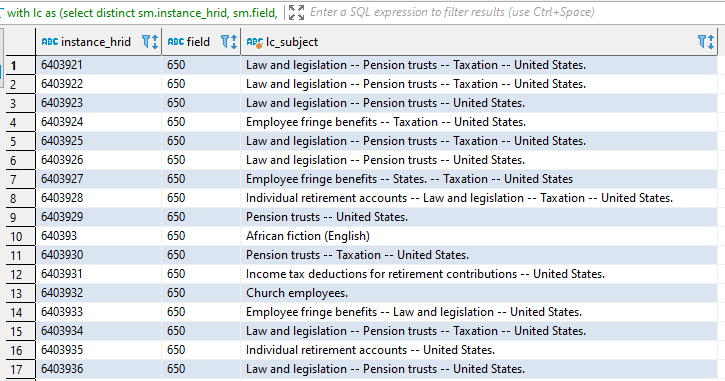
Further, if you want to display the subject heading as it appears in the bibliographic record, you may use a STRING_AGG FUNCTION to format the content rows as a subject heading string. Here is an example using instance HRIDs between 6403921 and 6404000:
WITH
...
lc
...
as
(SELECT
...
DISTINCT
...
sm.instance_hrid,
...
sm.field,
...
sm.content
FROM
...
srs_marctab
...
sm
WHERE
...
sm.instance_hrid
...
between
...
'6403921'
...
and
...
'6404000'
...
AND
...
sm.field
...
like
...
'6%%'
...
AND
...
sm.sf
...
in
...
('a','x','y','z')
...
AND
...
sm.ind2
...
=
...
'0'
...
AND
...
sm.ord
...
=
...
'1'
)
SELECT
...
...
...
...
lc.instance_hrid,
...
...
...
...
lc.field,
...
...
...
...
string_agg
...
(lc.content,
...
'
...
--
...
')
...
as
...
lc_subject
FROM
...
lc
GROUP
...
BY
...
...
...
...
lc.instance_hrid,
...
...
...
...
lc.field
;
And
...
the
...
results
...
would
...
be: