 Sign-up for free online course on ANSYS simulations!
...
| Wiki Markup |
|---|
{latex}
\begin{equation*}
\nabla \cdot (\rho \vec{v}^{\,}_r \vec{v}^{\,}_r)+\rho(2 \vec{\omega}^{\,} \times \vec{v}^{\,}_r+\vec{\omega}^{\,} \times \vec{\omega}^{\,} \times \vec{r}^{\,})=-\nabla p +\nabla \cdot \overline{\overline{\tau}}_r
\end{equation*}
{latex} |
...
|
| Wiki Markup |
|---|
Where {latex}$vec$\vec{v}^{\,}_r${latex} is the relative velocity (the velocity viewed from the moving frame) |
...
| Wiki Markup |
|---|
and {latex}$vec$\vec{\omega}^{\,}${latex} is the angular velocity. |
| Wiki Markup |
|---|
In Fluent, we'll turn on the additional terms for a moving frame of reference |
...
| Wiki Markup |
|---|
and input {latex}$vec$\vec{\omega}^{\,}=\omega \mathbf{\hat{k}}${latex}. |
For more information about flows in a moving frame of reference, visit ANSYS Help View > Fluent > Theory Guide > 2. Flow in a Moving Frame of Reference and ANSYS Help Viewer > Fluent > User's Guide > 9. Modeling Flows with Moving Reference Frames.
...
| Wiki Markup |
|---|
{latex}
\begin{equation*}
\vec{v}^{\,}(r_1,\theta_1) = \vec{v}^{\,}(r_1,\theta_1 - 120120n)
\end{equation*}
{latex} |
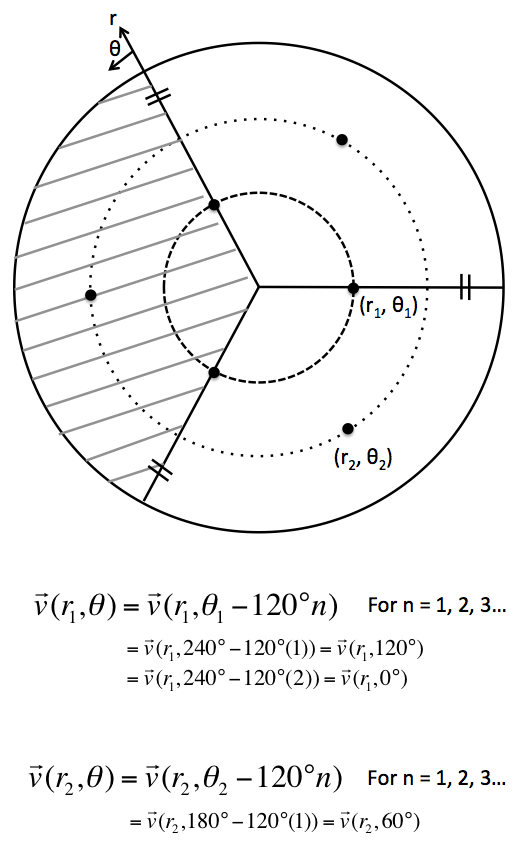
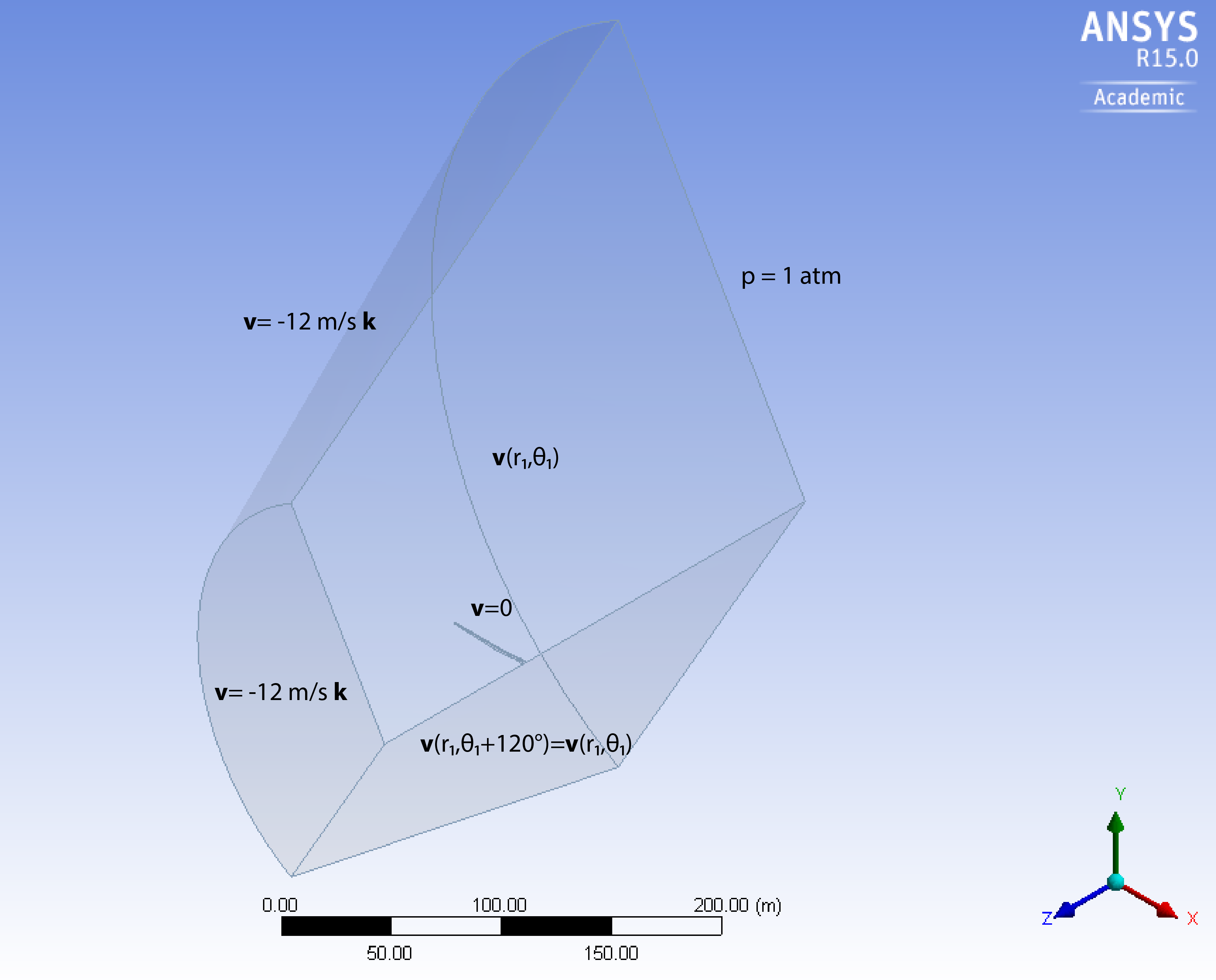
Inlet: Velocity of 12 m/s with turbulent intensity of 5% and turbulent viscosity ratio of 10
...