*** This version of Confluence is for testing only and contains a copy of content from June 29th 2026. No changes will be preserved. ***

...
We have managed to get the system running without electricity. This is done by placing the water tank above the foam filtration system and using the difference in elevation and head losses to meet the required flow.
A chemical dosing system designed by AguaClara researchers in the past was used as a basis for the chemical dosing systems for this set up. The flow of chemical (coagulant or chlorine) to the system is driven by head loss.
A Secchi Disk was built as a visual indicator to determine when the filters need to be cleaned.
A brief and user-friendly operator's manual in Spanish has been created for use in Honduras.
Designs for a coagulant doser have been drawn out in the figure below (click for larger image).
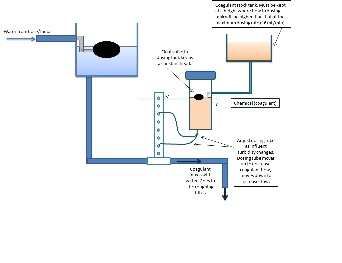
The amount of coagulant needed is based upon the amount of NTU's (Net Turbidity Units) in the influent. The coagulant flow is controlled through varying head loss using the dosing tube. The actual chemical dosers for both coagulant and chlorine are currently under construction.chlorine doser works the same way the coagulant doser does, but adds chlorine to the effluent before distribution of the treated water.
We have the idea of using constructed a secchi disk as a form of a visual indicator to tell when the filter needs to be cleaned. So far we have begun construction of the secchi disk and will soon begin to run experiments to determine the effectiveness of this method.When the roughing filter effluent is 20 NTU, the secchi disk becomes cloudy when it is placed on top of the finishing filter. Thus the secchi disk is a good way to indicate an increase in NTUs but more experiments need to be run with varying depths and turbidities.